Galah
Eolophus roseicapilla
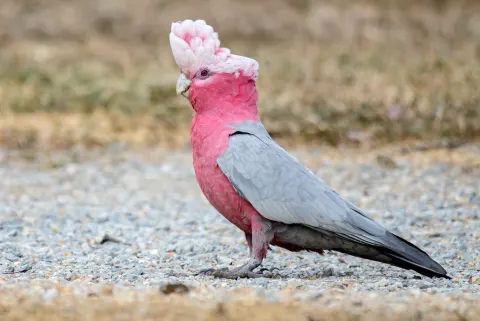
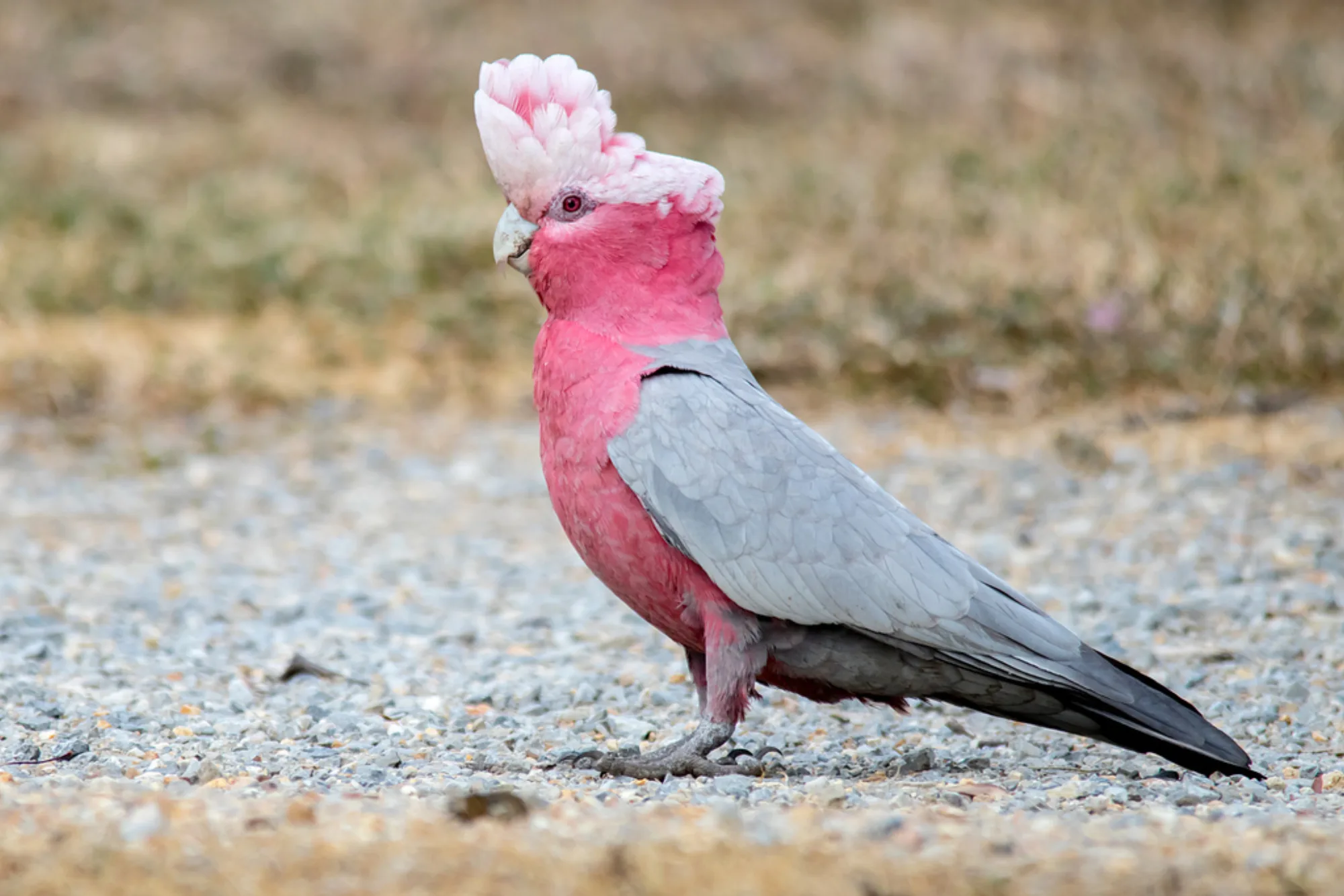
Pink across the face and breast, with a pale grey back and a light pink crest, the Galah is an Australian cockatoo that can be recognised at a glance. It is about 35 cm long, with a bone-coloured beak and grey legs. Males and females look much alike, while young birds are less brightly coloured, with greyish breasts and crests.
Galahs occur across mainland Australia, except in its most arid areas and at the northern tip of Cape York Peninsula. They have also been introduced to Tasmania, where they are widespread, and to New Zealand, where they became established in the South Auckland area. Look for them in open country with scattered trees for shelter, or in cities such as Adelaide, Perth and Melbourne. They are mostly found inland, although they are also moving into coastal regions. Forest clearing and the provision of watering points for livestock in arid areas have benefited the species.
Galahs often gather in flocks of 10 to 1,000 birds, sometimes alongside other cockatoos. In open grassy places, flocks come together to feed on the ground, gathering seeds mainly in the morning and late afternoon. They also pull bark and leaves off trees, and big flocks have been seen killing trees by removing their leaves. Partners form strong, lifelong bonds and nest in tree cavities. A clutch usually contains two to five white eggs, which both parents incubate for about 25 days; young birds depart the nest roughly 49 days after hatching. In the wild, traffic, predators and human activities in some agricultural areas take a toll. In South Australia, landowners may shoot, trap or gas galahs, subject to the stated permit conditions.
Written from the English Wikipedia article Galah (CC BY-SA 4.0).
- Records
- 578,097
- Countries
- 1
- Atlas places
- 5
These are open occurrence records, so they show where people looked for and recorded the Galah as much as where it lives. Cells are up to 25 km across, and every location is generalised to its cell.
Generalised encounter areas, not exact locations. Each shape is a grid cell coloured by how likely the species is there.
- Very likelyAustralia25 km zone · high confidence · 578097 records · updated 80 days ago
Conservation status not assessed here yet, so every location is generalised to its grid cell.