Sea Otter
Enhydra lutris
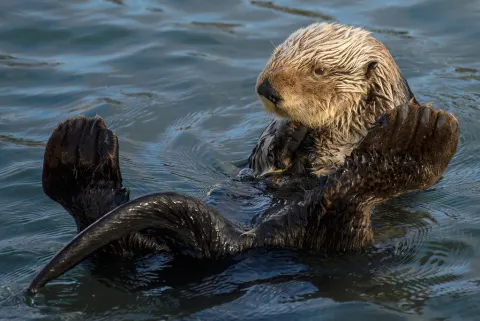
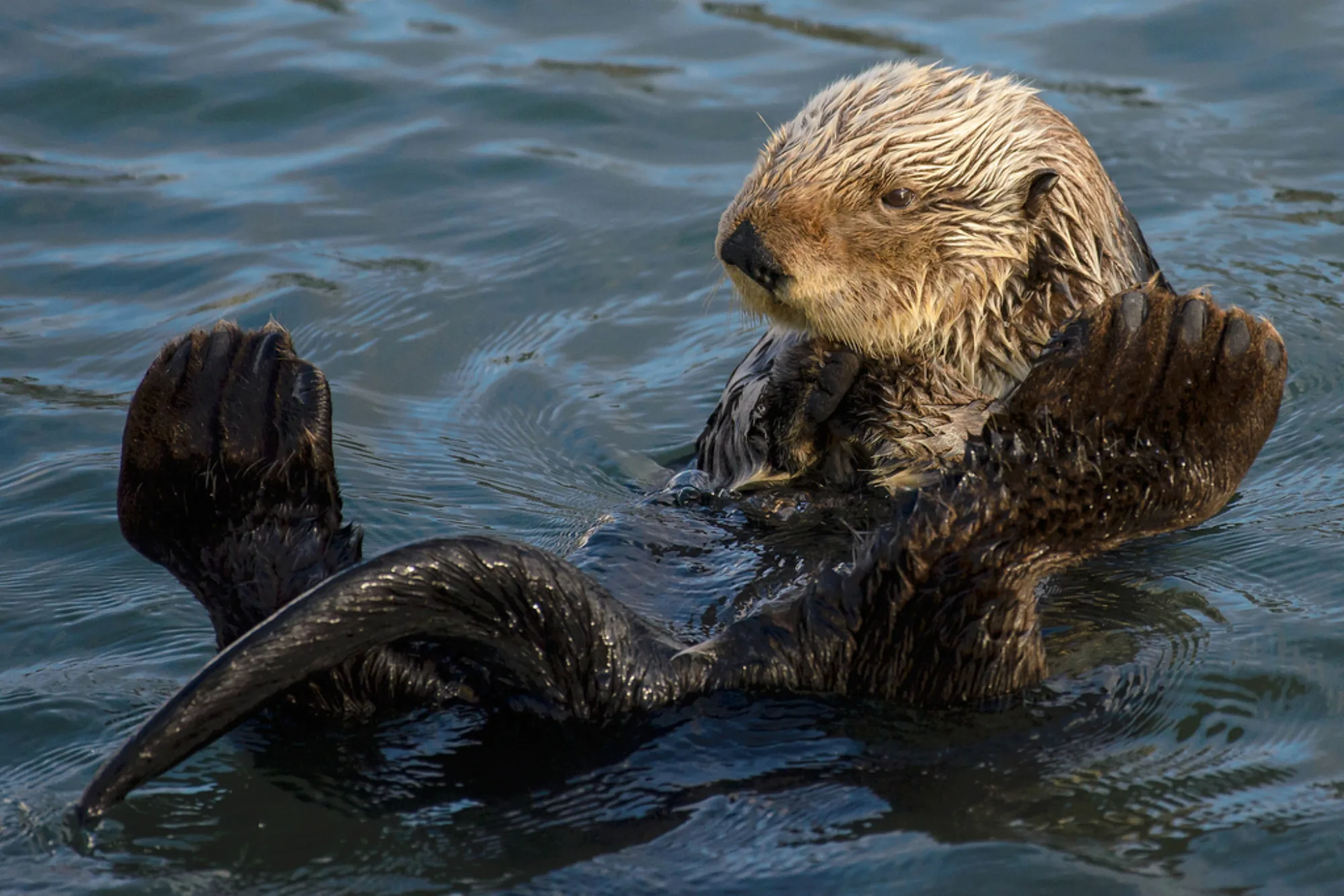
Floating on its back near a kelp forest, the Sea Otter is a marine mammal with exceptionally thick fur, usually deep brown flecked with silver-grey. Adults have paler heads, throats and chests, and weigh between 14 and 45 kg. Its broad, webbed hind feet help it swim, while its short front paws grip slippery prey. Sea otters live along northern and eastern North Pacific coasts, often in sheltered waters near rocky shores, kelp forests and barrier reefs. They usually stay within a kilometre of shore, although they can live entirely at sea.
Sea otters dive to the seabed for sea urchins, molluscs, crustaceans and some fish. They use rocks to dislodge prey or break open shells, and often eat at the surface while floating on their backs. Each adult and independent youngster forages alone, but otters often rest together in groups called rafts, sometimes wrapping themselves in kelp to avoid drifting away. They spend much of their time grooming the fur that keeps them warm. Births occur throughout the year, usually in the water, and typically produce a single pup. A mother cradles her pup on her chest and grooms its fur; when she dives for food, she may leave it floating in kelp.
Fur hunting drastically reduced sea otter numbers, and despite a later ban and recovery efforts, some populations have declined or remained low. Oil spills pose a danger: the Exxon Valdez spill killed thousands in Prince William Sound. In California, shark bites have added to mortality, while a toxin concentrated in shellfish appears to poison otters.
Written from the English Wikipedia article Sea otter (CC BY-SA 4.0).
- Records
- 909
- Countries
- 3
- Atlas places
- 5
These are open occurrence records, so they show where people looked for and recorded the Sea Otter as much as where it lives. Cells are up to 25 km across, and every location is generalised to its cell.
Generalised encounter areas, not exact locations. Each shape is a grid cell coloured by how likely the species is there.
- Very likelyUnited States25 km zone · medium confidence · 873 records · updated 80 days ago
- Very likelyCanada25 km zone · medium confidence · 36 records · updated 80 days ago
- RareRussia25 km zone · low confidence · 0 records · updated 80 days ago
Conservation status not assessed here yet, so every location is generalised to its grid cell.