European Anchovy
Engraulis encrasicolus
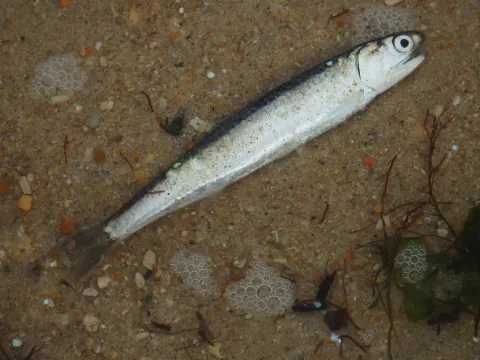
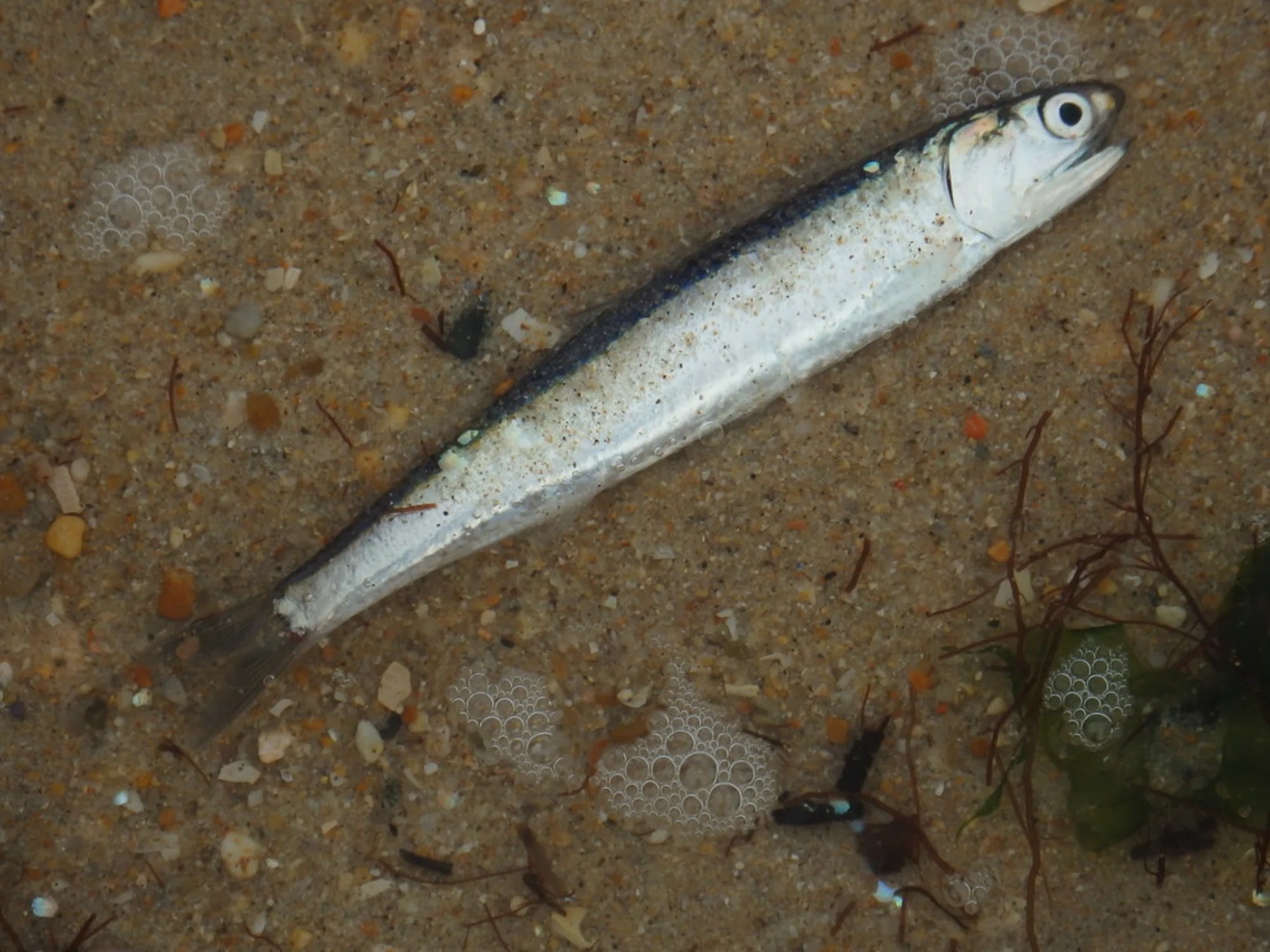
A slender fish with a pointed snout, the European Anchovy (Engraulis encrasicolus) has a silver belly and a blue, green or grey back and sides. Its forked tail and single dorsal fin give it a resemblance to a sprat, though its body is round and slender. A silver stripe runs along each side but fades with age. A typical fish measures 13.5 cm, while the maximum recorded length is 21 cm.
It lives in coastal waters off Europe and Africa, including the Mediterranean, Black Sea and Sea of Azov, and reaches the Atlantic coast as far north as southern Norway. It can also inhabit brackish lagoons, estuaries and lakes. In summer it usually stays in water less than 50 m deep; in the Mediterranean it descends to 200 m in winter, and it may reach 400 m. European anchovies travel in large schools, often moving north in summer and south in winter. When threatened, they may gather into bait balls. They feed on plankton, particularly copepods, as well as fish, mollusc and cirripede eggs and larvae. Fish, birds and marine mammals all prey on them.
Depending on the temperature, anchovies spawn several times between about April and November, sometimes in fresh water. Their eggs drift near the surface before hatching into transparent larvae. The species is fished across much of its range, and past local declines have been linked to overfishing, environmental problems and invasive species. In the Mediterranean, an invasive comb jelly that eats anchovy eggs and young severely depleted populations in the 1980s; they have since stabilised at a much lower level.
Written from the English Wikipedia article European anchovy (CC BY-SA 4.0).
- Records
- 5,136
- Countries
- 21
- Atlas places
- 1
These are open occurrence records, so they show where people looked for and recorded the European Anchovy as much as where it lives. Cells are up to 25 km across, and every location is generalised to its cell.
Generalised encounter areas, not exact locations. Each shape is a grid cell coloured by how likely the species is there.
- Very likelySpain25 km zone · medium confidence · 2955 records · updated 80 days ago
- Very likelyNetherlands25 km zone · high confidence · 727 records · updated 80 days ago
- Very likelyNorway25 km zone · medium confidence · 512 records · updated 80 days ago
- Very likelyFrance25 km zone · high confidence · 262 records · updated 80 days ago
- Very likelyBelgium25 km zone · high confidence · 164 records · updated 80 days ago
- Very likelyCroatia25 km zone · high confidence · 149 records · updated 80 days ago
- Very likelyDenmark25 km zone · medium confidence · 125 records · updated 80 days ago
- Very likelySweden25 km zone · medium confidence · 109 records · updated 80 days ago
- Very likelyIsrael25 km zone · medium confidence · 36 records · updated 80 days ago
- Very likelyGermany25 km zone · medium confidence · 22 records · updated 80 days ago
Conservation status not assessed here yet, so every location is generalised to its grid cell.