Blanding's Turtle
Emydoidea blandingii
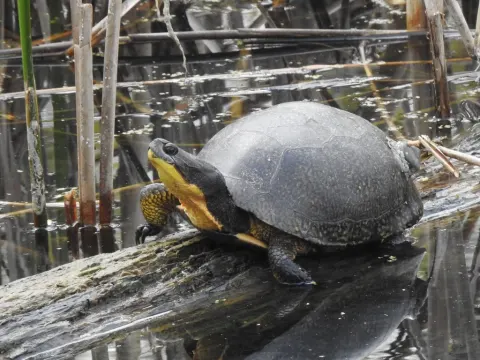
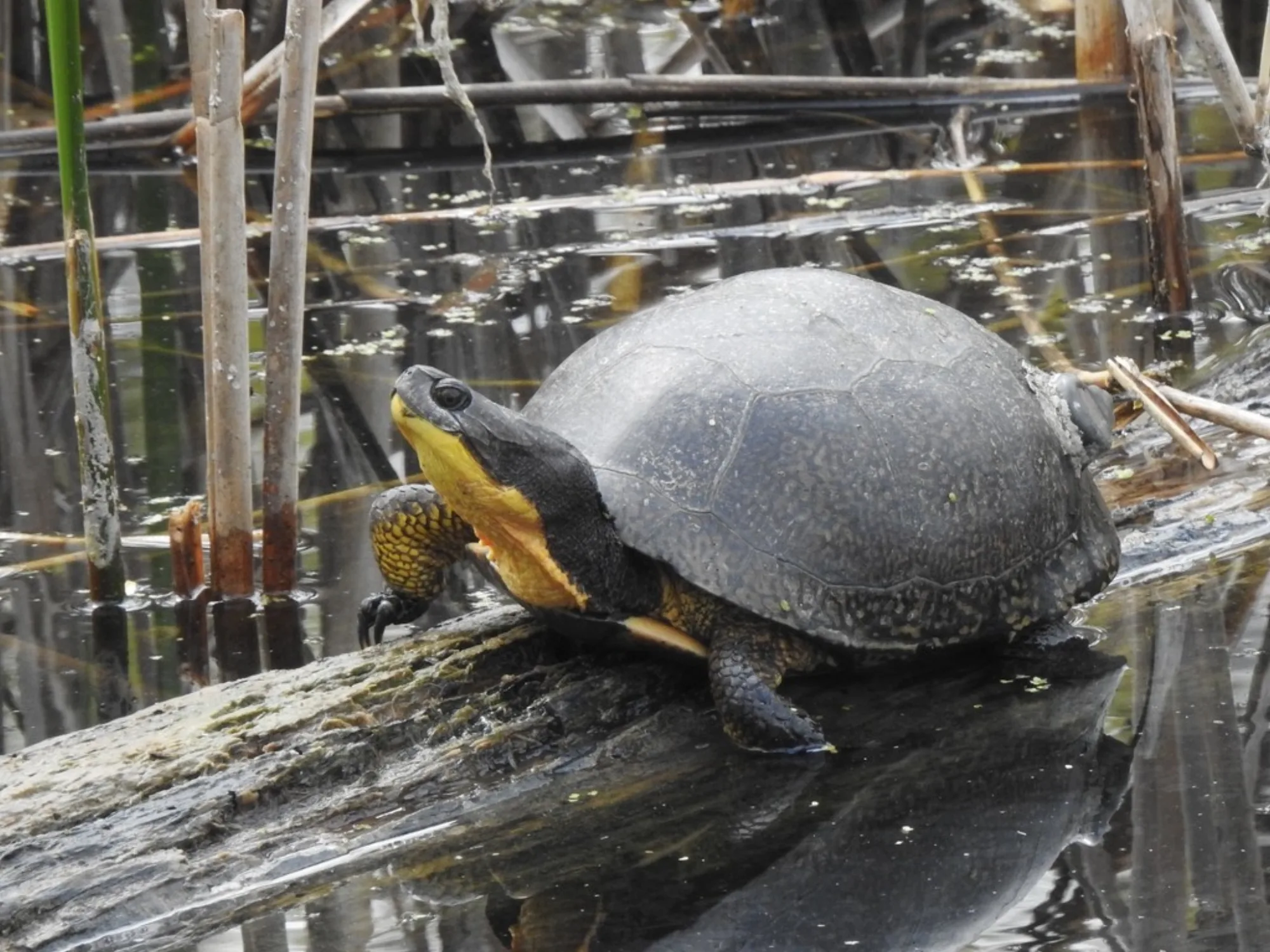
A bright yellow chin and throat make the Blanding's Turtle easy to distinguish. This medium-sized, semi-aquatic turtle has a domed, oblong upper shell, dark with yellow or pale flecks and streaks. Its head and legs are dark too, usually marked with yellow, while the lower shell is yellow with symmetrical dark blotches. The upper shell averages approximately 18 to 23 cm in straight length, reaching a maximum of 25.5 cm.
Its range centres on the Great Lakes, stretching from central Nebraska and Minnesota east through southern Ontario to northern New York. Isolated populations also live in southeastern New York, New England and Nova Scotia. Look for it in wetlands with clean, shallow water, where it basks on logs, although younger turtles may use sedge and alder hummocks. It swims with agility, but can be timid when disturbed, withdrawing into its shell or staying underwater for hours. In winter it shelters under or near water, in mud, or beneath vegetation or debris.
An omnivore, it eats crayfish and other crustaceans, insects, snails, fish, frogs, berries, seeds and plant debris, and can catch live fish. Nesting takes place from late May into early July, generally in sunny places with well-drained soil, sometimes far from water. A nesting female may travel more than a kilometre from her wintering site, and the turtles take 14 to 20 years to reach sexual maturity. Habitat destruction and fragmentation are primary threats, along with nest predation by unnaturally large predator populations. Prescribed burns can also harm the turtles, including hatchlings moving overland in autumn and late spring.
Written from the English Wikipedia article Blanding's turtle (CC BY-SA 4.0).
- Records
- 616
- Countries
- 2
- Atlas places
- 1
These are open occurrence records, so they show where people looked for and recorded the Blanding's Turtle as much as where it lives. Cells are up to 25 km across, and every location is generalised to its cell.
Generalised encounter areas, not exact locations. Each shape is a grid cell coloured by how likely the species is there.
- Very likelyCanada25 km zone · medium confidence · 372 records · updated 80 days ago
- Very likelyUnited States25 km zone · medium confidence · 244 records · updated 80 days ago
Conservation status not assessed here yet, so every location is generalised to its grid cell.