Yellowhammer
Emberiza citrinella
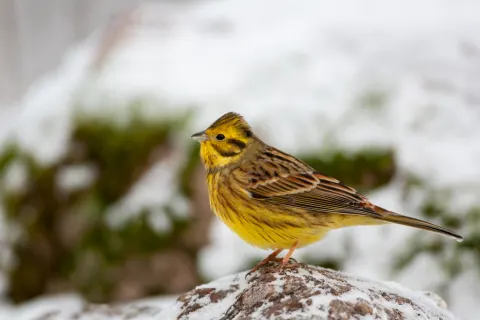
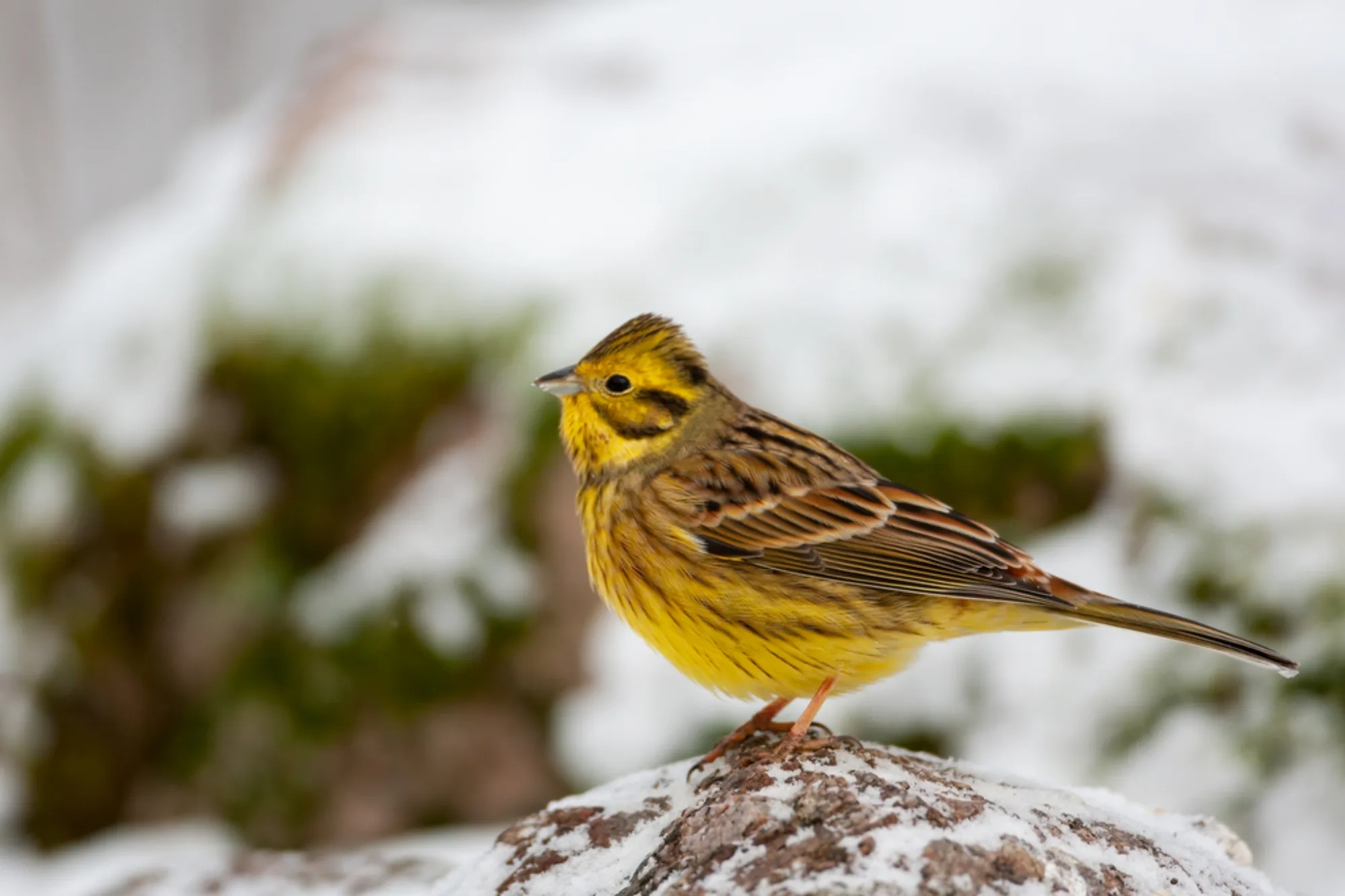
A flash of yellow and a song from a hedge can help reveal a Yellowhammer. This large bunting has a bright yellow head and underparts in the male, with a streaked brown back and chestnut rump. Females are less brightly coloured, while young birds are duller still. Listen for a series of short notes that grows louder, followed by one or two longer notes. Its familiar rhythm is often remembered through a phrase about bread without cheese.
Native to Eurasia, the Yellowhammer has also been introduced to New Zealand and Australia. It favours dry, open country with varied vegetation and trees for singing, including farmland with hedges and clumps of trees. Most European birds stay within their breeding range for winter, while Asian birds are more migratory. Outside the breeding season, yellowhammers feed on the ground in flocks, sometimes alongside other buntings and finches. Seeds make up most of their diet, with cereals especially important in autumn and winter. During breeding, they also take invertebrates, particularly for their chicks.
Breeding usually begins in early May, or often in April in the south. Males sing from trees or bushes along hedges and woodland edges. The female conceals her cup nest on or close to the ground, often among tussocks, beside a bank or in the lower branches of a bush. She usually lays three to five whitish eggs with fine dark markings. Both adults feed the chicks, and they bring up two or three broods a year. Rodents and crows can raid nests, while birds of prey hunt adults. In western Europe, populations have declined, with changes in farming practices thought to have reduced breeding densities.
Written from the English Wikipedia article Yellowhammer (CC BY-SA 4.0).
- Records
- 630,000
- Countries
- 63
- Atlas places
- 1
These are open occurrence records, so they show where people looked for and recorded the Yellowhammer as much as where it lives. Cells are up to 25 km across, and every location is generalised to its cell.
Generalised encounter areas, not exact locations. Each shape is a grid cell coloured by how likely the species is there.
- Very likelyNorway25 km zone · high confidence · 257977 records · updated 86 days ago
- Very likelyFinland25 km zone · high confidence · 94960 records · updated 86 days ago
- Very likelyBelgium25 km zone · high confidence · 44398 records · updated 86 days ago
- Very likelyUnited Kingdom25 km zone · high confidence · 44179 records · updated 86 days ago
- Very likelyFrance25 km zone · high confidence · 33965 records · updated 86 days ago
- Very likelySweden25 km zone · high confidence · 31778 records · updated 86 days ago
- Very likelyCzechia25 km zone · high confidence · 21833 records · updated 86 days ago
- Very likelyNew Zealand25 km zone · high confidence · 21220 records · updated 86 days ago
- Very likelyGermany25 km zone · high confidence · 14761 records · updated 86 days ago
- Very likelySwitzerland25 km zone · high confidence · 9680 records · updated 86 days ago
Conservation status not assessed here yet, so every location is generalised to its grid cell.