Southern Alligator Lizard
Elgaria multicarinata
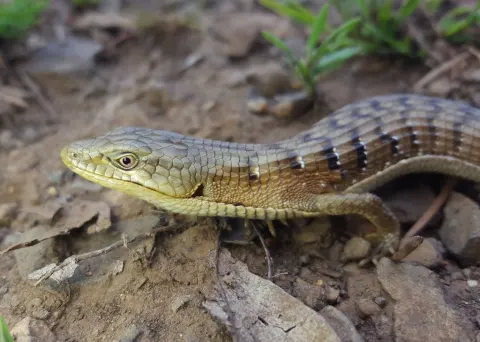
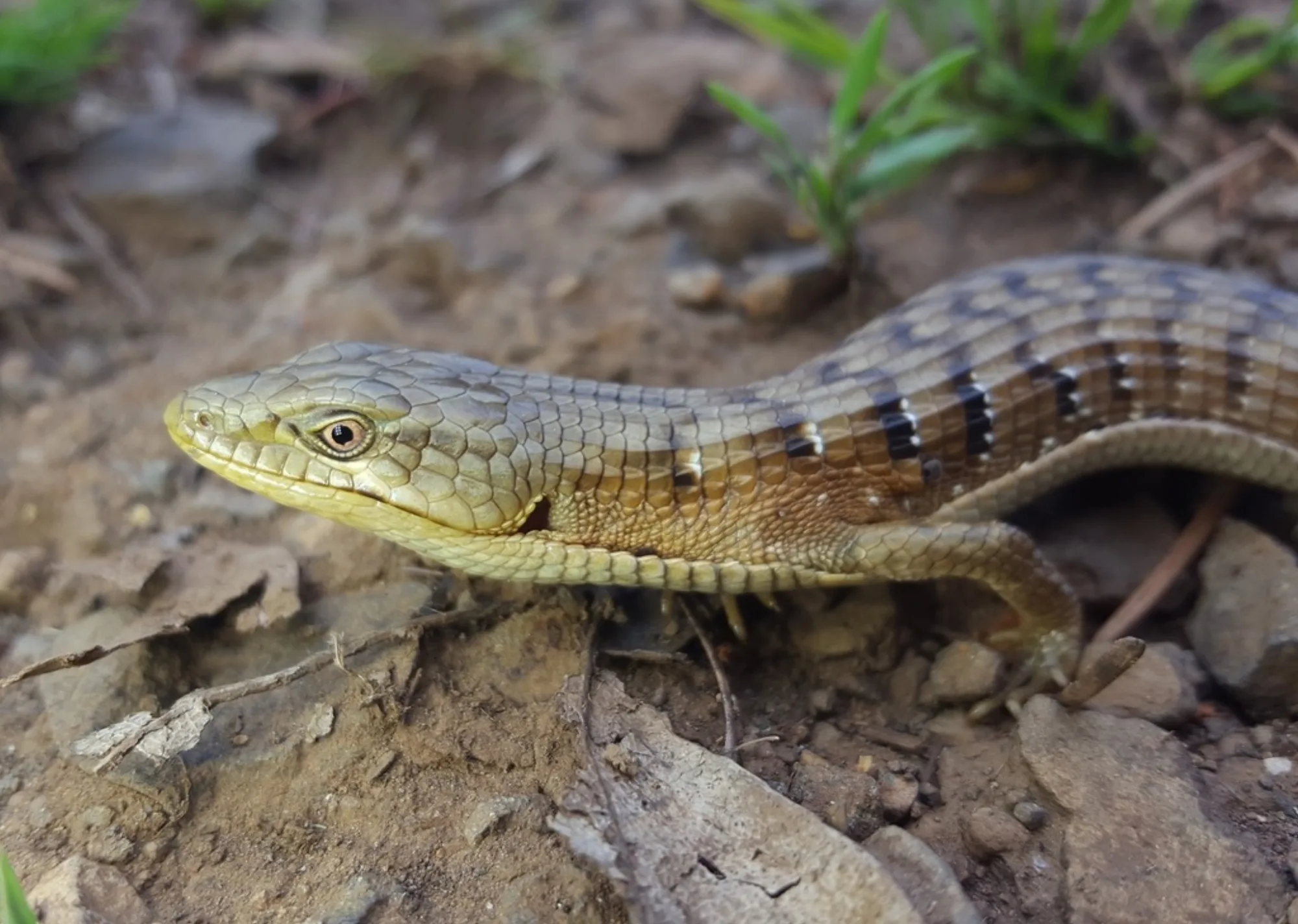
Along the Pacific coast of North America, the Southern Alligator Lizard ranges from Baja California to Washington. This common lizard has a thick, rounded body, short legs and a long tail that can be twice the length of its body. It measures 8 to 18 cm from snout to vent and can reach 30 cm including the tail. Its upper colour varies from brown, grey or green to yellowish, often with red patches down the middle of the back. Dark bands, usually 9 to 13, cross the back, sides and tail, with white spots beside them. The bands may stand out clearly or be masked by reddish or yellowish colour.
Look for it in grassland, open forest and chaparral, as well as in suburban and urban areas. It is especially common in foothill oak woodlands, where it may shelter beneath rocks, logs or other cover. In dry climates it favours moist places or the edges of streams, and it also reaches the desert along the Mojave River. Near homes, it can turn up in yards and garages, often searching for food in the morning or evening. Its diet includes small arthropods, slugs, other lizards and small mammals, as well as young birds and eggs on occasion. It frequently eats western black widow spiders. When attacked, it can shed its tail, potentially allowing it to escape. If handled, it may bite and defecate in defence.
Breeding takes place in spring, generally from April to May, although it can continue year-round in warmer regions. Females lay two clutches a year, often in decaying wood or plant material, and guard the eggs until they hatch. Eggs are usually laid from May to June and hatch in late summer or early autumn.
Written from the English Wikipedia article Southern alligator lizard (CC BY-SA 4.0).
- Records
- 2,480
- Countries
- 2
- Atlas places
- 4
These are open occurrence records, so they show where people looked for and recorded the Southern Alligator Lizard as much as where it lives. Cells are up to 25 km across, and every location is generalised to its cell.
Generalised encounter areas, not exact locations. Each shape is a grid cell coloured by how likely the species is there.
- Very likelyUnited States25 km zone · medium confidence · 2442 records · updated 80 days ago
- LikelyMexico25 km zone · medium confidence · 38 records · updated 80 days ago
Conservation status not assessed here yet, so every location is generalised to its grid cell.