Common Coqui
Eleutherodactylus coqui
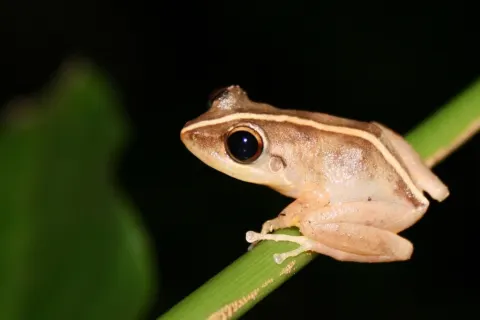
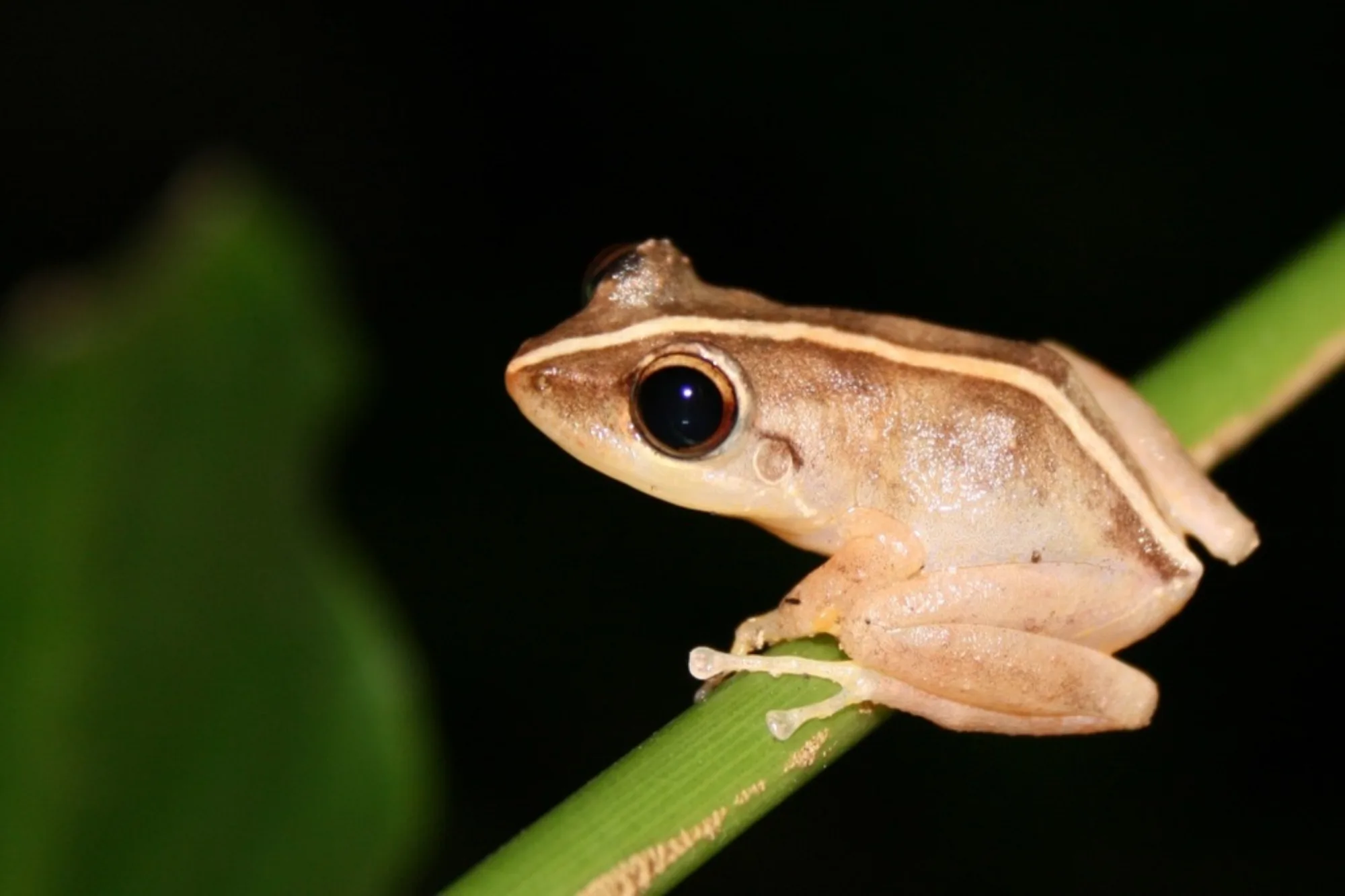
At night in Puerto Rico, a loud two-part call can reveal the presence of the Common Coqui, a small frog named for the sound males make. The first note helps males defend territory, while the second attracts females. Its back is mottled muddy brown, with rust-tan sides and a pale grey belly; sticky toe pads help it cling to damp or slippery surfaces. Grown males measure 30 to 37 mm from snout to vent, while females measure 36 to 52 mm.
Native to Puerto Rico, Vieques and Culebra, the frog is widespread but less common in Puerto Rican dry forests. It lives in habitats from broadleaf forests and mountains to urban areas, and can be found in bromeliads, tree holes, homes and parks, or beneath rocks and fallen trunks. In Puerto Rico it occurs from sea level to 1,200 m, where sufficient moisture is available. It has also been introduced to Colombia, Hawaii and the Virgin Islands.
After dark, coquís emerge as humidity rises and climb towards the canopy, returning lower as the air becomes drier. They wait for prey, mostly arthropods: young frogs eat small creatures such as ants, while adults also take spiders, moths, crickets, snails and small frogs. Breeding takes place throughout the year, with a peak around the wet season; females lay eggs on land, including on palm leaves and other plants. Males guard the eggs from predators, and fully formed froglets hatch without an aquatic tadpole stage. Predation, disease and competition for resources are likely contributors to high mortality, and in Hawaii the introduced frog is subject to population control.
Written from the English Wikipedia article Common coquí (CC BY-SA 4.0).
- Records
- 1,465
- Countries
- 4
- Atlas places
- 1
These are open occurrence records, so they show where people looked for and recorded the Common Coqui as much as where it lives. Cells are up to 25 km across, and every location is generalised to its cell.
Generalised encounter areas, not exact locations. Each shape is a grid cell coloured by how likely the species is there.
- Very likelyUnited States25 km zone · high confidence · 1085 records · updated 80 days ago
- Very likelyPuerto Rico25 km zone · high confidence · 373 records · updated 80 days ago
- PossibleU.S. Virgin Islands25 km zone · medium confidence · 7 records · updated 80 days ago
- RareCosta Rica25 km zone · low confidence · 0 records · updated 80 days ago
Conservation status not assessed here yet, so every location is generalised to its grid cell.