Asian Elephant
Elephas maximus
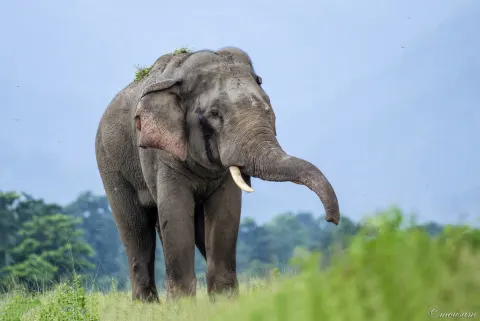
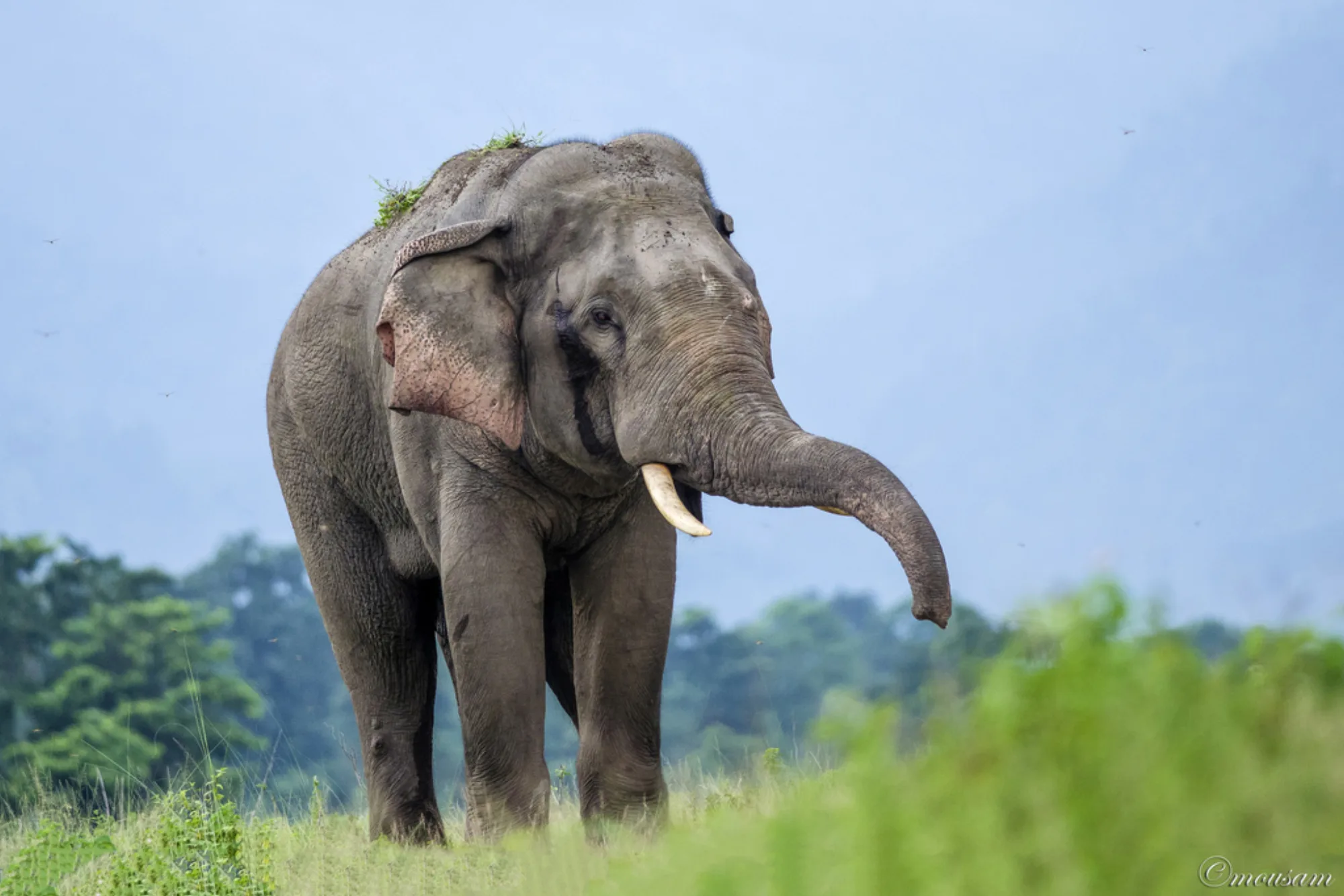
Asia's largest living land animal, the Asian Elephant (Elephas maximus) has a long trunk, wrinkled grey skin and ears with folded edges. Patches of lighter skin can appear on the trunk, ears or neck, while dust and mud may mask its grey colour. Males can have large tusks, though some lack them; females usually have none. Fully grown males average about 2.75 m at the shoulder, while females average about 2.40 m.
Its range extends from India eastwards to Borneo, and from Nepal southwards to Sumatra, across parts of South and Southeast Asia. Elephants live in grasslands, several kinds of tropical forest, scrublands and cultivated areas, from sea level to above 3,000 m. Most active around dawn and dusk, they spend much of the day feeding on a wide variety of plants. They graze and browse, eating up to 150 kg of plant matter a day, and drink at least once daily. In the dry season they browse more, with bark forming a major part of their diet during its cooler months.
Females and calves travel together in small groups, while males leave their mothers as adolescents and live alone or in temporary male groups. Males join female groups briefly during the breeding season. After a pregnancy of 18 to 22 months, a female usually gives birth to one calf, which may suckle for up to three years. Habitat loss, degradation and fragmentation threaten these elephants and contribute to conflict with people, including where elephants enter fields and damage crops. They are also poached for ivory, meat, leather and skin.
Written from the English Wikipedia article Asian elephant (CC BY-SA 4.0).
- Records
- 160
- Countries
- 6
- Atlas places
- 8
These are open occurrence records, so they show where people looked for and recorded the Asian Elephant as much as where it lives. Cells are up to 25 km across, and every location is generalised to its cell.
Generalised encounter areas, not exact locations. Each shape is a grid cell coloured by how likely the species is there.
- Very likelyIndia25 km zone · medium confidence · 102 records · updated 80 days ago
- Very likelyMalaysia25 km zone · medium confidence · 53 records · updated 80 days ago
- LikelyUnited States25 km zone · medium confidence · 3 records · updated 80 days ago
- PossibleThailand25 km zone · low confidence · 2 records · updated 80 days ago
- PossibleCambodia25 km zone · low confidence · 0 records · updated 80 days ago
- PossibleChina25 km zone · low confidence · 0 records · updated 80 days ago
Conservation status not assessed here yet, so every location is generalised to its grid cell.