Electric Eel
Electrophorus electricus
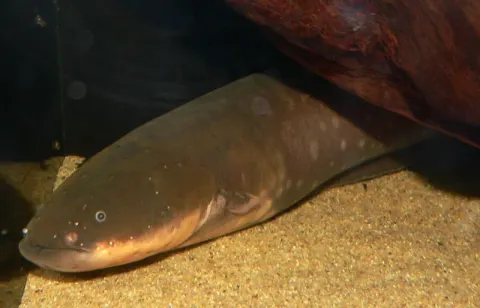
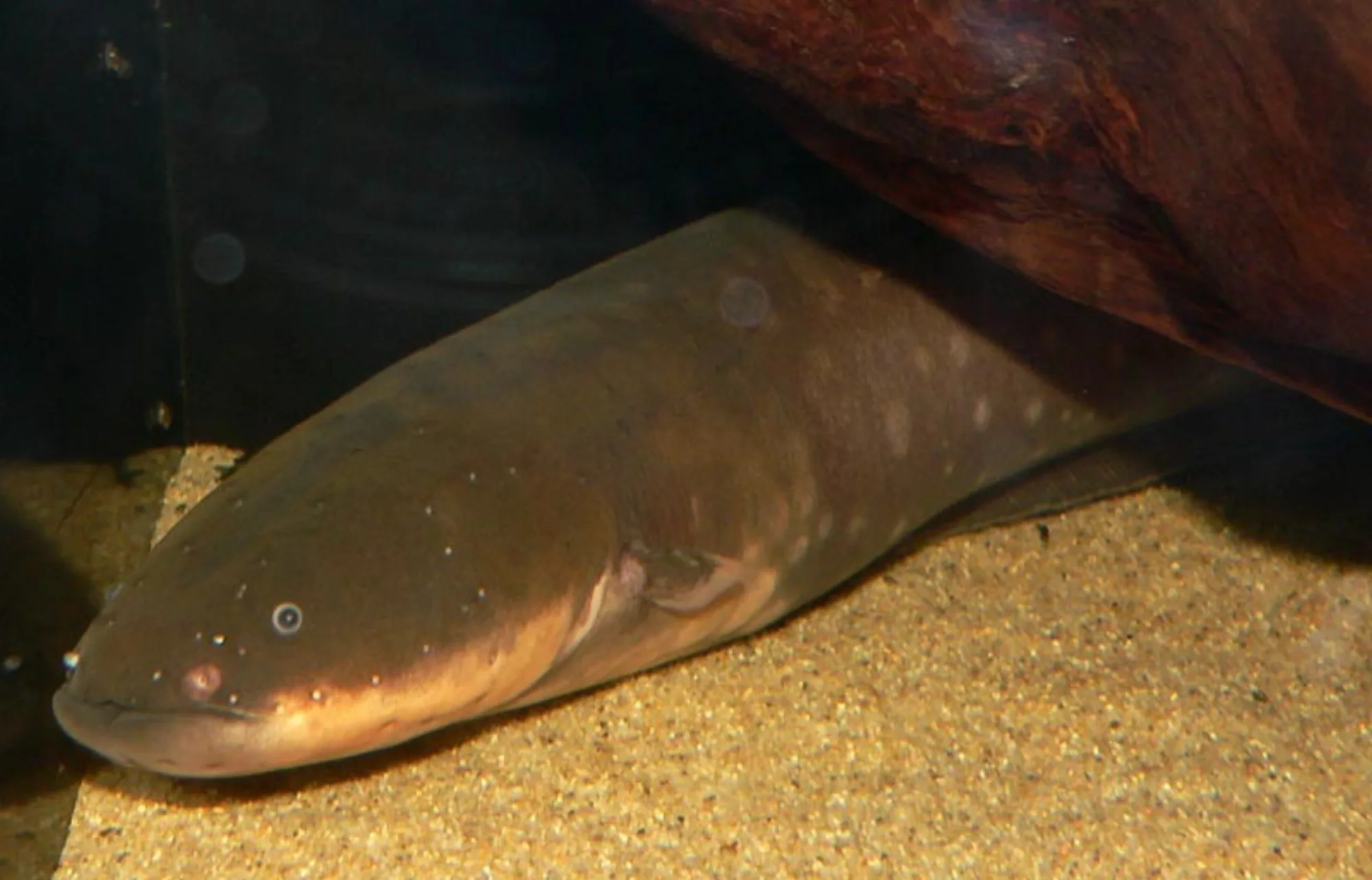
With a long, cylindrical body and a square mouth at the end of its snout, the Electric Eel cuts a distinctive shape in South American freshwater. Despite its name, this fish is a knifefish rather than an eel. It typically grows to about 2 m long and weighs around 20 kg, with a dark grey-brown back, a yellow or orange belly and no scales. Mature females have darker bellies, while males grow about 35 cm larger than females. The species lives in freshwater habitats in the Guiana Shield, where it must come to the surface to breathe before returning to the bottom, usually about every ten minutes.
Electricity helps the fish make sense of its surroundings and find food. It uses low-voltage discharges to sense its environment, and high-voltage discharges to detect and stun prey before taking it with a suction-feeding bite. Electrical pulses can also force prey to move, revealing its position, or keep it from escaping. Young fish eat a range of invertebrates, while adults feed on animals including fish, frogs and small mammals. In the dry season, a male builds a saliva nest for the female's eggs, and up to 3,000 young can hatch there. The first hatchlings eat eggs and embryos from later clutches. Electric Eels can adjust the strength of their discharges, using higher intensities to stun prey or defend themselves. Their typical output is enough to stun or deter virtually any animal.
Written from the English Wikipedia article Electrophorus electricus (CC BY-SA 4.0).
- Records
- 36
- Countries
- 6
- Atlas places
- 2
These are open occurrence records, so they show where people looked for and recorded the Electric Eel as much as where it lives. Cells are up to 25 km across, and every location is generalised to its cell.
Generalised encounter areas, not exact locations. Each shape is a grid cell coloured by how likely the species is there.
- Very likelySuriname25 km zone · medium confidence · 24 records · updated 80 days ago
- LikelyPeru25 km zone · medium confidence · 5 records · updated 80 days ago
- LikelySouth Africa25 km zone · medium confidence · 4 records · updated 80 days ago
- PossibleGuyana25 km zone · medium confidence · 3 records · updated 80 days ago
- PossibleColombia25 km zone · low confidence · 0 records · updated 80 days ago
- RareBrazil25 km zone · low confidence · 0 records · updated 80 days ago
Conservation status not assessed here yet, so every location is generalised to its grid cell.