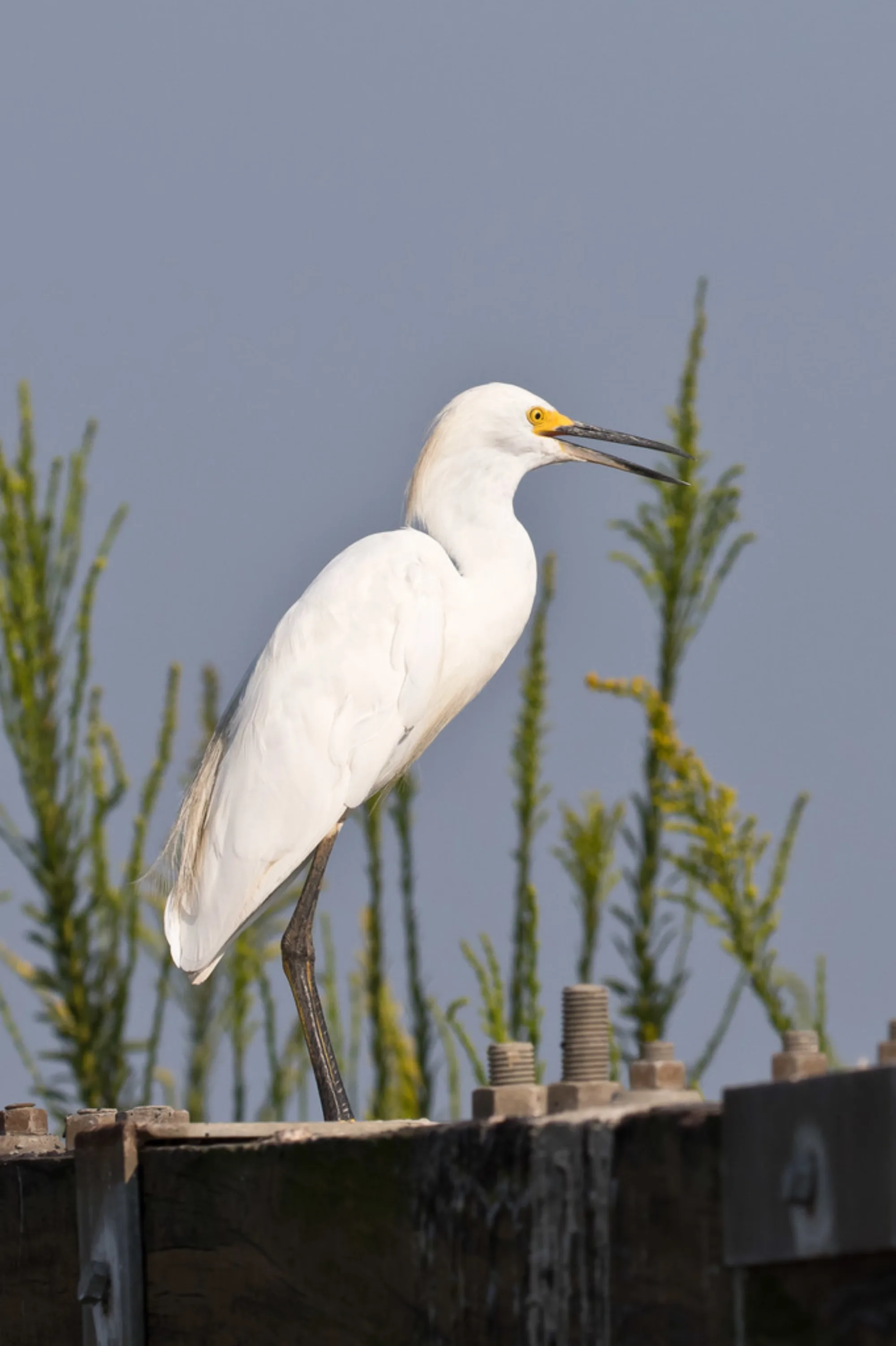
Snowy Egret
Egretta thula
Bright yellow feet stand out beneath the Snowy Egret, a small white heron with a long black bill and black legs. Adults have yellow patches between bill and eye, while long, shaggy plumes hang from the neck and nape. Younger birds can be distinguished by their duller, greenish legs. An adult measures 56 to 66 cm in length, with a wingspan of 100 cm.
Native to North, Central and South America, the species lives year-round across South America, with its range extending south to Argentina and Chile. Florida, the West Indies and coastal parts of North and Central America also have year-round populations. In other parts of the southern United States, it migrates and breeds in states from California to Mississippi. Look for it in wetlands, including marshes, riverbanks, lakesides, pools and estuaries; it is absent from high altitudes and generally from the coast.
In shallow water, snowy egrets stalk their food, often running or shuffling their feet and using movements of the head, wings or bill to bring prey into view. They also wait motionless to ambush prey, hover, or fly just above the water with their feet close to the surface. Their varied diet includes fish, crabs, shrimp, insects, frogs, snails and worms. They breed in colonies alongside other birds, building nests in trees, vines or thick undergrowth. Up to six pale bluish-green eggs hatch after about 24 days, and the young leave the nest after about 22 days. Hunting for hat plumes once drove numbers dangerously low, but populations have since recovered, and no particular threats have been recognised.
Written from the English Wikipedia article Snowy egret (CC BY-SA 4.0).
- Records
- 2,518,200
- Countries
- 8
- Atlas places
- 1
These are open occurrence records, so they show where people looked for and recorded the Snowy Egret as much as where it lives. Cells are up to 25 km across, and every location is generalised to its cell.
Generalised encounter areas, not exact locations. Each shape is a grid cell coloured by how likely the species is there.
- Very likelyUnited States25 km zone · high confidence · 2428779 records · updated 80 days ago
- Very likelyMexico25 km zone · high confidence · 33950 records · updated 80 days ago
- Very likelyCosta Rica25 km zone · high confidence · 19959 records · updated 80 days ago
- Very likelyArgentina25 km zone · high confidence · 9905 records · updated 80 days ago
- Very likelyBelize25 km zone · high confidence · 7696 records · updated 80 days ago
- Very likelyPeru25 km zone · high confidence · 6195 records · updated 80 days ago
- Very likelyChile25 km zone · high confidence · 6170 records · updated 80 days ago
- Very likelyBrazil25 km zone · high confidence · 5546 records · updated 80 days ago
Conservation status not assessed here yet, so every location is generalised to its grid cell.