Honduran White Bat
Ectophylla alba
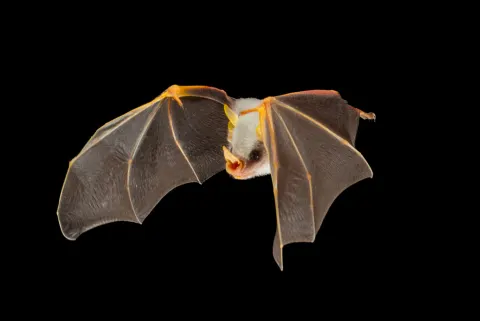
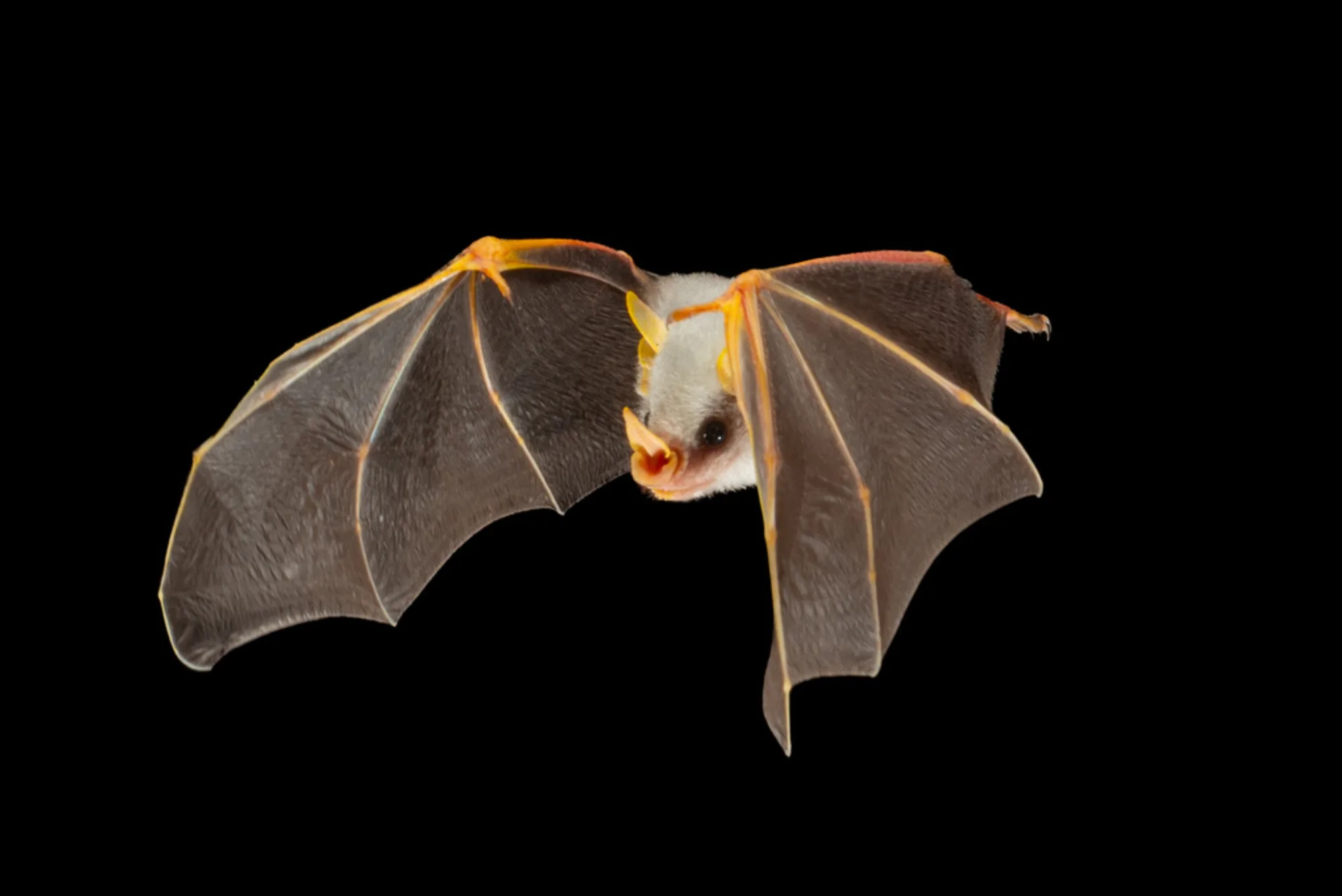
Bright white fur and yellowish orange ears, nose and lips make the Honduran White Bat (Ectophylla alba) distinctive. Its wings are black, its ears are large and rounded, and it has no tail. Small enough to fit beneath a leaf, it measures 37 to 47 mm from head to body and weighs 5 to 6 g. Its range includes Honduras, Nicaragua, Costa Rica and western Panama, from sea level up to 700 m. It favours wet evergreen and secondary forests that provide the plants it needs for shelter and food.
By day, these bats shelter beneath leaf tents, often made by biting through the side veins of large Heliconia leaves so that the leaves fold down. They cling to the roof in groups of 1 to 15 and move between a network of tents scattered through the forest. Sunlight passing through a leaf gives their white fur a greenish cast, helping conceal them when they stay still. The bats feed mainly on the fruit of one fig species, Ficus colubrinae, although they occasionally eat other figs. They favour trees bearing plenty of fruit and close to their daytime roosts; Ficus colubrinae produces fruit throughout the year.
Females give birth to one pup at a time, and births within a colony are synchronised to the same week. Nursing mothers visit the roost as many as six times each night to feed their pups, which can fly at 3 to 4 weeks old. The population is declining as habitat is converted to farmland and the human population expands. Dependence on a single fig species makes the bat especially susceptible to habitat loss.
Written from the English Wikipedia article Honduran white bat (CC BY-SA 4.0).
- Records
- 61
- Countries
- 1
- Atlas places
- 1
These are open occurrence records, so they show where people looked for and recorded the Honduran White Bat as much as where it lives. Cells are up to 25 km across, and every location is generalised to its cell.
Generalised encounter areas, not exact locations. Each shape is a grid cell coloured by how likely the species is there.
- Very likelyCosta Rica25 km zone · medium confidence · 61 records · updated 80 days ago
Conservation status not assessed here yet, so every location is generalised to its grid cell.