Saw-scaled Viper
Echis carinatus
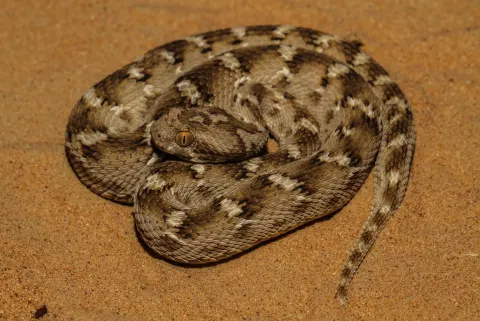
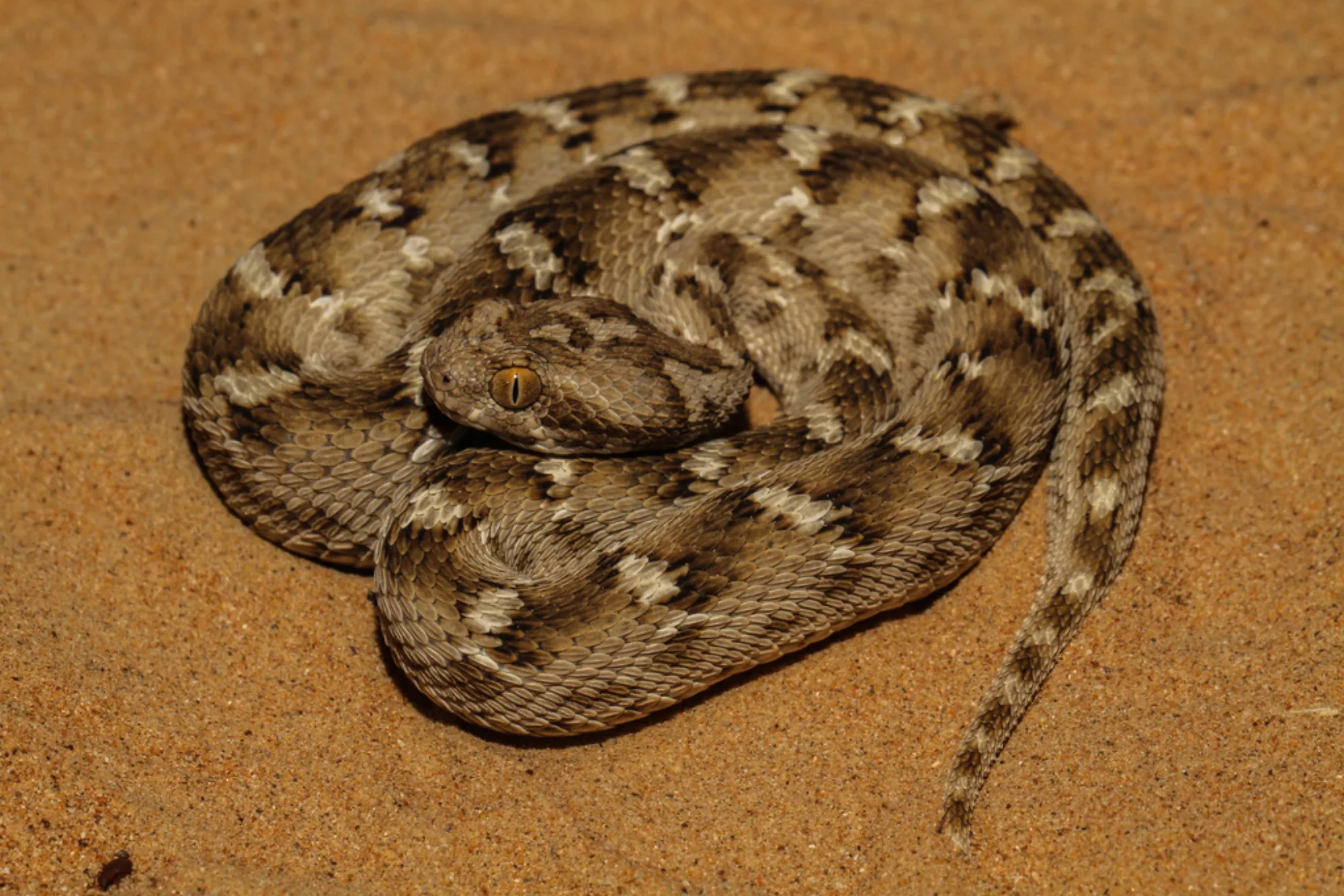
Small and easily overlooked, the Saw-scaled Viper is a venomous snake found across parts of Asia. It measures 38 to 80 cm in total length, though it is usually no longer than 60 cm. Its short, rounded snout and head, which stands apart from the neck, help give it a distinctive outline. The ground colour ranges from pale buff and greyish to reddish, olive or pale brown, with mostly whitish spots edged in dark brown along the back. White bows mark the sides of the back, while a whitish cross or trident pattern sits on top of the head.
Its range reaches from the Indian subcontinent into the Middle East and Central Asia. It lives among sand, rock, soft soil and scrub, often sheltering beneath loose rocks. Mostly active at dusk and at night, it may also emerge during daylight, and is often most active after rain or on humid nights. By day it hides in mammal burrows, rock fissures and fallen, rotting logs; in sand, it may bury itself with only its head showing. It also climbs bushes and shrubs, sometimes reaching 2 m above the ground, and can move quickly across sand by sidewinding.
The viper eats rodents, lizards and frogs, as well as scorpions, centipedes and large insects, varying its diet with the prey available. In northern parts of its range it hibernates through winter. In northern India, live young arrive from April to August, with occasional births at other times of year. Litters generally contain 3 to 15 young. The snake can be aggressive, and its coiled posture allows it to strike rapidly.
Written from the English Wikipedia article Echis carinatus (CC BY-SA 4.0).
- Records
- 105
- Countries
- 5
No atlas park has a record of the Saw-scaled Viper in or around it yet.
These are open occurrence records, so they show where people looked for and recorded the Saw-scaled Viper as much as where it lives. Cells are up to 25 km across, and every location is generalised to its cell.
Generalised encounter areas, not exact locations. Each shape is a grid cell coloured by how likely the species is there.
- Very likelyIndia25 km zone · medium confidence · 63 records · updated 80 days ago
- Very likelyAfghanistan25 km zone · medium confidence · 22 records · updated 80 days ago
- Very likelyTurkmenistan25 km zone · medium confidence · 11 records · updated 80 days ago
- LikelyIran25 km zone · medium confidence · 9 records · updated 80 days ago
- UncommonUnited Arab Emirates25 km zone · low confidence · 0 records · updated 80 days ago
Conservation status not assessed here yet, so every location is generalised to its grid cell.