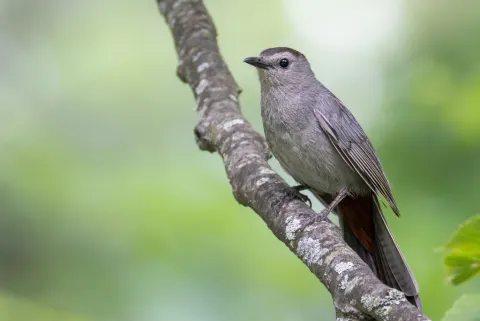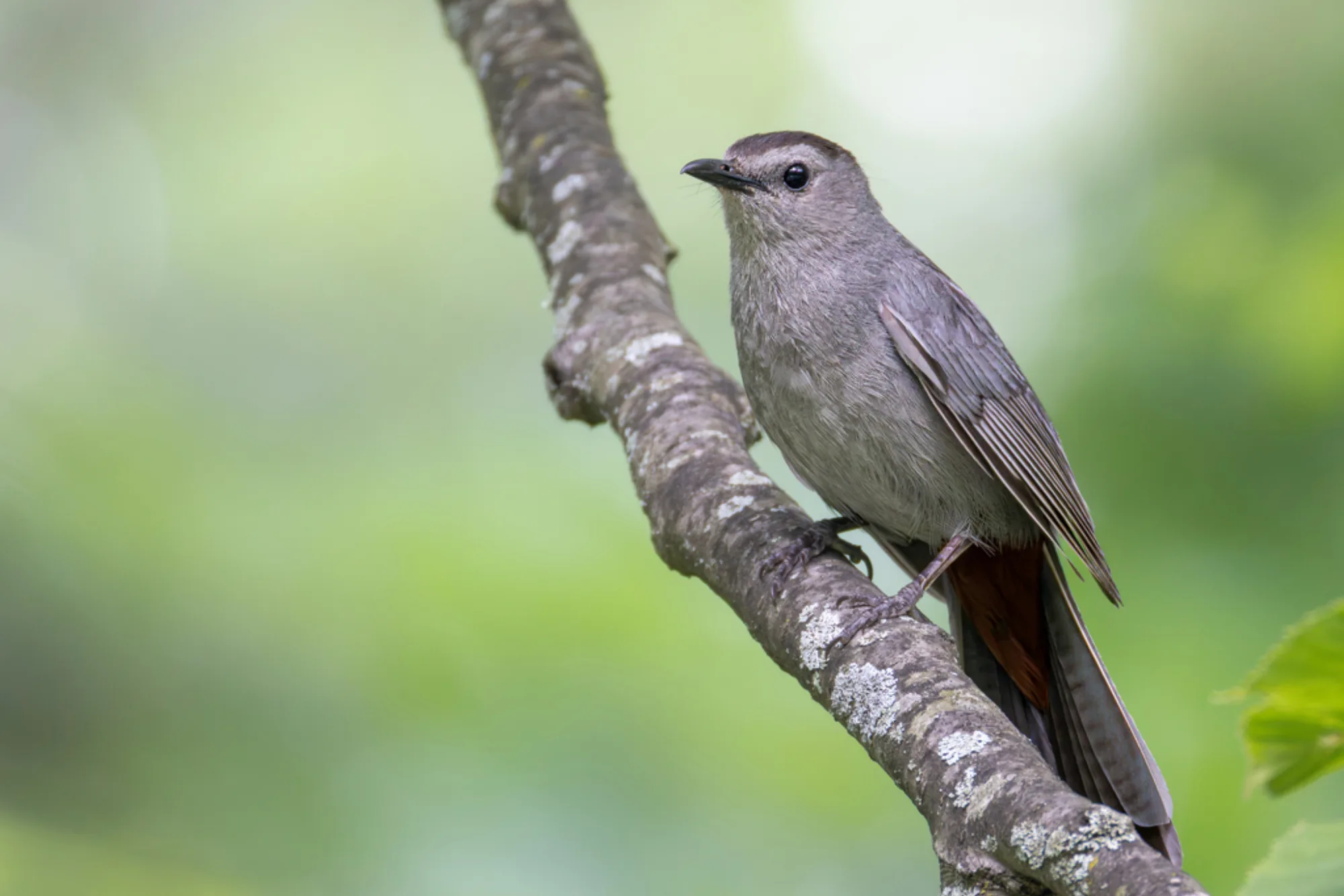
Gray Catbird
Dumetella carolinensis
A catlike call can reveal a Gray Catbird before the bird itself appears. This medium-sized member of the mimid family often sings from within a bush or small tree, hidden by leaves. Its plumage is mostly lead grey, with a darker crown, black wings and tail, and a rusty patch beneath the tail. Males and females look alike, while young birds have plainer colouring and buffy feathers beneath the tail. Listen, too, for its raspy song and imitations of other birds, tree frogs and even mechanical sounds.
Its native range covers much of temperate North America, on the eastern side of the Rocky Mountains. For winter, it migrates to Mexico, the Caribbean, Central America and the southeastern United States. Look for it in scrubland, along woodland edges, on overgrown farmland and in abandoned orchards. It favours dense, low growth, especially thorny vegetation, and avoids unbroken woodland and pine forests. In winter, berry-rich thickets near water are particularly appealing. It feeds mainly among fallen leaves on the ground, as well as in shrubs and trees, eating arthropods, fruit and berries. Summer meals include ants, beetles, grasshoppers, caterpillars and moths.
A bulky cup nest sits close to the ground in a shrub or tree. The light blue eggs number from one to five, most often two or three, and both parents feed the young. Near a nest, adults may flash their wings and tails, call or peck at predators. Although widespread and generally plentiful, the bird has declined greatly in Bermuda, where deforestation and nest predation by introduced species have reduced its numbers.
Written from the English Wikipedia article Gray catbird (CC BY-SA 4.0).
- Records
- 3,862,719
- Countries
- 26
- Atlas places
- 4
These are open occurrence records, so they show where people looked for and recorded the Gray Catbird as much as where it lives. Cells are up to 25 km across, and every location is generalised to its cell.
Generalised encounter areas, not exact locations. Each shape is a grid cell coloured by how likely the species is there.
- Very likelyUnited States25 km zone · high confidence · 3536594 records · updated 86 days ago
- Very likelyCanada25 km zone · high confidence · 239975 records · updated 86 days ago
- Very likelyBelize25 km zone · high confidence · 33506 records · updated 86 days ago
- Very likelyGuatemala25 km zone · high confidence · 10579 records · updated today
- Very likelyBermuda25 km zone · high confidence · 10387 records · updated today
- Very likelyMexico25 km zone · high confidence · 8320 records · updated today
- Very likelyBahamas25 km zone · high confidence · 6415 records · updated today
- Very likelyCuba25 km zone · high confidence · 5842 records · updated today
- Very likelyHonduras25 km zone · high confidence · 5531 records · updated today
- Very likelyCayman Islands25 km zone · high confidence · 1716 records · updated today
Conservation status not assessed here yet, so every location is generalised to its grid cell.