Dugong
Dugong dugon
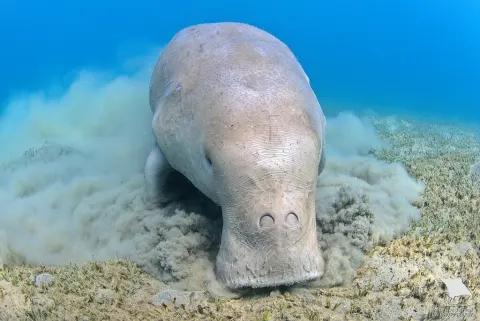
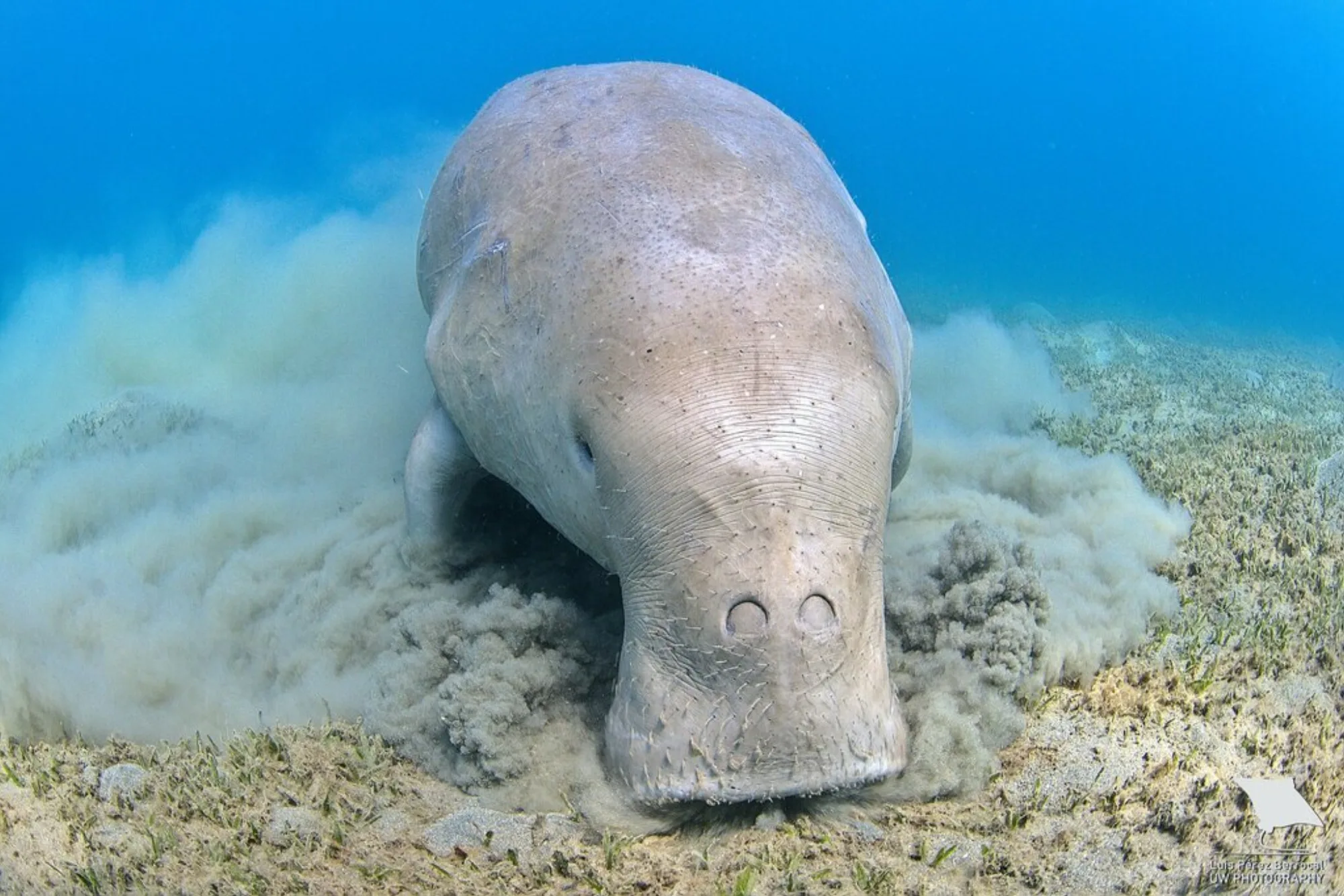
A rounded body, paddle-like flippers and a dolphin-like tail give the Dugong its distinctive outline. This marine mammal has no dorsal fin, and its snout turns sharply down towards the seabed. Its smooth skin is pale cream at birth, becoming brownish to dark grey with age; algae growing on the skin can also change its colour. Adults rarely grow longer than 3 metres.
Dugongs inhabit warm seas along the coast of eastern Africa and across to the western Pacific Ocean. They depend on seagrass meadows and often gather in broad, shallow, sheltered bays, mangrove channels and waters around large inshore islands. Northern Australian waters between Shark Bay and Moreton Bay are thought to be their stronghold. Although social, dugongs are usually alone or in pairs, and their shyness means they do not approach people. They communicate underwater with chirps, whistles and barks, and may travel long distances in search of food. Seagrass makes up most of their diet: they can dig up a whole plant and shake off the sand before eating it. They may also eat algae when seagrass is scarce, and sometimes take invertebrates.
Females usually give birth to one calf in very shallow water after a pregnancy of 13 to 15 months. The calf stays close to its mother, nursing for 14 to 18 months while beginning to eat seagrass soon after birth. Dugongs reproduce slowly, with females giving birth only a few times in their lives. Hunting, deaths associated with fishing and damage to habitat are major causes of their decline; plastic waste can also be mistaken for food and swallowed.
Written from the English Wikipedia article Dugong (CC BY-SA 4.0).
- Records
- 7,872
- Countries
- 9
- Atlas places
- 2
These are open occurrence records, so they show where people looked for and recorded the Dugong as much as where it lives. Cells are up to 25 km across, and every location is generalised to its cell.
Generalised encounter areas, not exact locations. Each shape is a grid cell coloured by how likely the species is there.
- Very likelyAustralia25 km zone · medium confidence · 6726 records · updated 86 days ago
- Very likelyNew Caledonia25 km zone · high confidence · 1117 records · updated 86 days ago
- LikelyThailand25 km zone · medium confidence · 11 records · updated 86 days ago
- LikelyEgypt25 km zone · medium confidence · 10 records · updated 86 days ago
- PossibleMayotte25 km zone · medium confidence · 3 records · updated 86 days ago
- PossibleVietnam25 km zone · medium confidence · 3 records · updated 86 days ago
- PossiblePhilippines25 km zone · medium confidence · 2 records · updated today
- PossibleMozambique25 km zone · low confidence · 0 records · updated today
- RareTimor-Leste25 km zone · low confidence · 0 records · updated today
Conservation status not assessed here yet, so every location is generalised to its grid cell.