Pileated Woodpecker
Dryocopus pileatus
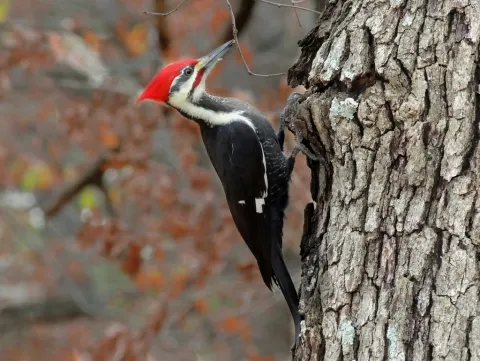
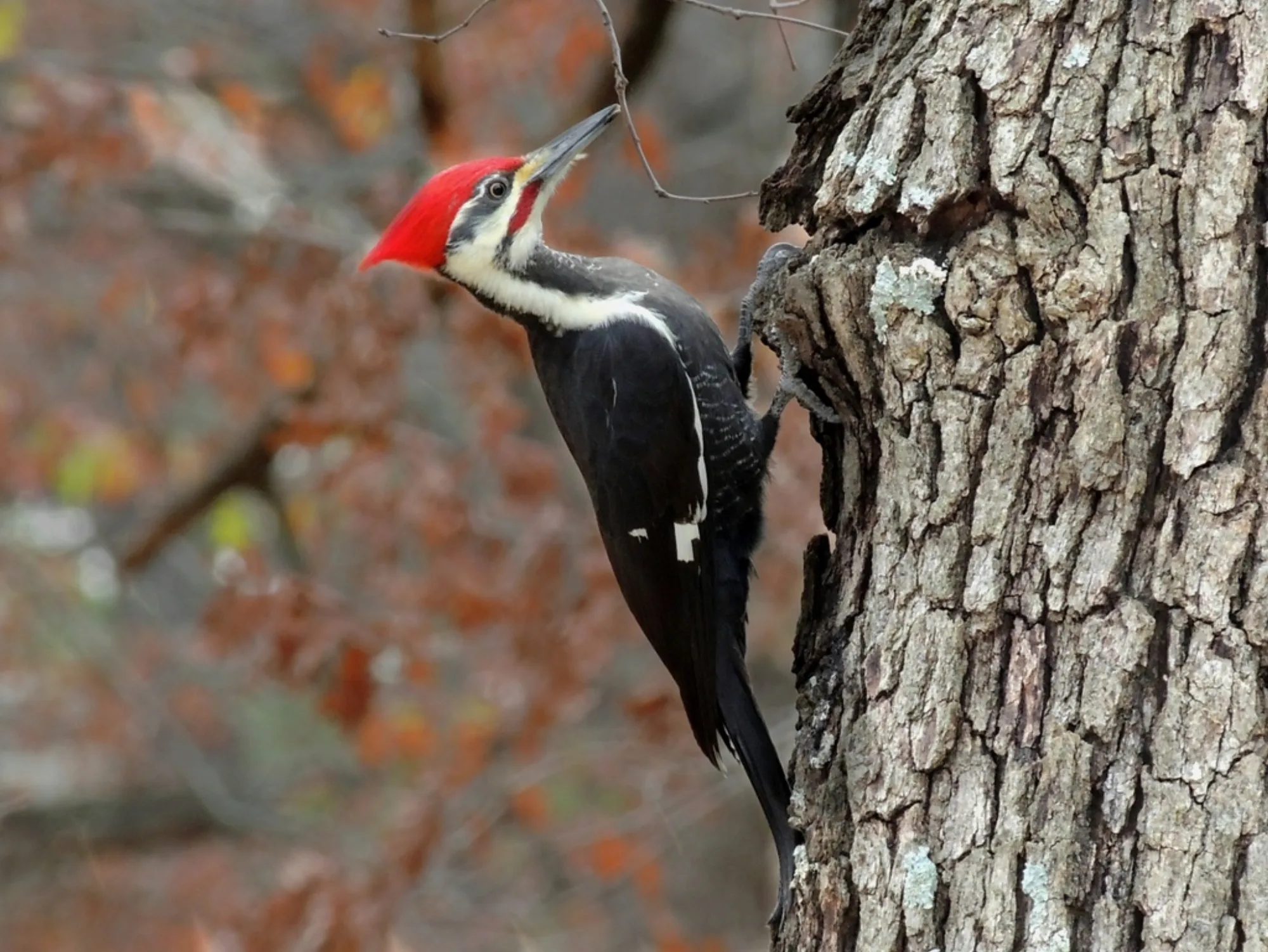
A flash of red crest and white in the wings can reveal a Pileated Woodpecker in flight. Crow-sized and mostly black, this North American bird also has a white stripe along its neck. A red streak runs between the bill and throat of an adult male, whereas the same marking is black in females. Adults measure 40 to 49 cm long, and their flight is strong and direct, with the rising and falling motion typical of woodpeckers.
Look for them in Canadian forests, in the eastern United States and along parts of the Pacific Coast. They favour mature woodland and heavily wooded parks, particularly places with large, mature hardwoods, but also use smaller woodlots with scattered tall trees. Pairs remain on their territory throughout the year, and their slow, deep drumming on hollow trees announces their presence. Carpenter ants and the larvae of wood-boring beetles are favoured insect prey, while fruit, nuts and berries also feature in the diet. Large, roughly rectangular holes in trees can mark their search for insects, and they also forage near the ground around fallen dead trees. After forest fires, they may gather at downed trees to seek insects sheltering there.
Pairs usually stay together for life and excavate nest cavities in dead trees, beginning the work in early spring. Both parents incubate the 3 to 5 eggs for 12 to 16 days; the chicks can take a month before they fledge. Abandoned nest holes can later shelter other birds and mammals, including owls, tree-nesting ducks and raccoons. Habitat loss caused a drastic population decline in the 1700s and 1800s, although the population has since recovered. Squirrels, rat snakes and gray foxes are among the predators that threaten nests, while birds of prey can catch adults in flight.
Written from the English Wikipedia article Pileated woodpecker (CC BY-SA 4.0).
- Records
- 1,654,631
- Countries
- 2
- Atlas places
- 4
These are open occurrence records, so they show where people looked for and recorded the Pileated Woodpecker as much as where it lives. Cells are up to 25 km across, and every location is generalised to its cell.
Generalised encounter areas, not exact locations. Each shape is a grid cell coloured by how likely the species is there.
- Very likelyUnited States25 km zone · high confidence · 1478849 records · updated 80 days ago
- Very likelyCanada25 km zone · high confidence · 175782 records · updated 80 days ago
Conservation status not assessed here yet, so every location is generalised to its grid cell.