Black Woodpecker
Dryocopus martius
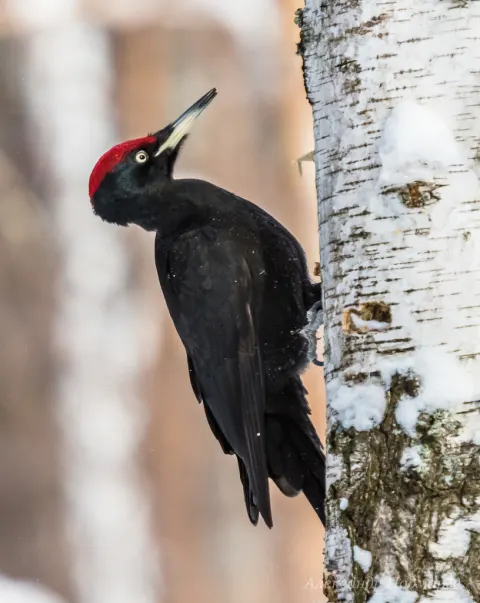
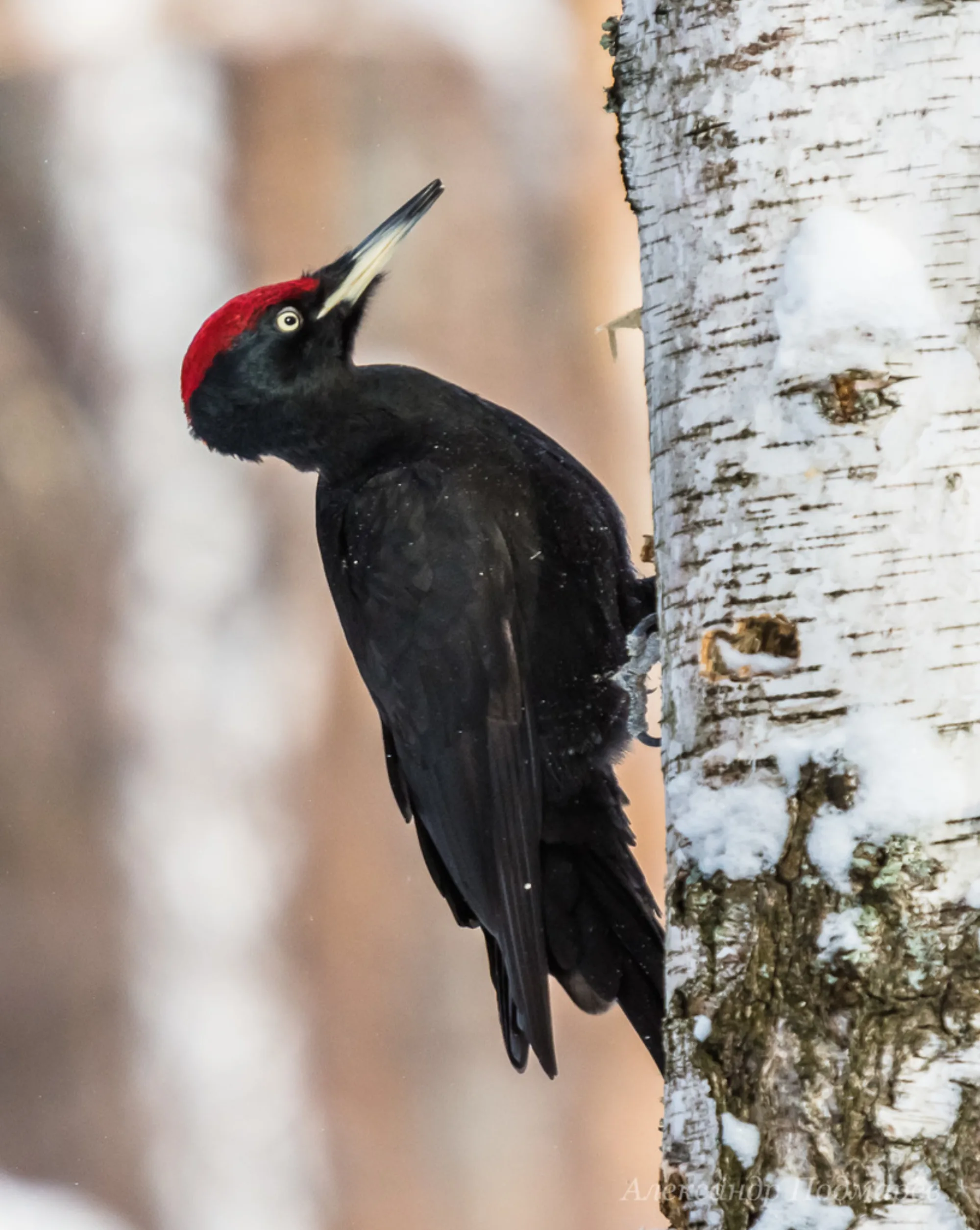
Crow-sized and almost entirely black, the Black Woodpecker has a red crown and piercing yellow eyes. The male's whole crown is red, while the female has red only at the back of the crown. Young birds are less glossy, with duller red and a paler grey throat and bill. Listen for a loud, high-pitched whistle or a shrill screech in flight, and look for slow, unsteady-looking wingbeats with the head held up.
This resident bird inhabits mature woodland throughout the northern Palearctic, ranging east from Spain across Europe and into parts of Asia. It favours extensive woodland, including coniferous and boreal forests, in both mountains and lowlands. Outside the breeding season, it is more likely to visit woods near human settlements. It hammers at dead trees to reach carpenter ants and the grubs of wood-boring beetles, sometimes digging deep into the wood for its food. The birds excavate tree holes, often choosing a tree affected by fungal disease, and their abandoned excavations provide homes for other birds and mammals.
A female lays two to eight eggs in a chamber lined with woodchips, and both parents incubate the eggs and care for the chicks. Young birds leave the nest after 18 to 35 days and stay with the adults for another week. Past deforestation caused declines, and the species still struggles in some areas, including the Pyrenees. Predation appears to be the main cause of nesting failure: pine martens take eggs, chicks and brooding females. Some birds also die from electrocution or are killed by people after damaging power lines, communication poles or houses.
Written from the English Wikipedia article Black woodpecker (CC BY-SA 4.0).
- Records
- 174,101
- Countries
- 47
No atlas park has a record of the Black Woodpecker in or around it yet.
These are open occurrence records, so they show where people looked for and recorded the Black Woodpecker as much as where it lives. Cells are up to 25 km across, and every location is generalised to its cell.
Generalised encounter areas, not exact locations. Each shape is a grid cell coloured by how likely the species is there.
- Very likelyNorway25 km zone · high confidence · 53580 records · updated 86 days ago
- Very likelyFrance25 km zone · high confidence · 33726 records · updated 86 days ago
- Very likelyBelgium25 km zone · high confidence · 24128 records · updated 86 days ago
- Very likelyFinland25 km zone · high confidence · 16384 records · updated 86 days ago
- Very likelyCzechia25 km zone · high confidence · 7549 records · updated 86 days ago
- Very likelyNetherlands25 km zone · high confidence · 6270 records · updated 86 days ago
- Very likelyGermany25 km zone · high confidence · 4610 records · updated 86 days ago
- Very likelyAustria25 km zone · high confidence · 3470 records · updated 86 days ago
- Very likelySwitzerland25 km zone · high confidence · 2855 records · updated 86 days ago
- Very likelyPoland25 km zone · high confidence · 2411 records · updated 86 days ago
Conservation status not assessed here yet, so every location is generalised to its grid cell.