Downy Woodpecker
Dryobates pubescens
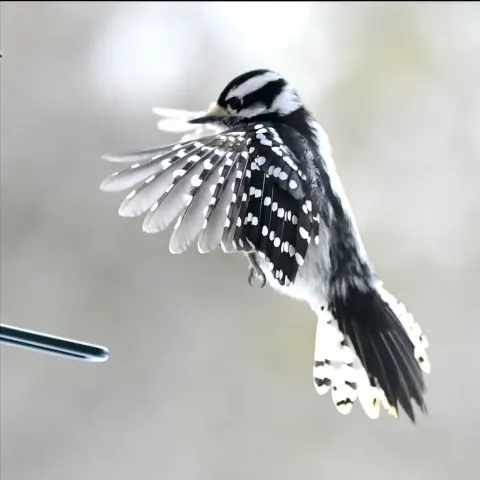
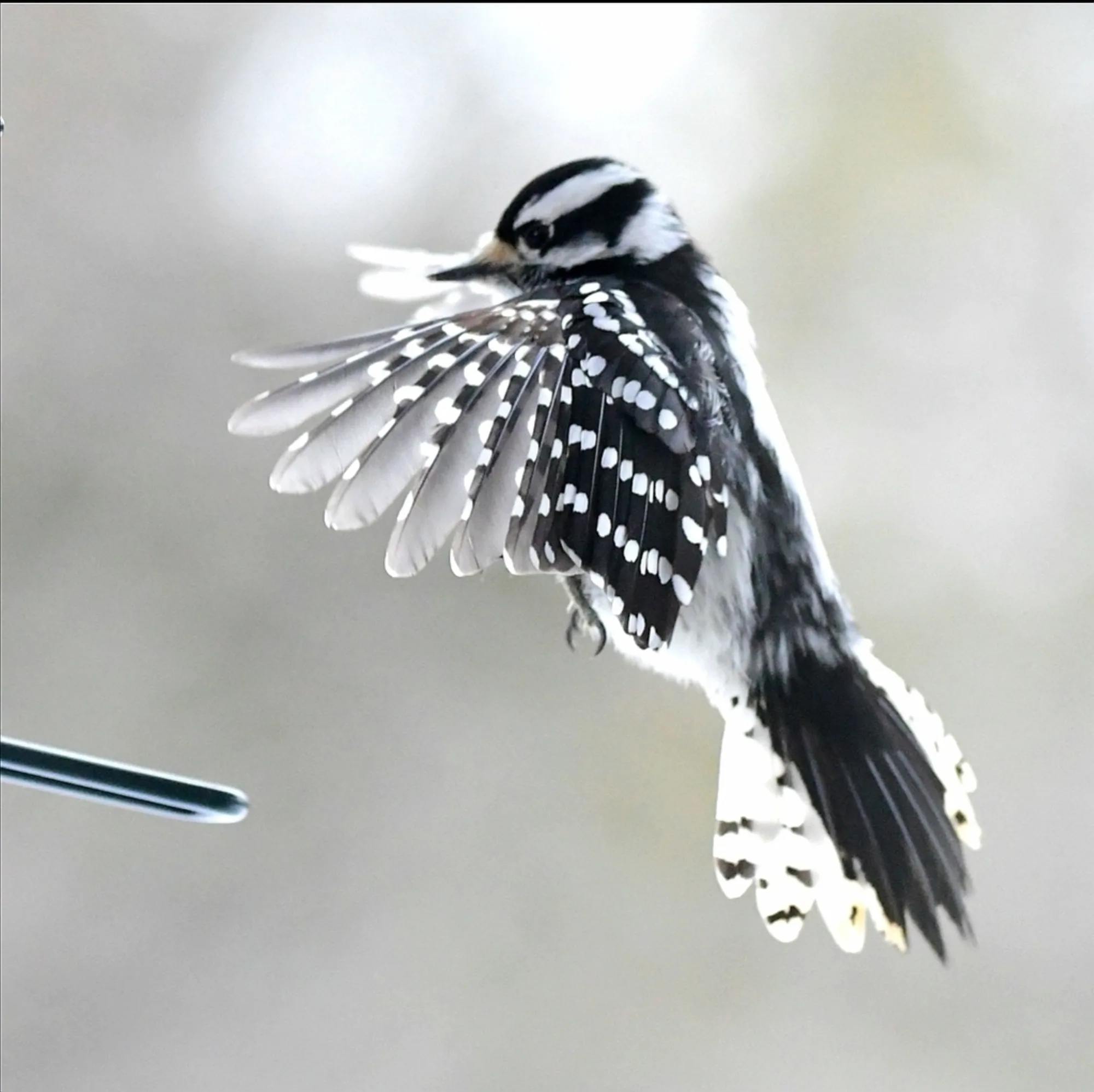
Small enough to measure just 14 to 18 cm in length, the Downy Woodpecker is North America's smallest woodpecker. Its back, throat and belly are white, while its largely black wings carry white spots. White bars frame the eye, and the black tail has white outer feathers marked with black. Adult males have a red patch at the back of the head; young males have a red cap. The larger hairy woodpecker looks very similar, but the Downy's bill is shorter than its head and its white tail feathers have black spots. Listen for a short pik call, a rattling burst like a bouncing ball, or the slow drumming of its bill on a tree.
Across most of the United States and Canada, this bird lives mainly in deciduous woodland, avoiding the southwestern deserts and northern tundra. Most stay year-round, though some northern birds move south and mountain birds descend to lower elevations. It searches trees for insects, picking at the bark in summer and digging deeper in winter, and also eats seeds and berries. In winter, suburban backyards with mature trees can offer sightings at feeders stocked with suet or shelled peanuts.
A nesting pair excavates a cavity in a dead tree or limb, often near forest openings and edges where there is plenty of light. The female usually lays four or five white eggs, and both parents take turns keeping them warm during the day. The young look fully grown by day 17 or 18. Predators and the weather are hazards at the nest, where the tree's harder outer wood helps protect the cavity.
Written from the English Wikipedia article Downy woodpecker (CC BY-SA 4.0).
- Records
- 6,648,535
- Countries
- 5
- Atlas places
- 1
These are open occurrence records, so they show where people looked for and recorded the Downy Woodpecker as much as where it lives. Cells are up to 25 km across, and every location is generalised to its cell.
Generalised encounter areas, not exact locations. Each shape is a grid cell coloured by how likely the species is there.
- Very likelyUnited States25 km zone · high confidence · 5563966 records · updated 86 days ago
- Very likelyCanada25 km zone · high confidence · 1081191 records · updated 86 days ago
- Very likelyMexico25 km zone · high confidence · 3273 records · updated today
- PossibleSt. Pierre & Miquelon25 km zone · high confidence · 69 records · updated today
- UncommonBermuda25 km zone · medium confidence · 36 records · updated today
Conservation status not assessed here yet, so every location is generalised to its grid cell.