Emu
Dromaius novaehollandiae
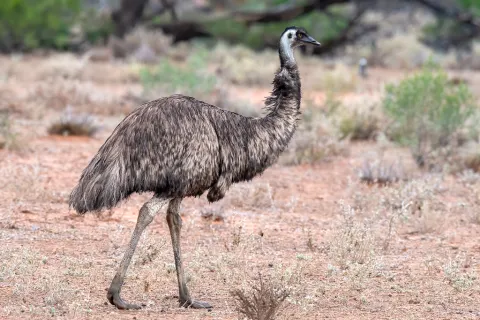
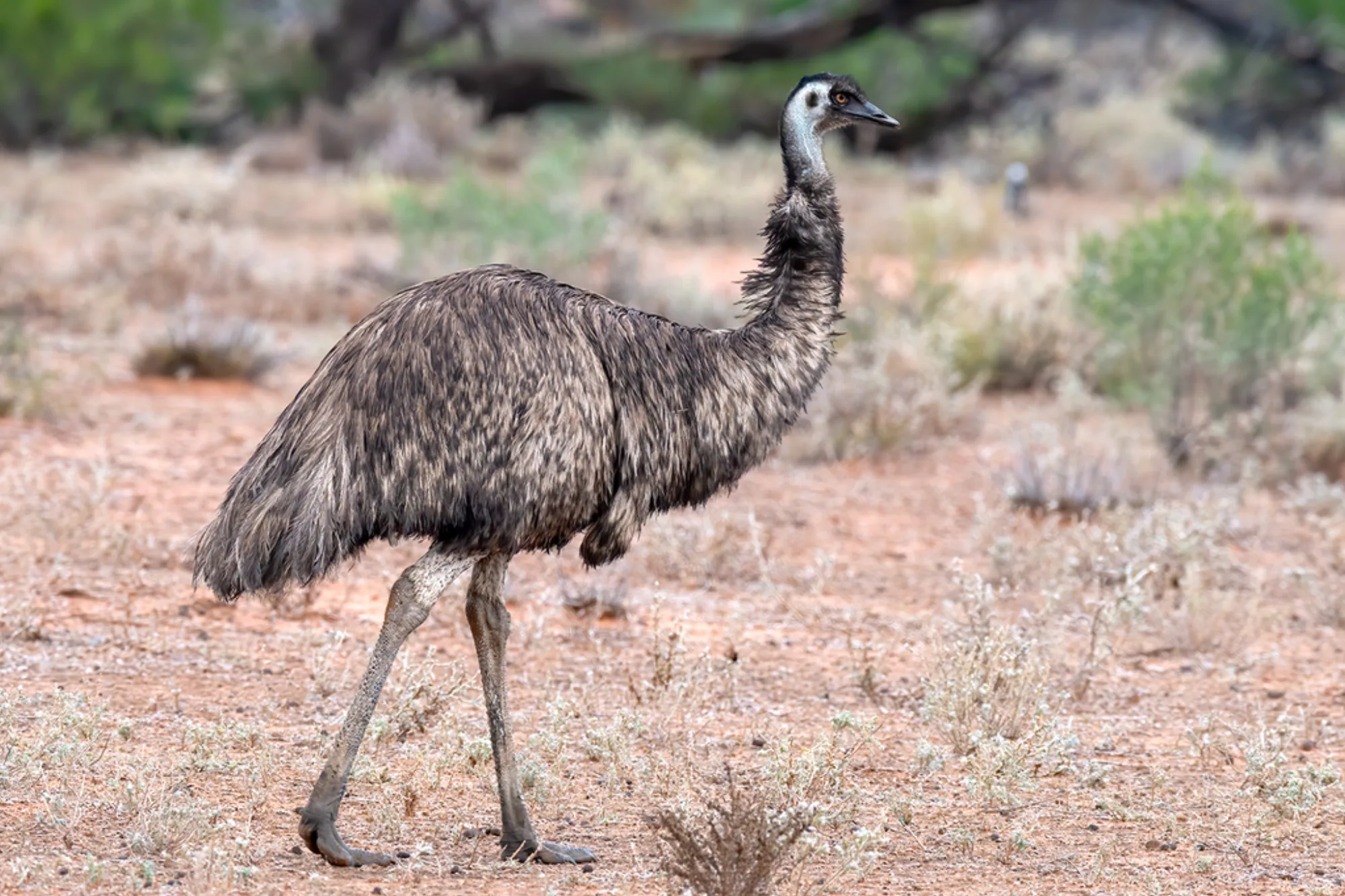
Standing up to 1.9 m tall, the Emu is Australia's tallest native bird, with a long neck, long legs and shaggy grey-brown feathers. Its pale blue neck shows through sparse feathers, while birds in dry country with red soil can have a reddish tint. Flightless but built for running, it can cover great distances and sprint at 48 km/h when necessary.
Emus range across most of mainland Australia, living both inland and near the coast. Savannah woodland and sclerophyll forest are favoured habitats, while heavily populated districts and the driest areas have fewer birds. They usually travel in pairs, though larger flocks sometimes gather as birds head towards fresh feeding grounds. During the day they forage, preen, dust bathe and rest, with some birds keeping watch while others feed. Their varied diet includes grasses, other plants and insects, with choices changing according to the season. They drink infrequently, but take in large amounts of water when they have the chance.
Breeding takes place in May and June, when females often fight over mates. The male builds a ground nest from bark, grass, sticks and leaves, usually where he can see approaching predators. He incubates the eggs for around eight weeks, eating and drinking very little, then guards the growing chicks and teaches them to find food. The young have brown and cream stripes, reach full size at around six months and may remain with their family until the next breeding season. Eggs and small chicks face predators including foxes, dogs and feral pigs, while road deaths and habitat fragmentation also threaten emus.
Written from the English Wikipedia article Emu (CC BY-SA 4.0).
- Records
- 66,636
- Countries
- 1
- Atlas places
- 3
These are open occurrence records, so they show where people looked for and recorded the Emu as much as where it lives. Cells are up to 25 km across, and every location is generalised to its cell.
Generalised encounter areas, not exact locations. Each shape is a grid cell coloured by how likely the species is there.
- Very likelyAustralia25 km zone · high confidence · 66636 records · updated 80 days ago
Conservation status not assessed here yet, so every location is generalised to its grid cell.