Gizzard Shad
Dorosoma cepedianum
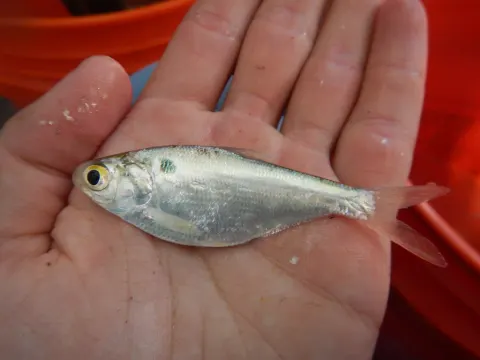
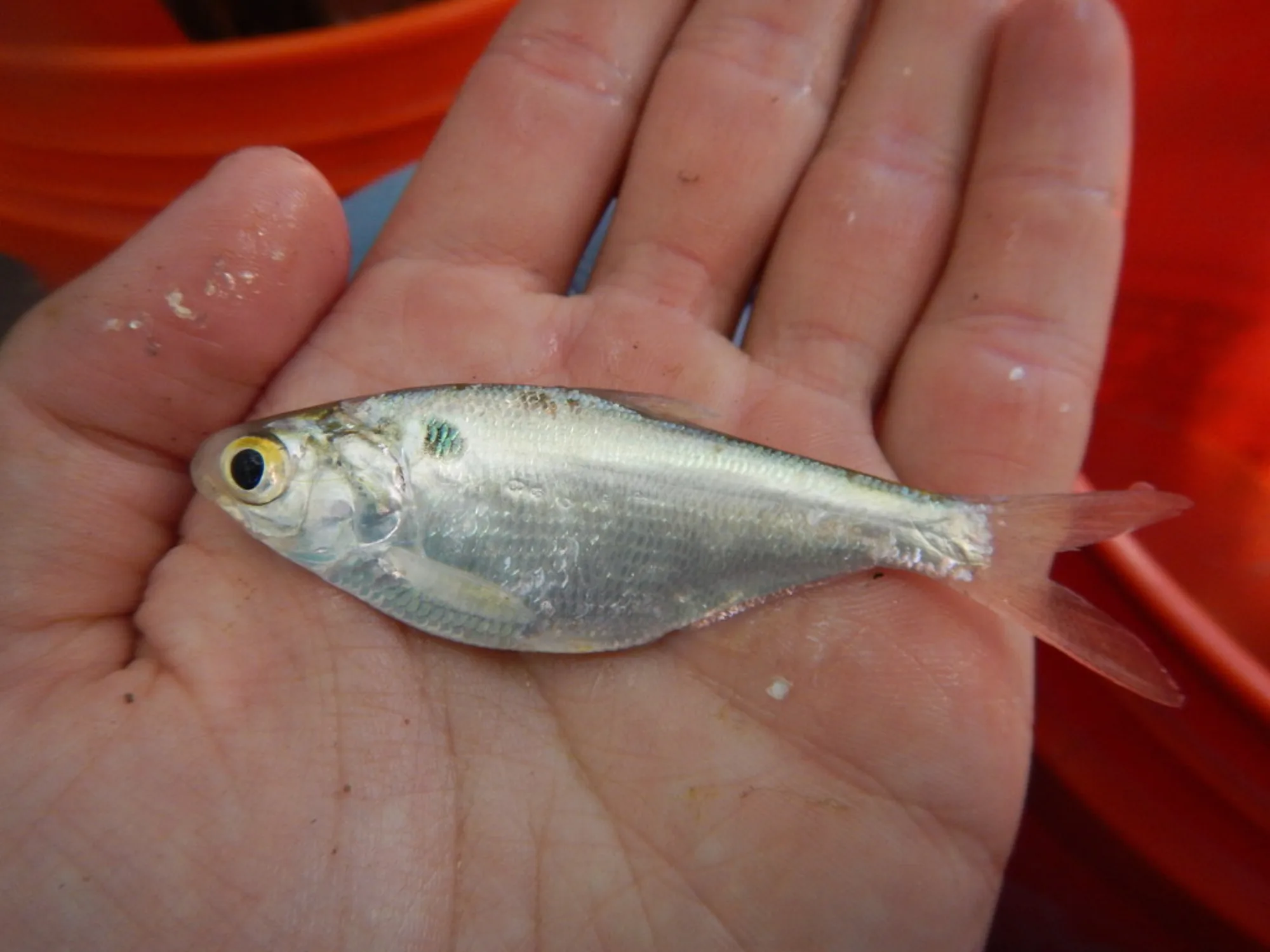
A deep-bodied member of the herring family, the Gizzard Shad has a silvery-green back that fades to silver underneath. Some appear brown or grey above and whitish below, and a faint spot may show behind the gill cover. The fish is often slimy, and its longest recorded length is 477 mm.
Gizzard Shad are native to fresh and brackish waters across much of the United States, as well as parts of Canada and Mexico. They live in lakes and reservoirs, and also occur in rivers, streams and brackish water. Shallow, muddy-bottomed lakes with cloudy water are favoured, while survival is lower in clear water and where vegetation is dense. Along the US Atlantic shoreline, they also inhabit brackish water.
These fish feed mainly by day and are much less active at night. In Lake Mead, Arizona, they have been seen gathering in schools in very shallow water on autumn nights. Young fish eat mainly plant and animal plankton. In midwestern US reservoirs, they generally shift towards dead material from the lake bed during their first year, while in some natural lakes they may depend heavily on animal plankton throughout life. Spawning usually begins between mid-May and early June as the water warms. Eggs are laid in clumps in shallow water, stick to underwater plants and receive no parental care. Gizzard Shad can grow beyond the size many fish can eat, but remain prey for great blue herons, raccoons and other wetland predators.
Written from the English Wikipedia article American gizzard shad (CC BY-SA 4.0).
- Records
- 22,944
- Countries
- 3
- Atlas places
- 1
These are open occurrence records, so they show where people looked for and recorded the Gizzard Shad as much as where it lives. Cells are up to 25 km across, and every location is generalised to its cell.
Generalised encounter areas, not exact locations. Each shape is a grid cell coloured by how likely the species is there.
- Very likelyUnited States25 km zone · high confidence · 22703 records · updated 80 days ago
- Very likelyCanada25 km zone · medium confidence · 127 records · updated 80 days ago
- Very likelyMexico25 km zone · medium confidence · 114 records · updated 80 days ago
Conservation status not assessed here yet, so every location is generalised to its grid cell.