Patagonian Mara
Dolichotis patagonum
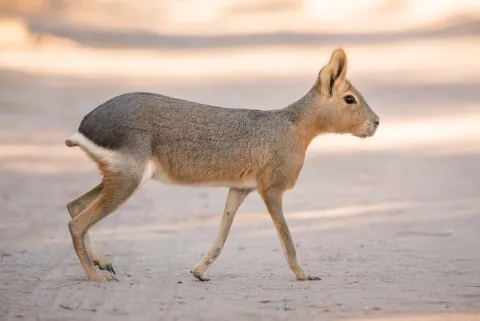
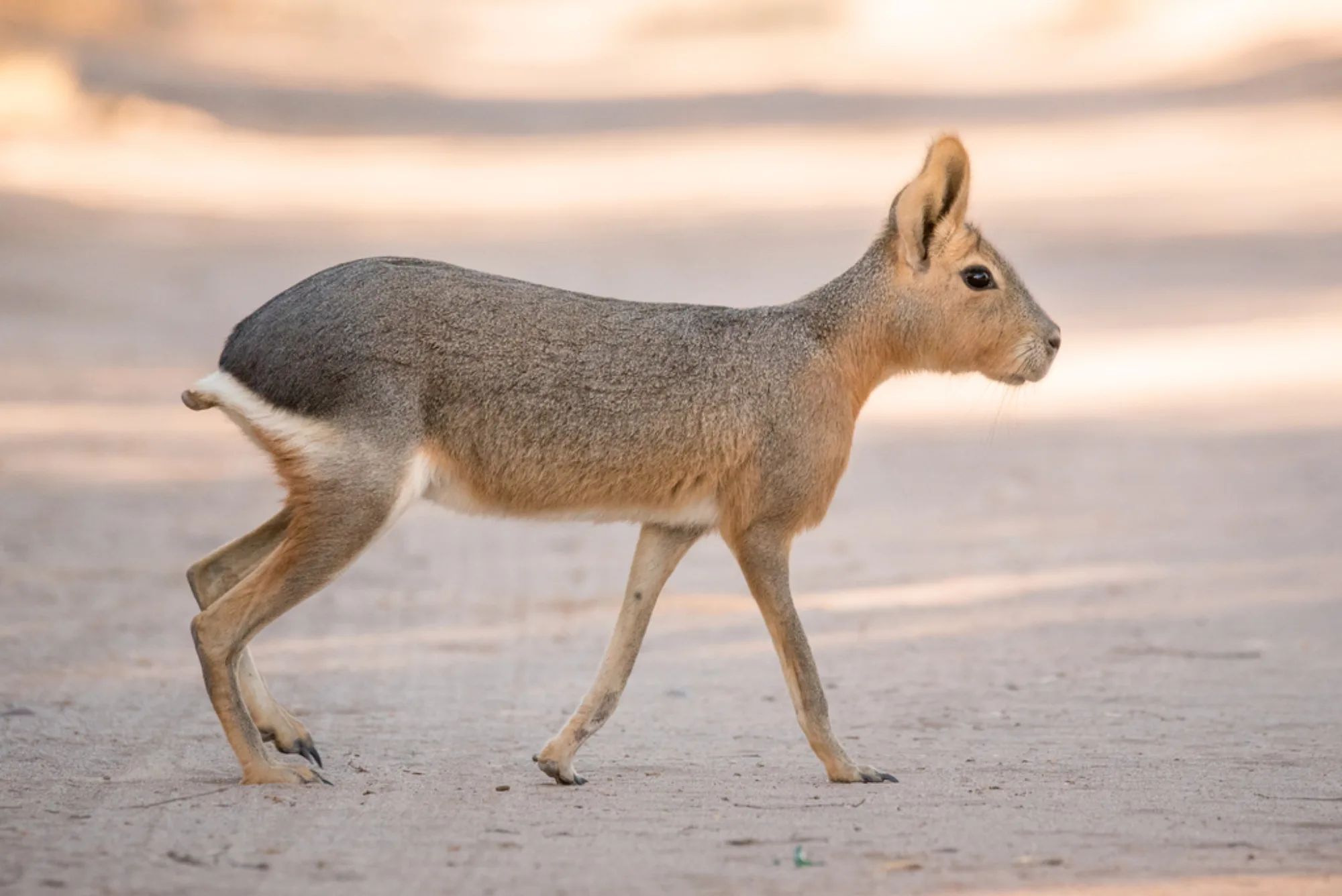
With upright ears, long legs and a rabbit-like profile, the Patagonian Mara is a rodent that can also look like a small hoofed animal when standing or walking. Its back is grey, with a white rump patch bordered by black, while its underside is white and its flanks and chin are somewhat orange. Its head and body typically measure 69 to 75 cm, and it weighs 8 to 16 kg. Found only in Argentina, it lives across large parts of Patagonia in open and semi-open country. It favours places with shrub cover, although it also occupies barren and overgrazed ground in the Monte Desert. On the Valdes Peninsula, sandy areas with low shrubs are preferred.
Maras are active mainly during the day, and feeding accounts for around 46% of their daily activity. They eat mostly green vegetation and fruit, including grasses and shrubs. Males spend much of the day sitting watchfully for predators, which include foxes, wild cats, grisons and birds of prey. Pairs stay together for life, and may breed alone or share a warren with other pairs. In southern Argentina, breeding takes place from August to January, with most Patagonian births occurring in September and October. Young can walk almost immediately after birth, but stay close to the den for their first three weeks before grazing with their parents. Larger communal groups offer young better protection from predators. Hunting and changes to habitat have had a major effect on maras, and they have disappeared from some areas, including Buenos Aires Province. Their skins have been used for rugs and bedspreads.
Written from the English Wikipedia article Patagonian mara (CC BY-SA 4.0).
- Records
- 87
- Countries
- 4
- Atlas places
- 1
These are open occurrence records, so they show where people looked for and recorded the Patagonian Mara as much as where it lives. Cells are up to 25 km across, and every location is generalised to its cell.
Generalised encounter areas, not exact locations. Each shape is a grid cell coloured by how likely the species is there.
- Very likelyArgentina25 km zone · medium confidence · 78 records · updated 80 days ago
- LikelyUnited Arab Emirates25 km zone · medium confidence · 5 records · updated 80 days ago
- LikelyUnited States25 km zone · medium confidence · 4 records · updated 80 days ago
- UncommonBelgium25 km zone · low confidence · 0 records · updated 80 days ago
Conservation status not assessed here yet, so every location is generalised to its grid cell.