Bobolink
Dolichonyx oryzivorus
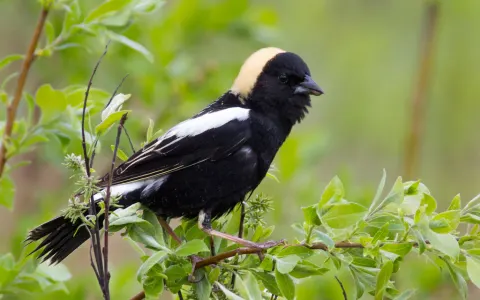
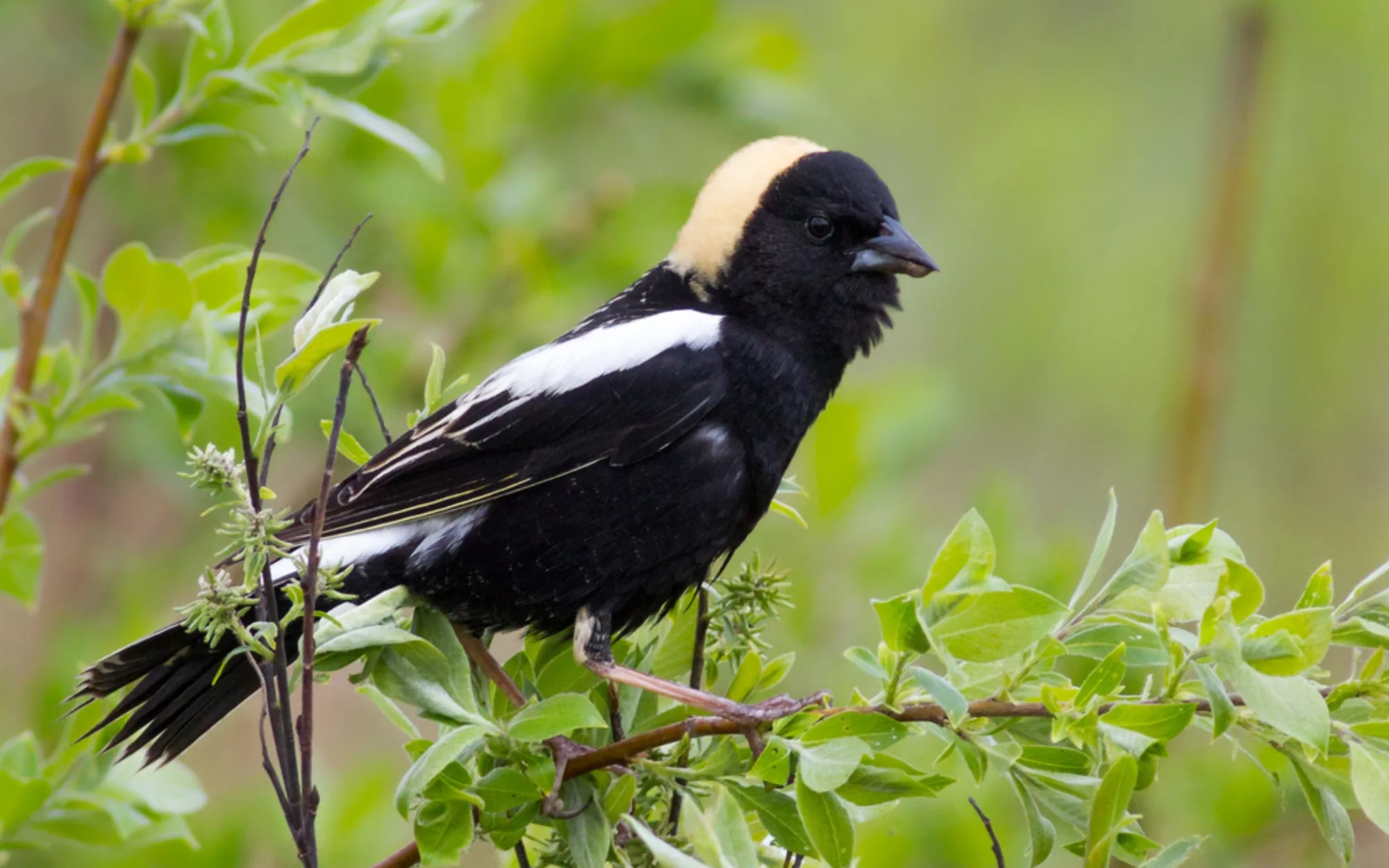
In summer, the Bobolink sings in grassy fields from the northern United States into much of southern Canada. This small blackbird has a short, finch-like bill and measures 16 to 18 cm long as an adult. Males are mostly black, with a creamy nape and white patches on the shoulders, lower back and rump. The female has a mainly pale brown body, with black streaks along her back and sides, dark head stripes and darker wings and tail. Males sing from perches and in flight, sometimes combining their two song types.
Bobolinks formerly nested on the Great Plains, among tallgrass and mixed-grass prairie, but now breed in open grassy fields, especially hay fields. The female makes a cup-shaped ground nest and lays between three and seven eggs. The young receive food from both parents, and some males bring food to more than one nest. Foraging on or near the ground, these birds mainly eat seeds and insects, including large numbers of armyworms. They often migrate in flocks and feed on cultivated grains and rice along the way. For winter, they travel to the south of South America, chiefly to Bolivia, Paraguay and Argentina. One tracked bird travelled 19,000 km in a year, sometimes flying up to 1,800 km in a day before resting for days or weeks.
Bobolink numbers are falling rapidly as habitat is lost and agriculture intensifies. Hay fields can provide nesting habitat, but early or repeated harvests may leave young birds too little time to fledge. A study also found declines where American bison were reintroduced, although lighter grazing did not have the same harmful effects.
Written from the English Wikipedia article Bobolink (CC BY-SA 4.0).
- Records
- 357,709
- Countries
- 2
- Atlas places
- 2
These are open occurrence records, so they show where people looked for and recorded the Bobolink as much as where it lives. Cells are up to 25 km across, and every location is generalised to its cell.
Generalised encounter areas, not exact locations. Each shape is a grid cell coloured by how likely the species is there.
- Very likelyUnited States25 km zone · high confidence · 267389 records · updated 80 days ago
- Very likelyCanada25 km zone · high confidence · 90320 records · updated 80 days ago
Conservation status not assessed here yet, so every location is generalised to its grid cell.