Patagonian Toothfish
Dissostichus eleginoides
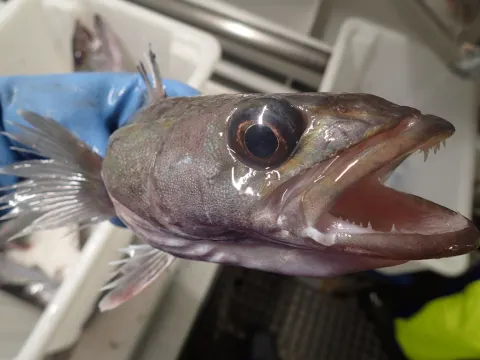
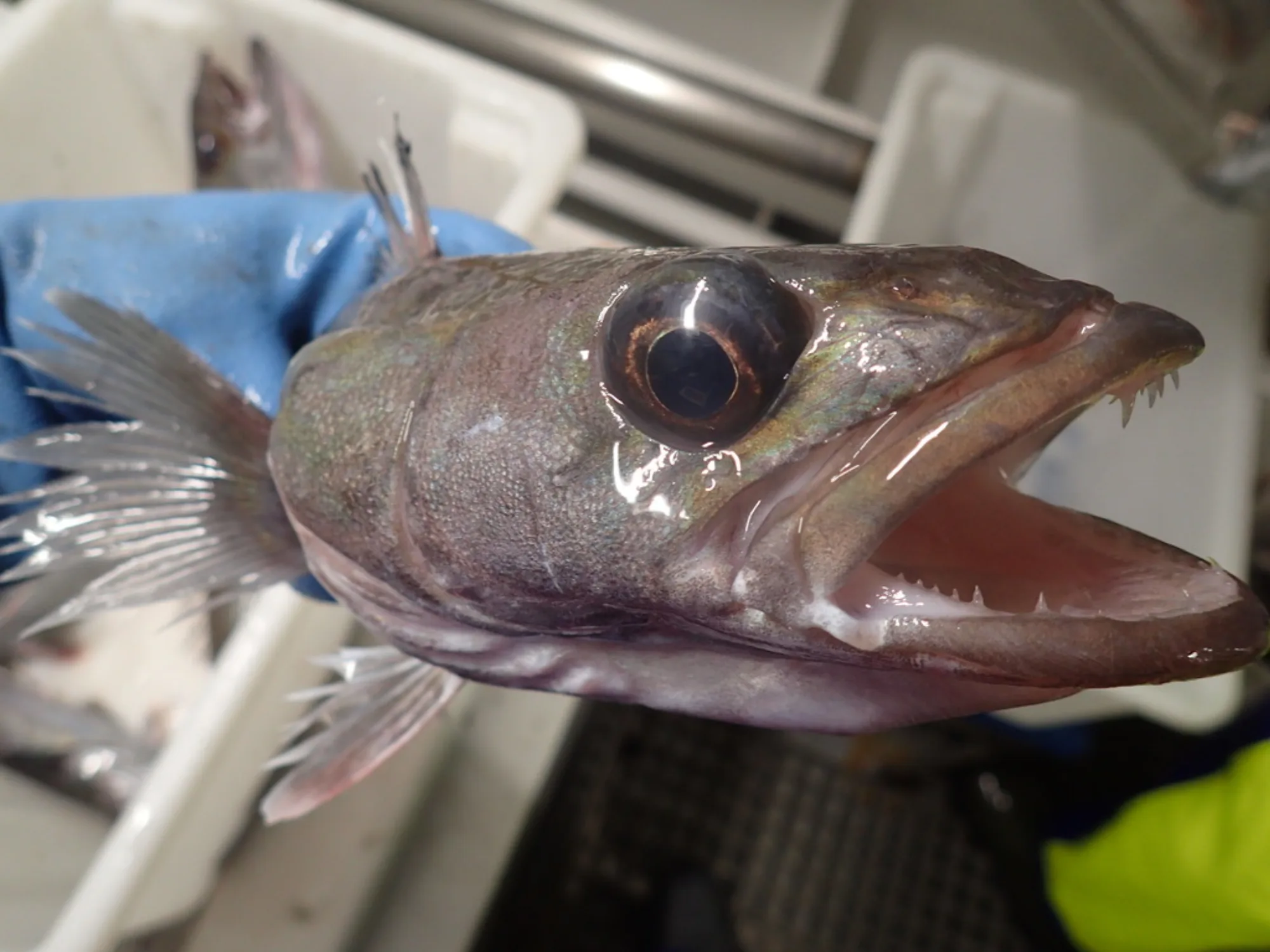
Brownish-grey with darker blotches, the Patagonian Toothfish has a streamlined body, a flattened head and a large mouth. Its large, fan-shaped fins add to its distinctive outline. A length of 70 cm is more typical, though the species can reach 215 cm, and some large adults weigh more than 100 kg. It is thought to live for up to 50 years.
This fish lives in cold southern waters, around most subantarctic islands, where it occupies underwater mountains and the shallower margins of continents. Its range includes the coast of Patagonia, Argentina and the Falkland Islands, as well as South Georgia and Macquarie Island. It has been found at depths from 45 to 3,850 m, in water of 1 to 4 °C. Young fish spend time away from the seabed before becoming bottom-dwelling, while adults move deeper, often beyond 1,000 m. Spawning takes place in deep water during the austral winter, and the eggs and larvae drift in the water. The young settle into shallower habitat and begin moving gradually deeper at 6 to 7 years of age.
In shallow water, juveniles mainly eat fish, taking suitably sized prey that is abundant locally. As toothfish grow and move deeper, their diet broadens to include more scavenged squid, fish and crustaceans. They are also eaten by colossal squid, southern elephant seals and sperm whales, though they form only a small part of these predators' diets. Commercial fisheries catch toothfish, chiefly on longlines, and illegal, unreported and unregulated fishing nearly caused some Southern Ocean fisheries to collapse in the late 1990s and early 2000s. Measures to track catches and trade have helped reduce illegal fishing, which threatens toothfish stocks as well as marine habitats and other species caught alongside them.
Written from the English Wikipedia article Patagonian toothfish (CC BY-SA 4.0).
- Records
- 1,898
- Countries
- 6
No atlas park has a record of the Patagonian Toothfish in or around it yet.
These are open occurrence records, so they show where people looked for and recorded the Patagonian Toothfish as much as where it lives. Cells are up to 25 km across, and every location is generalised to its cell.
Generalised encounter areas, not exact locations. Each shape is a grid cell coloured by how likely the species is there.
- Very likelyChile25 km zone · medium confidence · 865 records · updated 81 days ago
- Very likelyHeard & McDonald Islands25 km zone · medium confidence · 723 records · updated 81 days ago
- Very likelyAntarctica25 km zone · medium confidence · 101 records · updated 81 days ago
- Very likelyArgentina25 km zone · high confidence · 94 records · updated 81 days ago
- Very likelyFalkland Islands25 km zone · medium confidence · 48 records · updated 81 days ago
- Very likelyAustralia25 km zone · medium confidence · 36 records · updated 81 days ago
- Very likelyUnnamed area25 km zone · medium confidence · 31 records · updated 81 days ago
Conservation status not assessed here yet, so every location is generalised to its grid cell.