Boomslang
Dispholidus typus
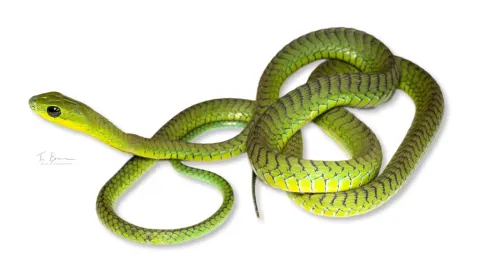
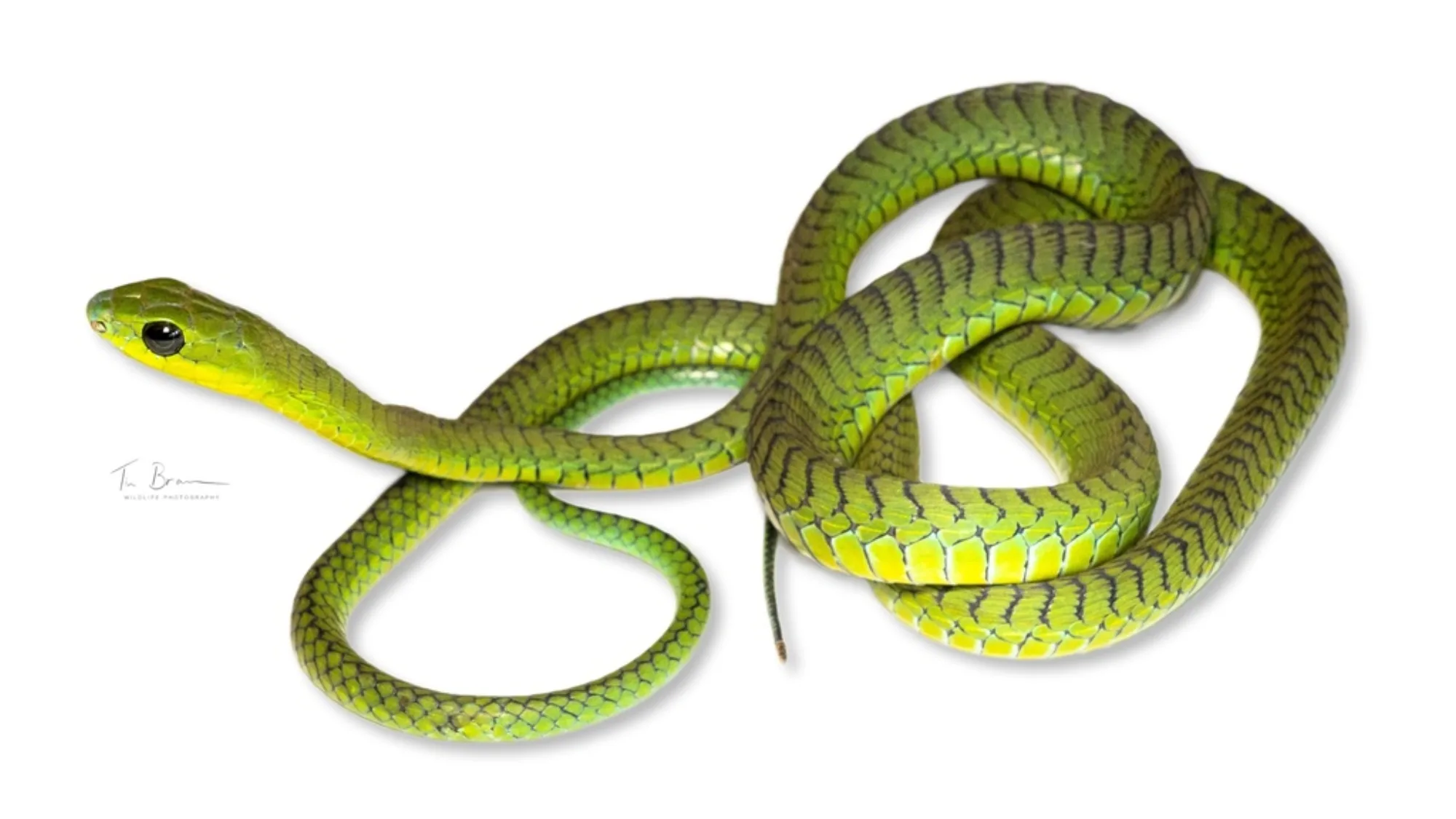
With exceptionally large eyes and an egg-shaped head, the Boomslang is a highly venomous snake native to sub-Saharan Africa. Adults average 100 to 160 centimetres in total length, including the tail, though some exceed 183 centimetres. Colour varies considerably: males have light green scales edged in black or blue, while adult females may be brown. Young males are grey with blue speckles and young females are pale brown; both take several years to acquire adult colouration. Its eyesight is excellent, and it swings its head from side to side to see more clearly what is directly ahead.
Its range extends from West Africa through Central and East Africa and across much of Southern Africa. An accomplished climber, it lives mainly in forested areas but also inhabits karoo shrubs, savannahs, lowland forests and grasslands. It spends much of its time in trees, yet also hunts, feeds and shelters on the ground. Active by day and reclusive, it moves between branches when pursued by an animal too large to eat. In cool weather it rests for short periods, often curled inside the enclosed nest of a weaverbird.
Its prey includes chameleons, other tree-dwelling lizards and frogs, as well as occasional small mammals, birds and eggs. It also eats other snakes, including members of its own species, and swallows its food whole. Females lay an average of 8 to 14 leathery eggs, depositing them inside hollow trunks or decaying logs; incubation averages 3 months. When cornered, the snake inflates its neck and takes up an S-shaped striking pose; bites generally happen when people try to handle, catch, pursue or kill it.
Written from the English Wikipedia article Boomslang (CC BY-SA 4.0).
- Records
- 120
- Countries
- 9
- Atlas places
- 14
- Kruger National Park· South Africa
- Garden Route National Park· South Africa
- Addo Elephant National Park· South Africa
- Table Mountain National Park· South Africa
- iSimangaliso Wetland Park· South Africa
- Nyerere National Park· Tanzania
- Hluhluwe-iMfolozi Park· South Africa
- Mikumi National Park· Tanzania
- Mkomazi National Park· Tanzania
- Okavango Delta· Botswana
- Pilanesberg National Park· South Africa
- Tsavo East National Park· Kenya
- Udzungwa Mountains National Park· Tanzania
- West Coast National Park· South Africa
These are open occurrence records, so they show where people looked for and recorded the Boomslang as much as where it lives. Cells are up to 25 km across, and every location is generalised to its cell.
Generalised encounter areas, not exact locations. Each shape is a grid cell coloured by how likely the species is there.
- Very likelySouth Africa25 km zone · medium confidence · 69 records · updated 80 days ago
- Very likelyTanzania25 km zone · medium confidence · 37 records · updated 80 days ago
- Very likelyZimbabwe25 km zone · medium confidence · 4 records · updated 80 days ago
- LikelyNamibia25 km zone · medium confidence · 4 records · updated 80 days ago
- LikelyBenin25 km zone · medium confidence · 3 records · updated 80 days ago
- LikelyBotswana25 km zone · medium confidence · 2 records · updated 80 days ago
- LikelyEswatini25 km zone · medium confidence · 1 record · updated 80 days ago
- RareKenya25 km zone · low confidence · 0 records · updated 80 days ago
- RareMozambique25 km zone · low confidence · 0 records · updated 80 days ago
Conservation status not assessed here yet, so every location is generalised to its grid cell.