Wandering Albatross
Diomedea exulans
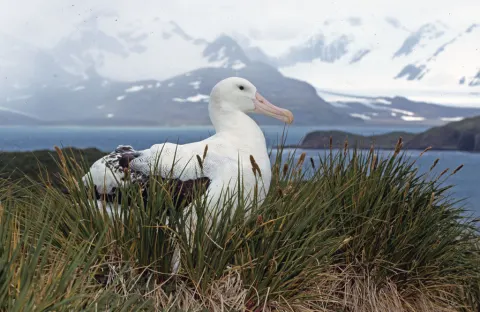
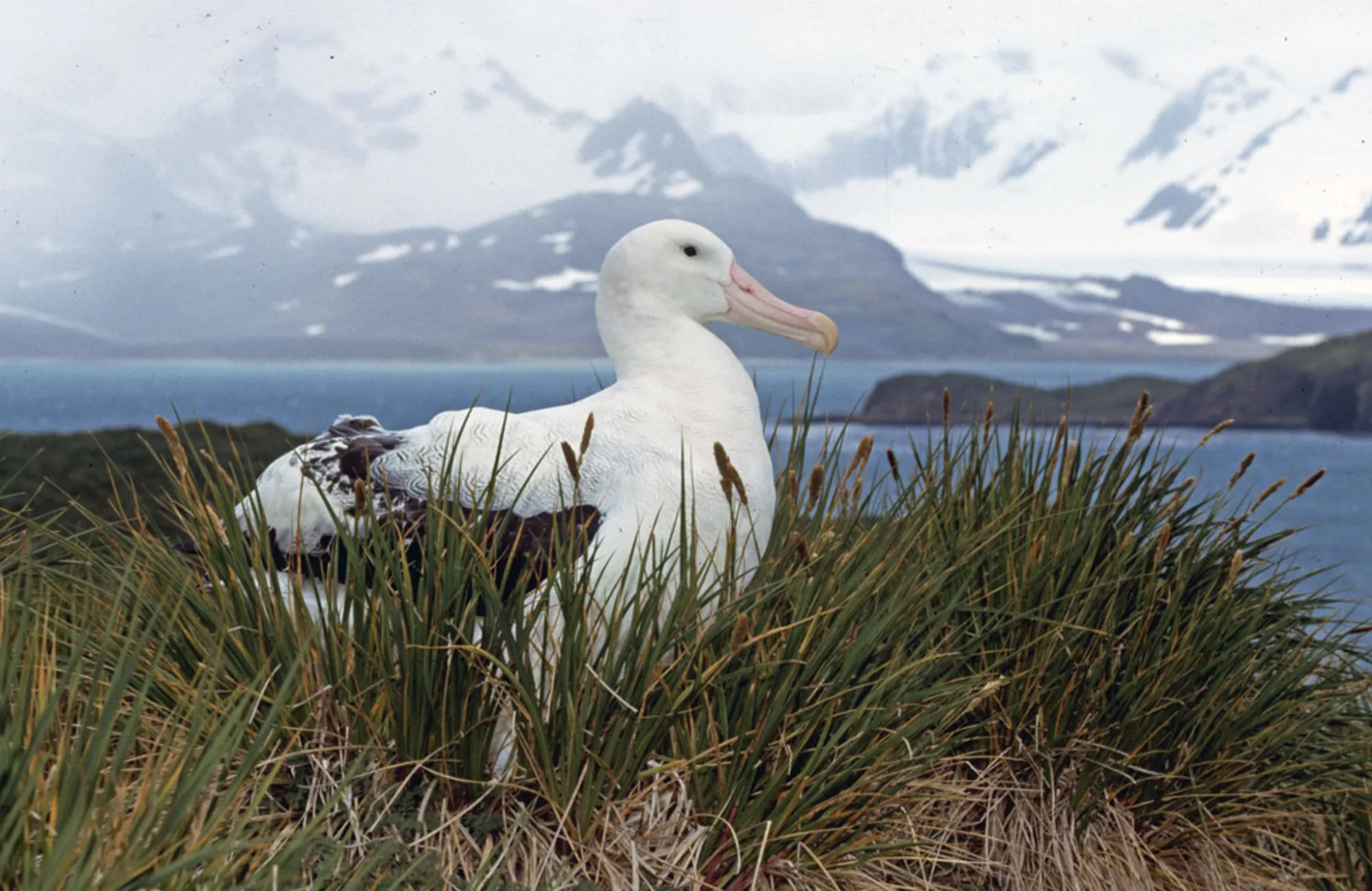
With wings stretching up to 3.7 m, the Wandering Albatross can stay airborne for hours without a flap. This large seabird has a wider wingspan than any other living bird. Adults have white bodies and black and white wings, while young birds begin chocolate brown and grow whiter with age. Look for the large pink bill and pink feet; males generally have whiter wings than females.
This wide-ranging bird lives across the Southern Ocean and spends most of its life in flight, coming down to feed and breed. In a single year, some individuals make three circuits of the Southern Ocean, travelling more than 120,000 km. It feeds in cold, open waters, taking cephalopods, small fish and crustaceans from the surface, mostly by day. Around New Zealand, it can be seen feeding throughout the year off the Kaikōura Peninsula. Fishing vessels also attract it with bait, caught fish and offal.
Pairs usually stay together for life and breed every other year in loose colonies on isolated Southern Ocean islands. Breeding sites include South Georgia, the Crozet Islands, the Kerguelen Islands, the Prince Edward Islands and Macquarie Island. The birds build large bowl-shaped nests from grass and peat and lay a single white egg with a few spots. Both parents share incubation, which takes about 11 weeks; once the chick hatches, they alternate between sitting on the nest and finding food. Later, both forage and return to the chick at irregular intervals. Longline fishing is the greatest threat: birds take the bait and become caught, while plastic pollution and abandoned fishing hooks also take a toll.
Written from the English Wikipedia article Snowy albatross (CC BY-SA 4.0).
- Records
- 14,228
- Countries
- 11
- Atlas places
- 1
These are open occurrence records, so they show where people looked for and recorded the Wandering Albatross as much as where it lives. Cells are up to 25 km across, and every location is generalised to its cell.
Generalised encounter areas, not exact locations. Each shape is a grid cell coloured by how likely the species is there.
- Very likelyAustralia25 km zone · high confidence · 5280 records · updated 80 days ago
- Very likelySouth Georgia & South Sandwich Islands25 km zone · medium confidence · 3977 records · updated 80 days ago
- Very likelySouth Africa25 km zone · medium confidence · 1931 records · updated 80 days ago
- Very likelyUnnamed area25 km zone · medium confidence · 938 records · updated 80 days ago
- Very likelyFalkland Islands25 km zone · medium confidence · 881 records · updated 80 days ago
- Very likelyArgentina25 km zone · medium confidence · 267 records · updated 80 days ago
- Very likelyNew Zealand25 km zone · medium confidence · 237 records · updated 80 days ago
- Very likelyAntarctica25 km zone · medium confidence · 235 records · updated 80 days ago
- Very likelyFrench Southern Territories25 km zone · medium confidence · 213 records · updated 80 days ago
- Very likelyChile25 km zone · medium confidence · 165 records · updated 80 days ago
Conservation status not assessed here yet, so every location is generalised to its grid cell.