Southern Royal Albatross
Diomedea epomophora
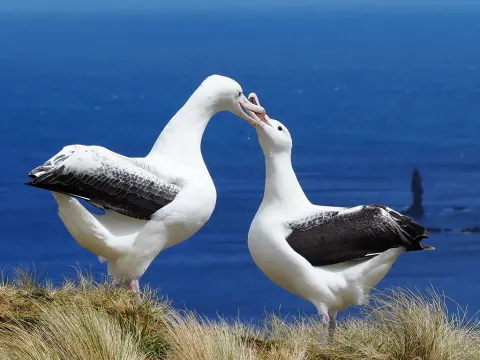
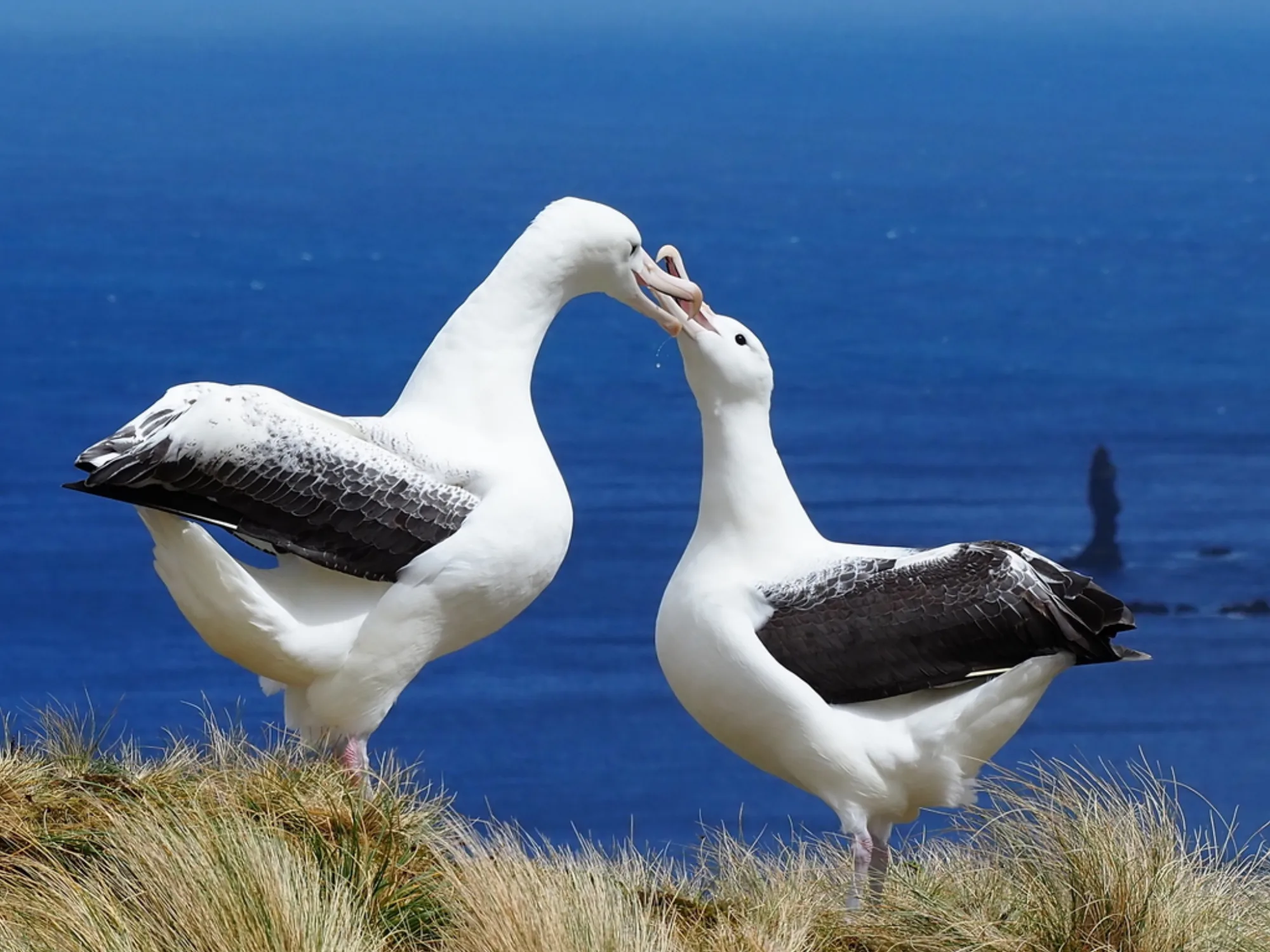
Among the largest albatrosses, the Southern Royal Albatross has an average wingspan exceeding 3 m. Its clean black and white appearance helps distinguish it from the wandering albatross. Young birds have dark wings flecked with white, while their heads and underparts are white. As they mature, white gradually spreads across the upper wings, and the black disappears from their tails and backs. Birds of all ages have pink bills with a black edge and flesh-coloured legs.
These seabirds range across the southern oceans, concentrating in waters around New Zealand and off both coasts of southern South America. Most nest on rat-free Campbell Island, with smaller colonies on Adams, Auckland and Enderby islands. They favour tussock grassland, plateaus and ridges for nesting. At sea, they eat mainly squid and fish, as well as some salps, crustaceans and carrion. They travel vast distances to feed, tending to seek shallower water and areas closer to continental shelves than wandering albatrosses. Foraging normally takes place within 1250 km of the breeding site.
A pair lays one egg every two years, normally in November or December. Both parents incubate it and raise the chick, which takes about 240 days to grow its flight feathers fully and fly independently. Parents feeding chicks travel as far as the Campbell Plateau to the south and the Chatham Rise to the north. Longline fishing is a major threat, while pigs and cats take eggs and chicks on Auckland Island. The shrub Dracophyllum may also threaten the birds by reducing the area available for nesting.
Written from the English Wikipedia article Southern royal albatross (CC BY-SA 4.0).
- Records
- 16,527
- Countries
- 8
- Atlas places
- 5
These are open occurrence records, so they show where people looked for and recorded the Southern Royal Albatross as much as where it lives. Cells are up to 25 km across, and every location is generalised to its cell.
Generalised encounter areas, not exact locations. Each shape is a grid cell coloured by how likely the species is there.
- Very likelyNew Zealand25 km zone · medium confidence · 11047 records · updated 80 days ago
- Very likelyAustralia25 km zone · medium confidence · 2660 records · updated 80 days ago
- Very likelyChile25 km zone · medium confidence · 1148 records · updated 80 days ago
- Very likelyArgentina25 km zone · medium confidence · 869 records · updated 80 days ago
- Very likelyFalkland Islands25 km zone · high confidence · 572 records · updated 80 days ago
- Very likelyAntarctica25 km zone · medium confidence · 101 records · updated 80 days ago
- Very likelySouth Africa25 km zone · medium confidence · 93 records · updated 80 days ago
- LikelySouth Georgia & South Sandwich Islands25 km zone · medium confidence · 37 records · updated 80 days ago
Conservation status not assessed here yet, so every location is generalised to its grid cell.