Tooth-billed Pigeon
Didunculus strigirostris
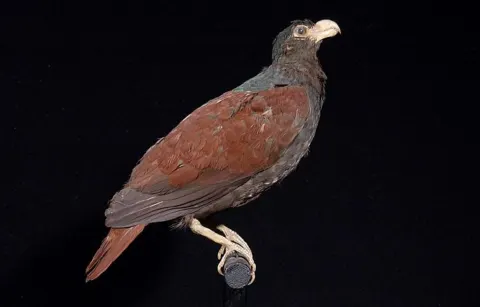
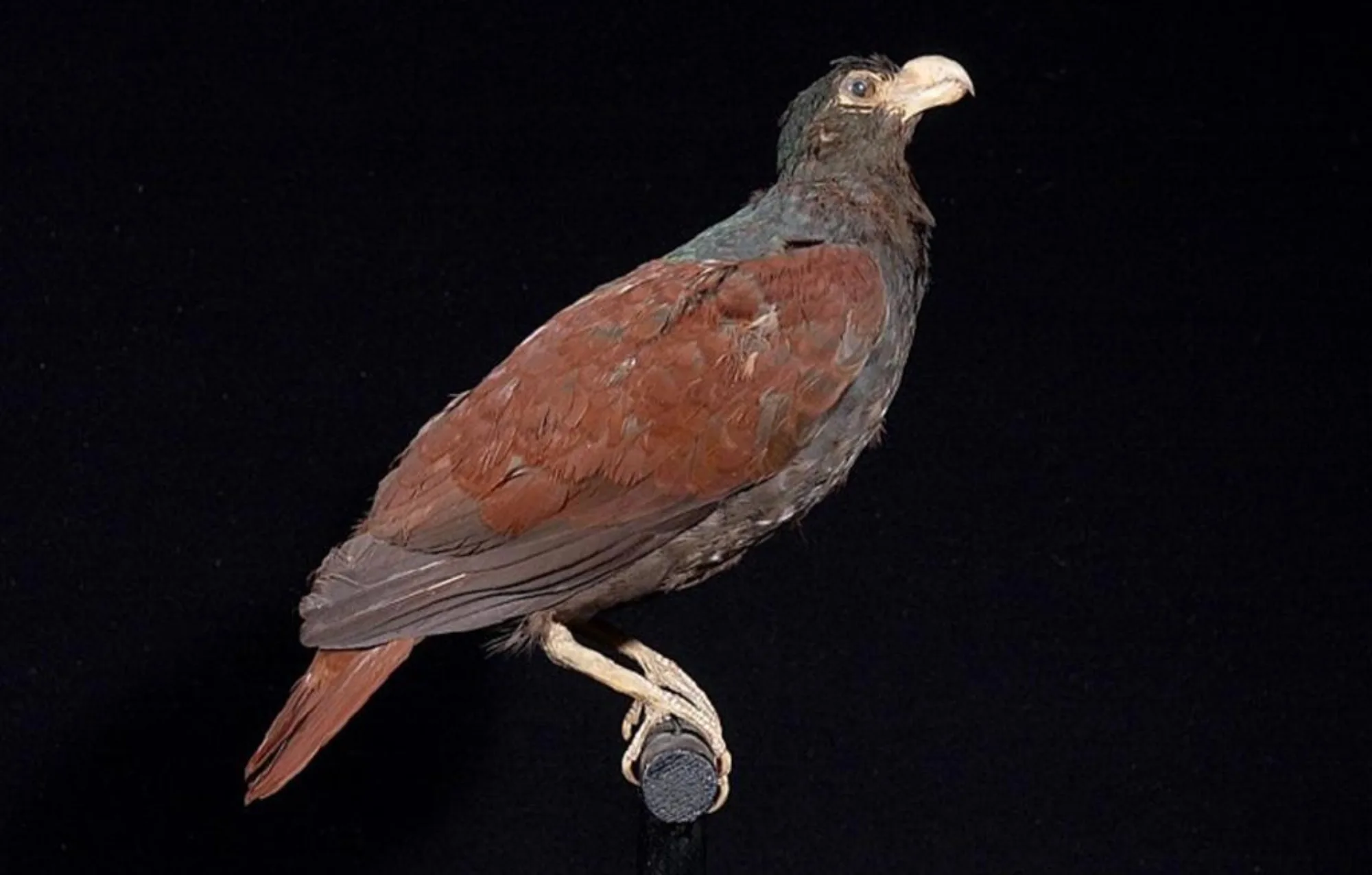
Known in Samoa as the manumea, the Tooth-billed Pigeon is a dark, medium-sized bird found nowhere else. Around 31 centimetres long, it has reddish feet, bare red skin around the eye and a large, hooked bright red bill. Its head, neck and underparts are greyish, with a slight blue-green sheen, while its tail and parts of its wings are rufous chestnut. Males and females look alike, but a young bird is duller, with a brownish head and a dark bill that is pale orange at the base.
The pigeon lives in undisturbed primary rainforest on Savai'i, Upolu and Nu'utele, away from sea level. Its main food is the fruit of two Dysoxylum tree species, although baby chicks cannot feed on it. To drink, it scoops water into its bill, a behaviour that may be unique among its pigeon relatives. The tooth-like projections on its lower bill help it dispense seeds.
Habitat destruction, hunting and invasive animals threaten the bird. Two major cyclones destroyed much of its natural habitat, and its estimated population fell from 7,000 in the 1990s to 2500. A recovery search in 2006 documented 500 birds, and the number of mature individuals is now suggested to be below 200. People have used the bird for food and its feathers to make fine mats. The last confirmed photograph showed a juvenile in 2013, though the bird was heard and seen during a forest survey on Savai'i in 2020.
Written from the English Wikipedia article Tooth-billed pigeon (CC BY-SA 4.0).
- Records
- 11
- Countries
- 1
No atlas park has a record of the Tooth-billed Pigeon in or around it yet.
These are open occurrence records, so they show where people looked for and recorded the Tooth-billed Pigeon as much as where it lives. Cells are up to 25 km across, and every location is generalised to its cell.
Generalised encounter areas, not exact locations. Each shape is a grid cell coloured by how likely the species is there.
- Very likelySamoa25 km zone · medium confidence · 11 records · updated 80 days ago
Conservation status not assessed here yet, so every location is generalised to its grid cell.