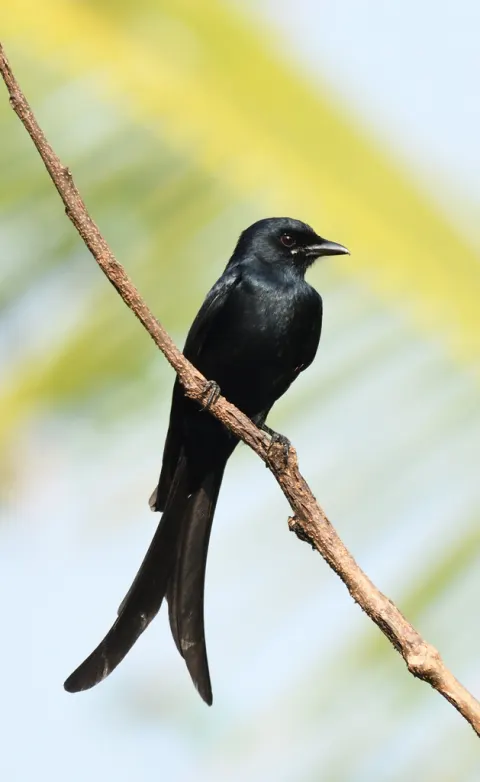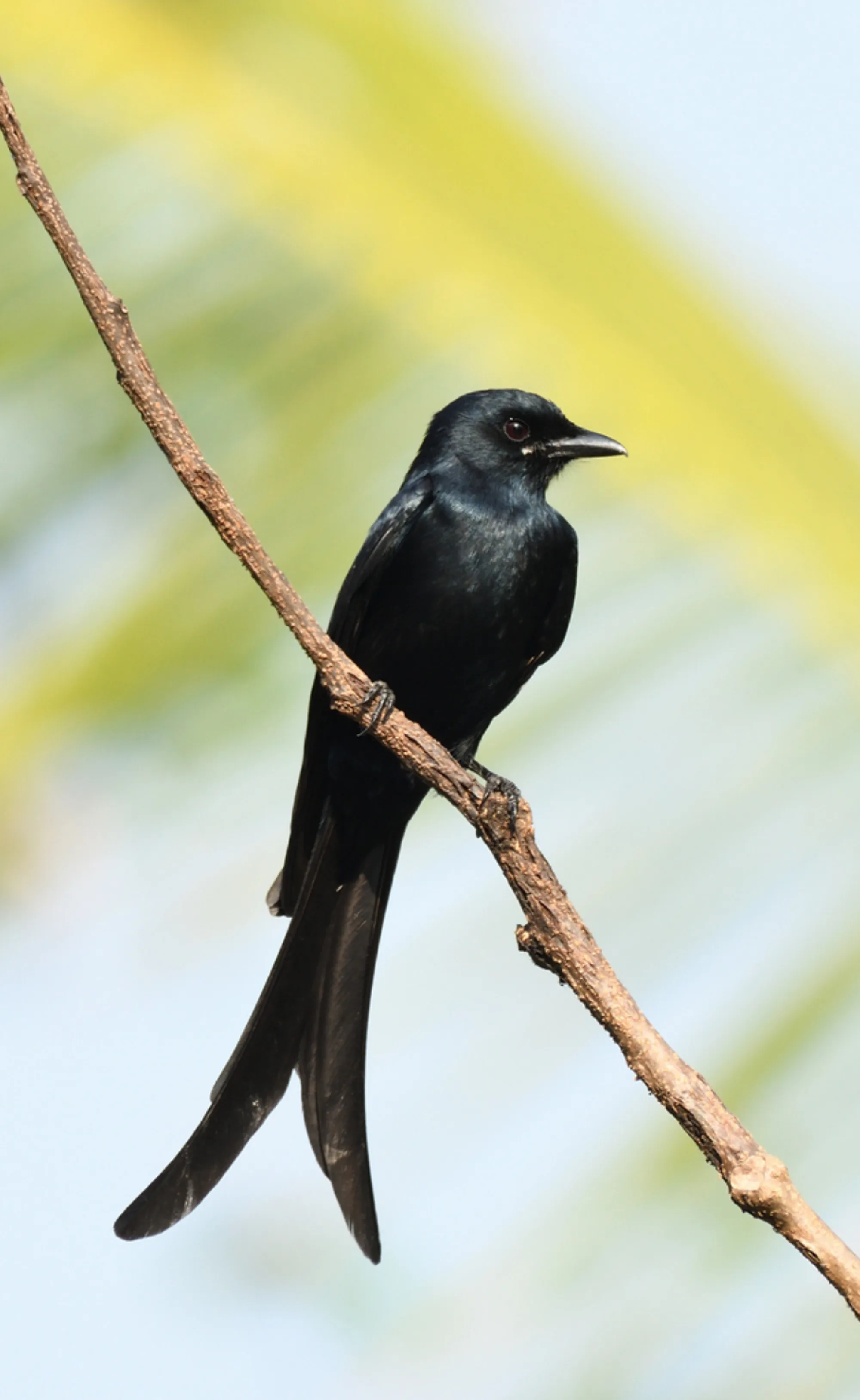
Black Drongo
Dicrurus macrocercus
Glossy black plumage and a deeply forked tail make the Black Drongo a distinctive sight in open country. This small Asian bird measures 28 cm long and often sits upright on a bare perch, thorny bush or electricity wire. It may also perch on grazing animals, and its common two-note call sounds like that of the shikra. Young birds are brownish and can show white markings on the belly.
Across tropical southern Asia, its range extends from southwest Iran through the Indian subcontinent to southern China and Indonesia. It lives in open farmland, light forest, savanna, fields and urban areas, usually hunting close to the ground. Some populations move with the seasons, while birds in Korea are known to migrate. Active early at dawn and late to roost, drongos catch flying insects with quick manoeuvres or pick prey from vegetation and the ground. Grasshoppers, cicadas, termites and beetles are among their foods, and birds gather at ploughed fields to take exposed caterpillars and grubs. They also visit scrub and grassland fires, where insects are disturbed.
During the breeding season, both sexes sing in the morning and build a shallow cup of sticks in a branch fork. Both parents incubate the eggs, which hatch after 14 to 15 days, and continue to feed and protect the young after they leave the nest. A nesting drongo will attack much larger intruders, including crows and birds of prey, and smaller birds sometimes nest nearby. Shortages of insect food, which depend on rainfall, are a major cause of fledgling deaths; nests can also be parasitised by Asian koels. No predators or diseases are described as significant causes of adult mortality.
Written from the English Wikipedia article Black drongo (CC BY-SA 4.0).
- Records
- 909,210
- Countries
- 27
- Atlas places
- 15
- Baluran National Park· Indonesia
- Kanha National Park· India
- Bandipur National Park· India
- Ranthambore National Park· India
- West Bali National Park· Indonesia
- Annapurna Conservation Area· Nepal
- Chitwan National Park· Nepal
- Jim Corbett National Park· India
- Kaziranga National Park· India
- Koshi Tappu Wildlife Reserve· Nepal
- Langtang National Park· Nepal
- Pench National Park· India
- Sundarbans National Park· India
- Tadoba Andhari Tiger Reserve· India
- Wilpattu National Park· Sri Lanka
These are open occurrence records, so they show where people looked for and recorded the Black Drongo as much as where it lives. Cells are up to 25 km across, and every location is generalised to its cell.
Generalised encounter areas, not exact locations. Each shape is a grid cell coloured by how likely the species is there.
- Very likelyIndia25 km zone · high confidence · 569039 records · updated 86 days ago
- Very likelyTaiwan25 km zone · high confidence · 284106 records · updated 86 days ago
- Very likelyBangladesh25 km zone · high confidence · 9644 records · updated 86 days ago
- Very likelyHong Kong SAR China25 km zone · high confidence · 9265 records · updated 86 days ago
- Very likelyNepal25 km zone · high confidence · 9078 records · updated 86 days ago
- Very likelyThailand25 km zone · high confidence · 8418 records · updated 86 days ago
- Very likelyCambodia25 km zone · high confidence · 3717 records · updated today
- Very likelyChina25 km zone · high confidence · 2869 records · updated today
- Very likelyPakistan25 km zone · high confidence · 2137 records · updated 86 days ago
- Very likelySri Lanka25 km zone · high confidence · 1437 records · updated today
Conservation status not assessed here yet, so every location is generalised to its grid cell.