Bass
Dicentrarchus labrax
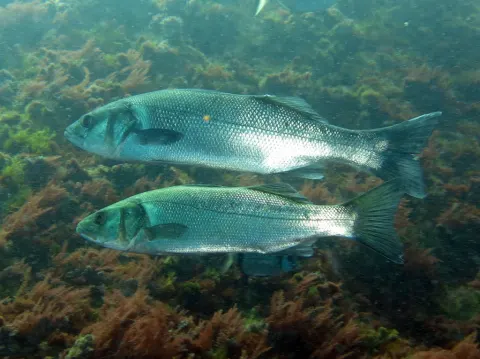
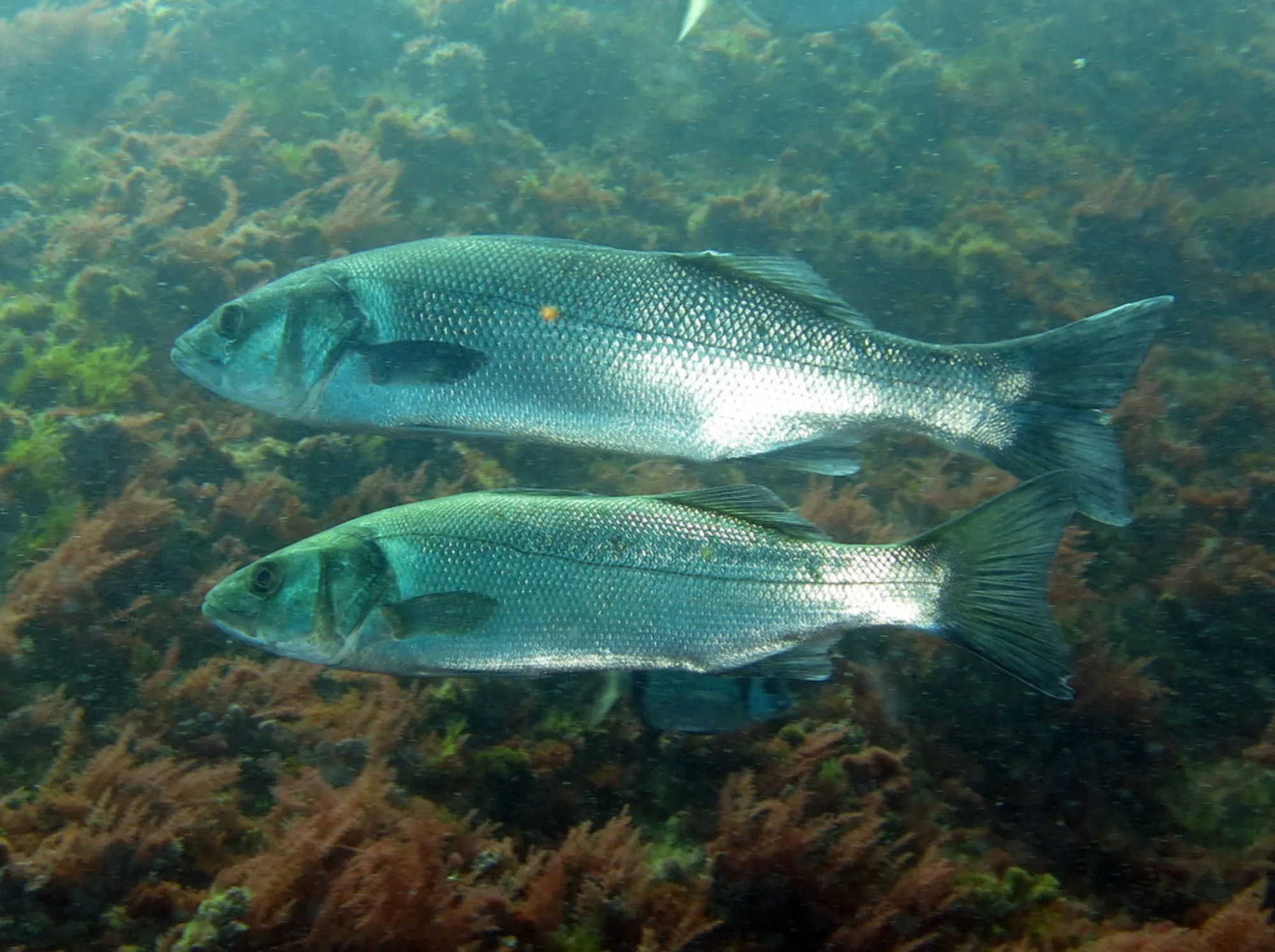
Silvery grey, sometimes with a dark blue tinge along its back, the Bass is an ocean-going fish also known as European seabass and branzino. It commonly reaches about 0.5 m in length, although individuals can grow to 1 m and weigh as much as 12 kg. Adults usually weigh around 2.5 kg, and the species grows slowly, taking several years to reach adulthood.
Its range stretches through much of the eastern Atlantic, from southern Norway to Senegal, and includes the Mediterranean and southern Black Sea. It uses a variety of habitats, including coastal waters, rivers, lagoons and estuaries, and can enter shallow coastal waters and river mouths in summer and late autumn. In summer, fish are generally found near river banks, lagoons and estuaries, then move offshore for winter. There are two genetically distinct wild populations, one in the northeast Atlantic and the other in the western Mediterranean.
Young Bass gather in schools and eat invertebrates, while adults are less social and favour other fish. They hunt by day and night, taking small fish, squid, crustaceans and polychaetes; fish weighing more than 4 kg hunt mostly at night. Spawning takes place from February to June, mainly in inshore waters, and the young move into estuaries as they develop, remaining there for a year or two. Commercial fishing has placed increasing pressure on the species, and a scientific advisory reported rising fishing mortality and a decline in total biomass since 2005.
Written from the English Wikipedia article European seabass (CC BY-SA 4.0).
- Records
- 15,604
- Countries
- 16
No atlas park has a record of the Bass in or around it yet.
These are open occurrence records, so they show where people looked for and recorded the Bass as much as where it lives. Cells are up to 25 km across, and every location is generalised to its cell.
Generalised encounter areas, not exact locations. Each shape is a grid cell coloured by how likely the species is there.
- Very likelyNetherlands25 km zone · medium confidence · 6094 records · updated 80 days ago
- Very likelyFrance25 km zone · medium confidence · 4924 records · updated 80 days ago
- Very likelyBelgium25 km zone · high confidence · 3220 records · updated 80 days ago
- Very likelyUnited Kingdom25 km zone · medium confidence · 719 records · updated 80 days ago
- Very likelySpain25 km zone · high confidence · 268 records · updated 80 days ago
- Very likelyCroatia25 km zone · high confidence · 123 records · updated 80 days ago
- Very likelyTürkiye25 km zone · medium confidence · 112 records · updated 80 days ago
- Very likelyMauritania25 km zone · medium confidence · 40 records · updated 80 days ago
- Very likelyGreece25 km zone · medium confidence · 39 records · updated 80 days ago
- LikelySweden25 km zone · medium confidence · 20 records · updated 80 days ago
Conservation status not assessed here yet, so every location is generalised to its grid cell.