Ringneck Snake
Diadophis punctatus
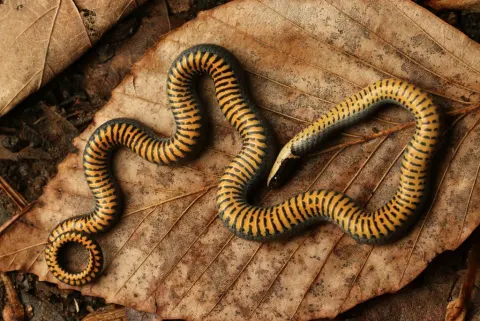
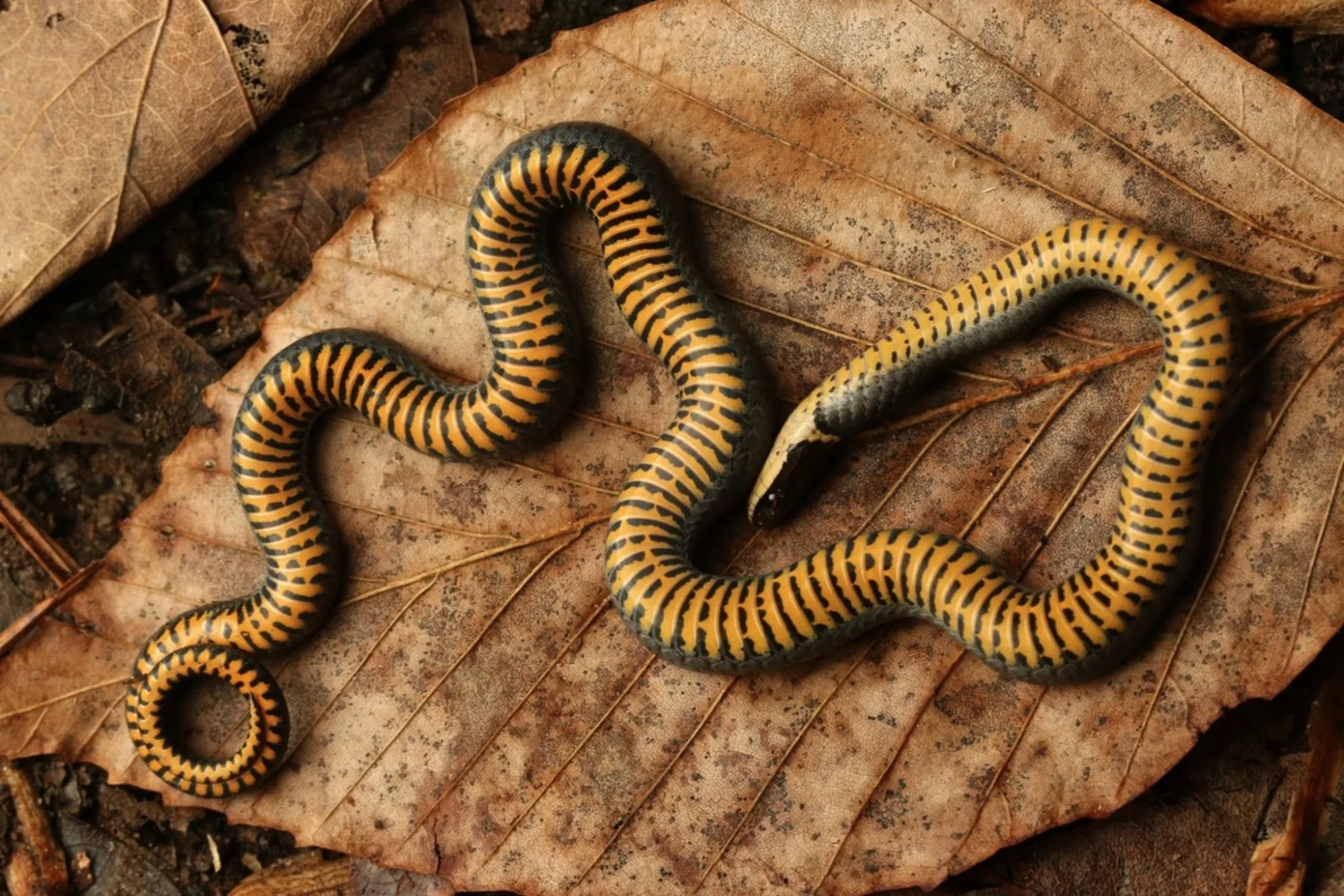
A flash of colour beneath the tail can reveal a Ringneck Snake, a small, harmless snake that usually stays out of sight. Its smooth back ranges from olive or brown to bluish-grey or smoky black, typically with a yellow, red or yellow-orange band around the neck. The underside ranges from yellow-orange to red, often with black spots along its edges. Some snakes have faint, incomplete or missing neck bands, and a few lack the distinctive underside colour. Adults typically measure 25 to 38 cm, although the regal subspecies can reach 38 to 46 cm.
The species ranges across much of the United States, reaching southeastern Canada and central Mexico. It occupies many habitats, favouring places with plenty of cover and sites for dens. In northern and western areas, look for suitable habitat in open woodland near rocky slopes, wetter places with woody debris, mixed forest and shrub steppe. Southern snakes live mainly near water and in wet habitats, especially in drier regions. Moist soil is preferred, and snakes may shelter beneath wood, rocks or other cover.
Secretive and mostly active at night or around twilight, they are occasionally seen by day, particularly when clouds are present. They eat mainly small salamanders, earthworms and slugs, but may also take lizards, frogs and young snakes of other species. When threatened, a snake coils its tail and displays its bright underside. Females lay three to ten eggs in loose soil beneath a rock or inside a rotting log, with hatchlings emerging in August or September. In the Florida Keys, rising seas, storm surges and flooding threaten island habitat and the availability of the small prey on which the local snakes depend.
Written from the English Wikipedia article Ring-necked snake (CC BY-SA 4.0).
- Records
- 2,127
- Countries
- 2
- Atlas places
- 2
These are open occurrence records, so they show where people looked for and recorded the Ringneck Snake as much as where it lives. Cells are up to 25 km across, and every location is generalised to its cell.
Generalised encounter areas, not exact locations. Each shape is a grid cell coloured by how likely the species is there.
- Very likelyUnited States25 km zone · medium confidence · 2093 records · updated 80 days ago
- Very likelyCanada25 km zone · medium confidence · 34 records · updated 80 days ago
Conservation status not assessed here yet, so every location is generalised to its grid cell.