Leatherback
Dermochelys coriacea
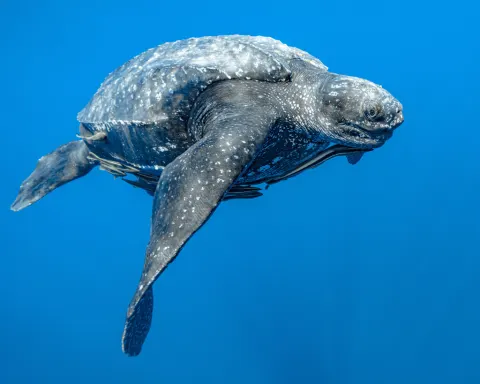
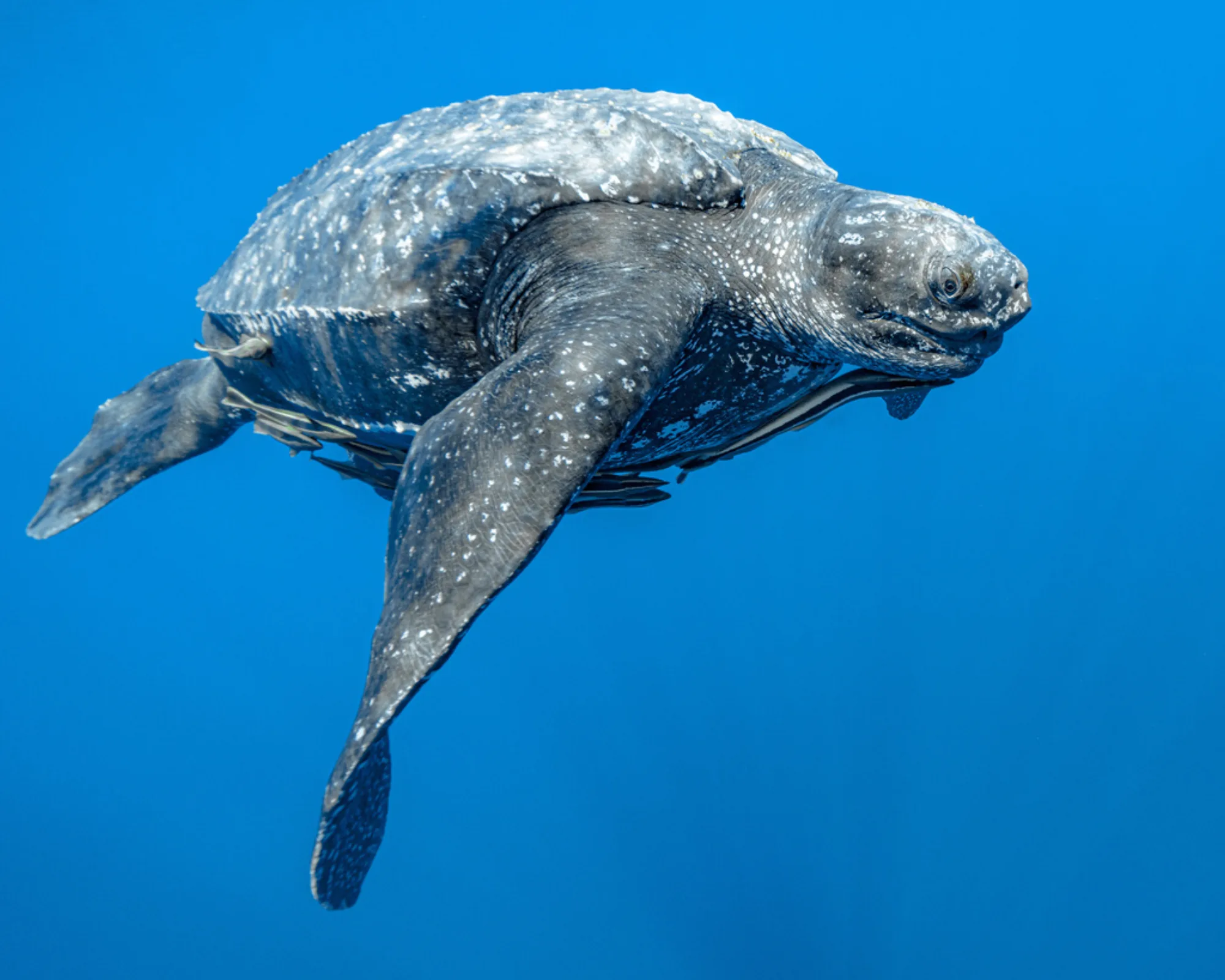
A giant among sea turtles, the Leatherback (Dermochelys coriacea) can reach 2.7 metres in length and weigh 500 kilograms. Its back has seven ridges and a covering of flexible, leather-like skin instead of a bony shell. Dark grey to black above, it has white-pink speckles and a pale underside. Large front flippers propel its teardrop-shaped body through the water.
Leatherbacks range through tropical and subtropical oceans and into colder waters, from Alaska and Norway south to Cape Agulhas and the southern tip of New Zealand. They spend most of their lives in the open ocean, travelling long distances between feeding grounds and nesting beaches. Adults eat mainly jellyfish, following them into deeper water by day and shallower water at night. A leatherback has been recorded diving to 1,280 m, although dives typically last between 3 and 8 minutes. Females come ashore at night to nest on sandy beaches, digging above the high-tide line and covering their eggs with sand. The eggs hatch after about 60 to 70 days, and the young emerge after dark and head for the sea.
The journey is hazardous: birds, mammals and other predators take eggs, while hatchlings face predators on the beach and in the water. People harvest eggs, and turtles can be caught accidentally in fishing gear or tangled in lobster pot ropes. Floating plastic bags can be mistaken for jellyfish and may cause fatal blockages. Artificial lights near nesting beaches can also draw hatchlings away from the sea.
Written from the English Wikipedia article Leatherback sea turtle (CC BY-SA 4.0).
- Records
- 2,392
- Countries
- 20
- Atlas places
- 3
These are open occurrence records, so they show where people looked for and recorded the Leatherback as much as where it lives. Cells are up to 25 km across, and every location is generalised to its cell.
Generalised encounter areas, not exact locations. Each shape is a grid cell coloured by how likely the species is there.
- Very likelyFrance25 km zone · medium confidence · 1084 records · updated 80 days ago
- Very likelyUnited States25 km zone · medium confidence · 458 records · updated 80 days ago
- Very likelyAustralia25 km zone · medium confidence · 247 records · updated 80 days ago
- Very likelySuriname25 km zone · high confidence · 142 records · updated 80 days ago
- Very likelyPeru25 km zone · high confidence · 114 records · updated 80 days ago
- Very likelyMexico25 km zone · medium confidence · 55 records · updated 80 days ago
- Very likelyIreland25 km zone · medium confidence · 45 records · updated 80 days ago
- Very likelyTrinidad & Tobago25 km zone · medium confidence · 31 records · updated 80 days ago
- Very likelyUnited Kingdom25 km zone · medium confidence · 23 records · updated 80 days ago
- Very likelyBenin25 km zone · medium confidence · 20 records · updated 80 days ago
Conservation status not assessed here yet, so every location is generalised to its grid cell.