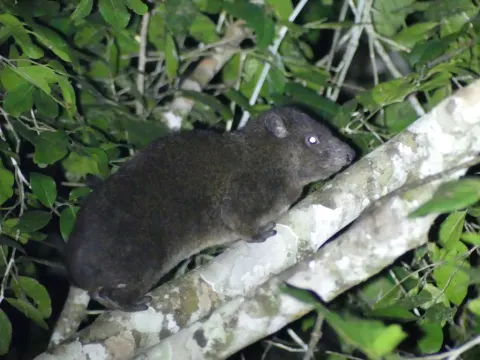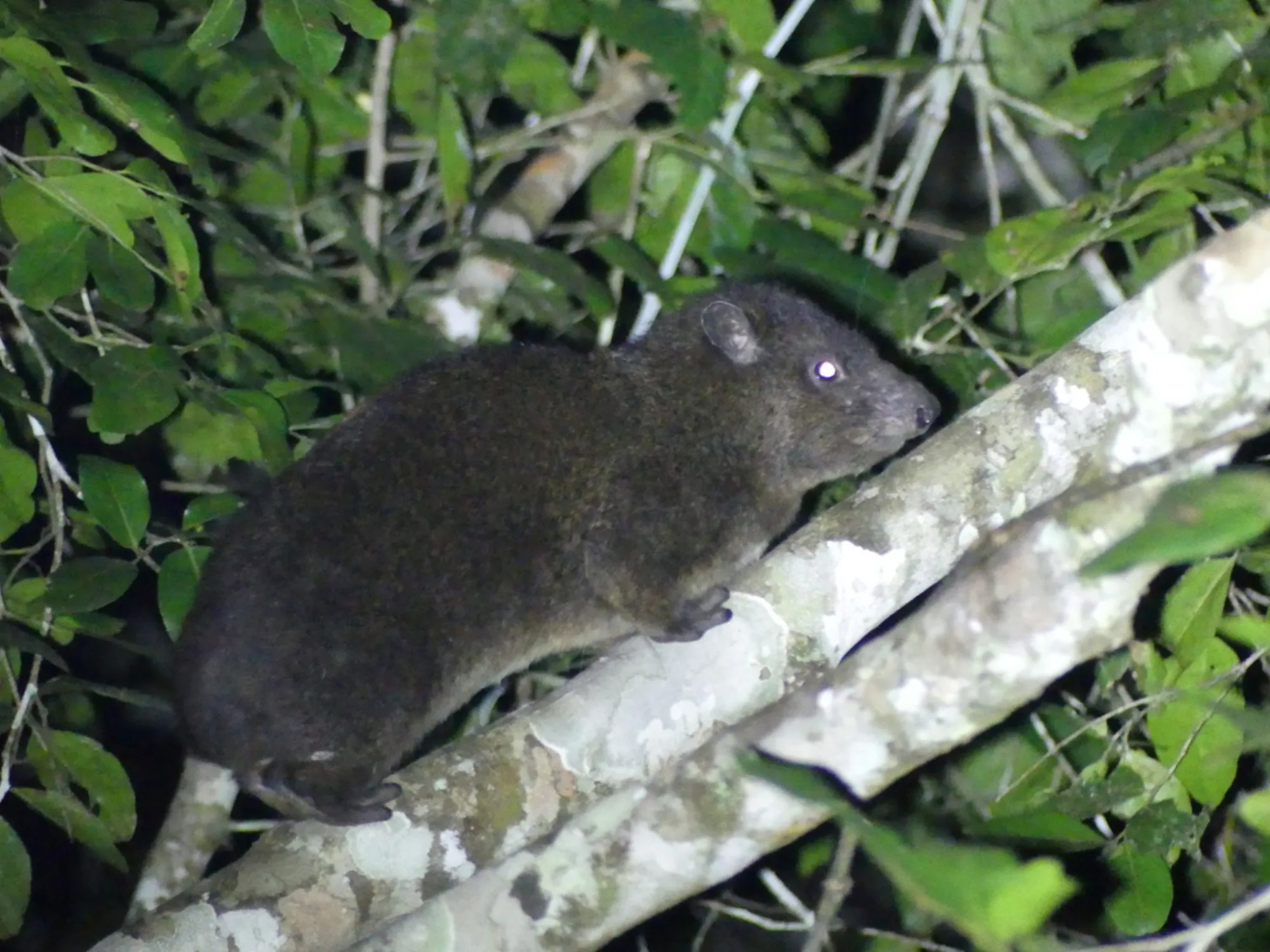
Eastern Tree Hyrax
Dendrohyrax validus
Resembling a rotund guinea pig, the Eastern Tree Hyrax is a small mammal with soft, dense fur and no visible tail. Its coat ranges from blackish to cinnamon brown, featuring a light-colored patch of hair that marks a scent gland on its back. While it is similar to the southern tree hyrax, this species has a longer, well-haired snout and a less grizzled appearance. These animals weigh around 2.75 kilograms and reach a length of 470 to 558 millimetres.
Travellers can find these creatures in a narrow, patchy band of forests in Kenya and Tanzania, as well as on the islands of Pemba and Zanzibar. They are most common at lower elevations but live as high as 3,070 metres on Mt. Kilimanjaro. Though they usually live in tree holes within montane and lowland forests, some populations are flexible enough to inhabit rocky boulders, mountain sides, and caves. They are skilled climbers that spend their time in the canopy feeding on tree leaves, though they avoid the exotic trees found in plantations.
Except for mothers with a single young, these animals are solitary. They are famous for being one of the few species capable of singing, using high energy calls to communicate. This vocal activity is most frequent during February and June. Large piles of waste, known as middens, often mark the ground near their roosting sites. Survival is difficult for this hyrax due to hunting and the loss of forest habitat. They are also frequently killed by dogs or hunted by natural predators like leopards, pythons, and crowned eagles.
Written from the English Wikipedia article Eastern tree hyrax (CC BY-SA 4.0).
- Records
- 0
- Countries
- 1
- Atlas places
- 3
These are open occurrence records, so they show where people looked for and recorded the Eastern Tree Hyrax as much as where it lives. Cells are up to 25 km across, and every location is generalised to its cell.
Generalised encounter areas, not exact locations. Each shape is a grid cell coloured by how likely the species is there.
- Very likelyTanzania25 km zone · low confidence · 0 records · updated 1 day ago
Conservation status not assessed here yet, so every location is generalised to its grid cell.