Great Spotted Woodpecker
Dendrocopos major
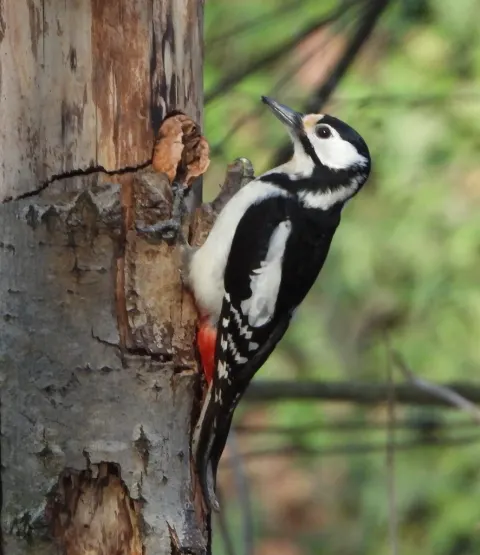
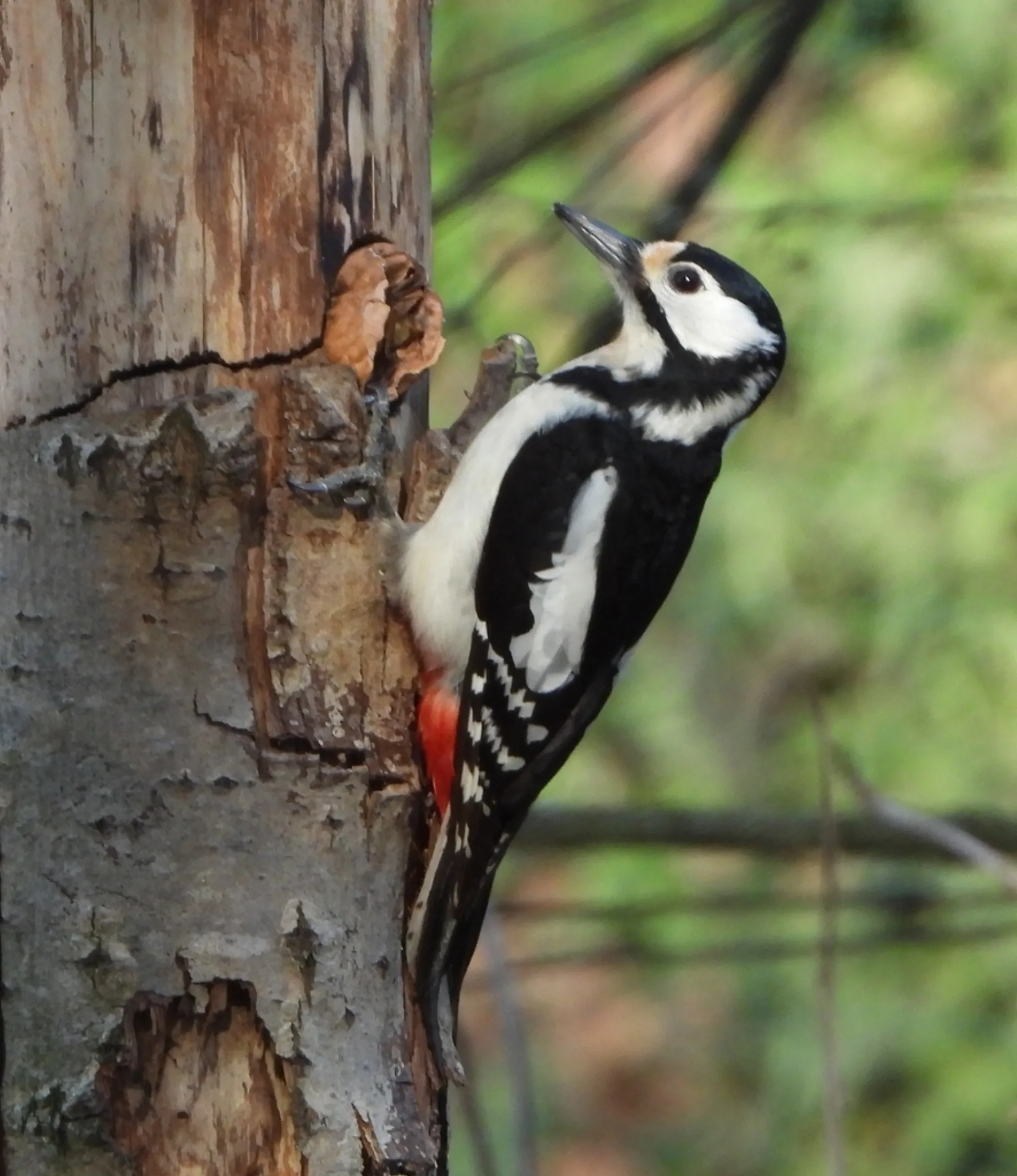
Look for a black and white woodpecker with a large white shoulder patch and a scarlet lower belly. The Great Spotted Woodpecker measures 20 to 24 cm in length, and adults have glossy blue-black upperparts. Males have a crimson patch on the back of the neck, while young birds have red crowns and duller, less clearly defined markings. A sharp kik call can give away its presence, as can rapid drumming on dead trees and branches.
Its range stretches from Ireland to Japan and from Morocco to Tunisia in North Africa. It uses broadleaf, coniferous and mixed woodland, as well as parks, gardens and olive groves. Most stay in their range year-round, although shortages of pine and spruce cones can prompt movements in the north, and highland birds often move downhill in winter. Often seen climbing tree trunks, it feeds at every level of a tree and usually forages alone. It chisels into wood for beetle larvae, takes ants and spiders, and eats nuts, seeds, buds and berries. It may also raid other birds' nests for eggs and chicks, or wedge cones against an anvil to hammer them open.
A pair excavates a fresh nest hole, usually in a living or dead tree, and both adults incubate the typical clutch of four to six white eggs. Both feed the chicks and clean the nest; once the young fledge, each adult feeds some of them for roughly ten days. There are no widespread threats, but harsh winters and fragmented woodland can cause local difficulties. On Tenerife and Gran Canaria, exploitation of local pine forests is a potential threat.
Written from the English Wikipedia article Great spotted woodpecker (CC BY-SA 4.0).
- Records
- 856,341
- Countries
- 65
No atlas park has a record of the Great Spotted Woodpecker in or around it yet.
These are open occurrence records, so they show where people looked for and recorded the Great Spotted Woodpecker as much as where it lives. Cells are up to 25 km across, and every location is generalised to its cell.
Generalised encounter areas, not exact locations. Each shape is a grid cell coloured by how likely the species is there.
- Very likelyUnited Kingdom25 km zone · high confidence · 170714 records · updated 86 days ago
- Very likelyNorway25 km zone · high confidence · 153438 records · updated 86 days ago
- Very likelyBelgium25 km zone · high confidence · 135231 records · updated 86 days ago
- Very likelyFrance25 km zone · high confidence · 85447 records · updated 86 days ago
- Very likelyFinland25 km zone · high confidence · 48928 records · updated 86 days ago
- Very likelySpain25 km zone · high confidence · 33252 records · updated 86 days ago
- Very likelyGermany25 km zone · high confidence · 31416 records · updated 86 days ago
- Very likelyCzechia25 km zone · high confidence · 30650 records · updated 86 days ago
- Very likelyNetherlands25 km zone · high confidence · 22300 records · updated 86 days ago
- Very likelySwitzerland25 km zone · high confidence · 12883 records · updated 86 days ago
Conservation status not assessed here yet, so every location is generalised to its grid cell.