Black Mamba
Dendroaspis polylepis
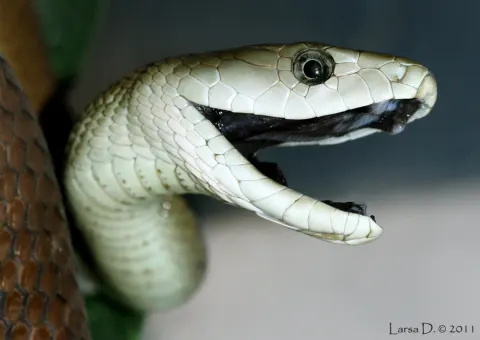
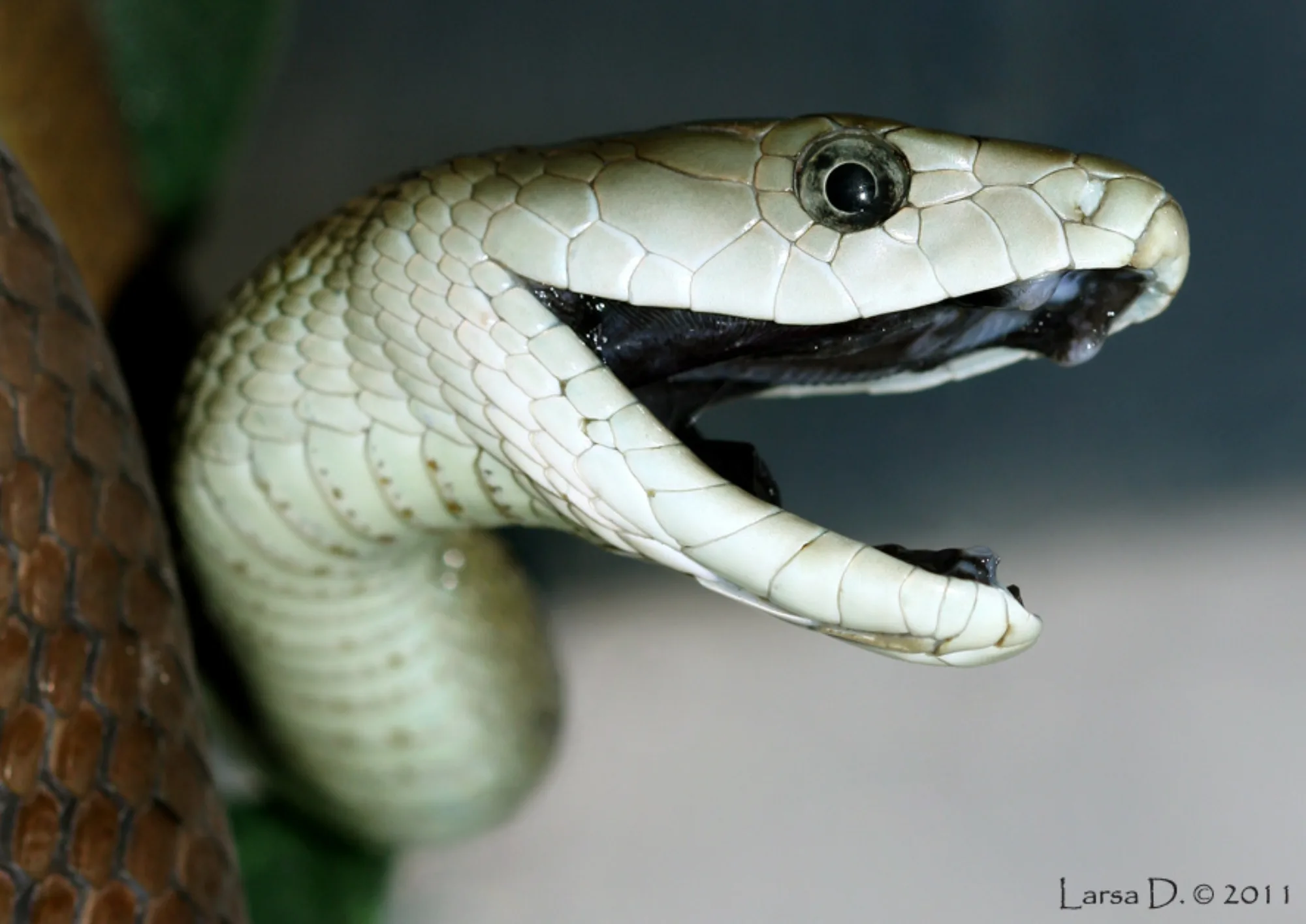
Long and slender, the Black Mamba is a highly venomous snake whose adults typically measure 2 to 3 m. Its colour ranges from olive and yellowish-brown to khaki or gunmetal, while younger snakes are usually paler and darken as they age. The name refers to the dark inside of its mouth, which it may show when threatened.
Across its wide range in sub-Saharan Africa, the snake favours moderately dry places, including scrub, open woodland, rocky ground and semi-arid savanna. It also occurs in moist savanna and lowland forest, spending time both on the ground and in trees. Active by day, it may shelter in abandoned burrows, termite mounds, rock crevices or cracks in trees, and can return to the same basking site each day. It usually hunts from a permanent lair, taking birds and small mammals, including rodents and squirrels. After biting prey, it generally releases it and waits for paralysis and death before swallowing it. Breeding runs from September to February, and females lay clutches of 6 to 17 eggs.
A Black Mamba will generally retreat into brush or a hole when it senses danger, and attacks people only when threatened or cornered. If confronted, it may open its dark mouth, spread its neck and hiss; sudden movement can provoke rapid strikes. Symptoms of its venom can appear in ten minutes, and a bite is often fatal without antivenom. Adults have few natural predators, although several eagles hunt or eat them, while young snakes are taken by birds and other snakes. Mongooses sometimes harass or prey on black mambas, even pursuing them in trees.
Written from the English Wikipedia article Black mamba (CC BY-SA 4.0).
- Records
- 28
- Countries
- 3
- Atlas places
- 2
These are open occurrence records, so they show where people looked for and recorded the Black Mamba as much as where it lives. Cells are up to 25 km across, and every location is generalised to its cell.
Generalised encounter areas, not exact locations. Each shape is a grid cell coloured by how likely the species is there.
- Very likelySouth Africa25 km zone · medium confidence · 23 records · updated 80 days ago
- Very likelyEswatini25 km zone · medium confidence · 5 records · updated 80 days ago
- RareCentral African Republic25 km zone · low confidence · 0 records · updated 80 days ago
Conservation status not assessed here yet, so every location is generalised to its grid cell.