Green Mamba
Dendroaspis angusticeps
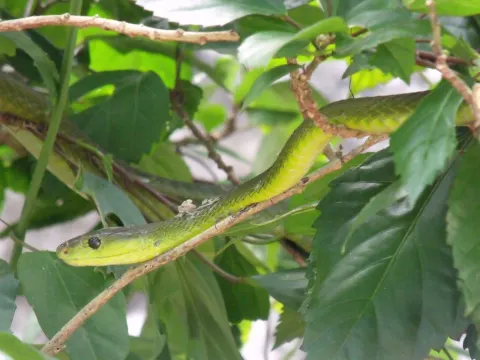
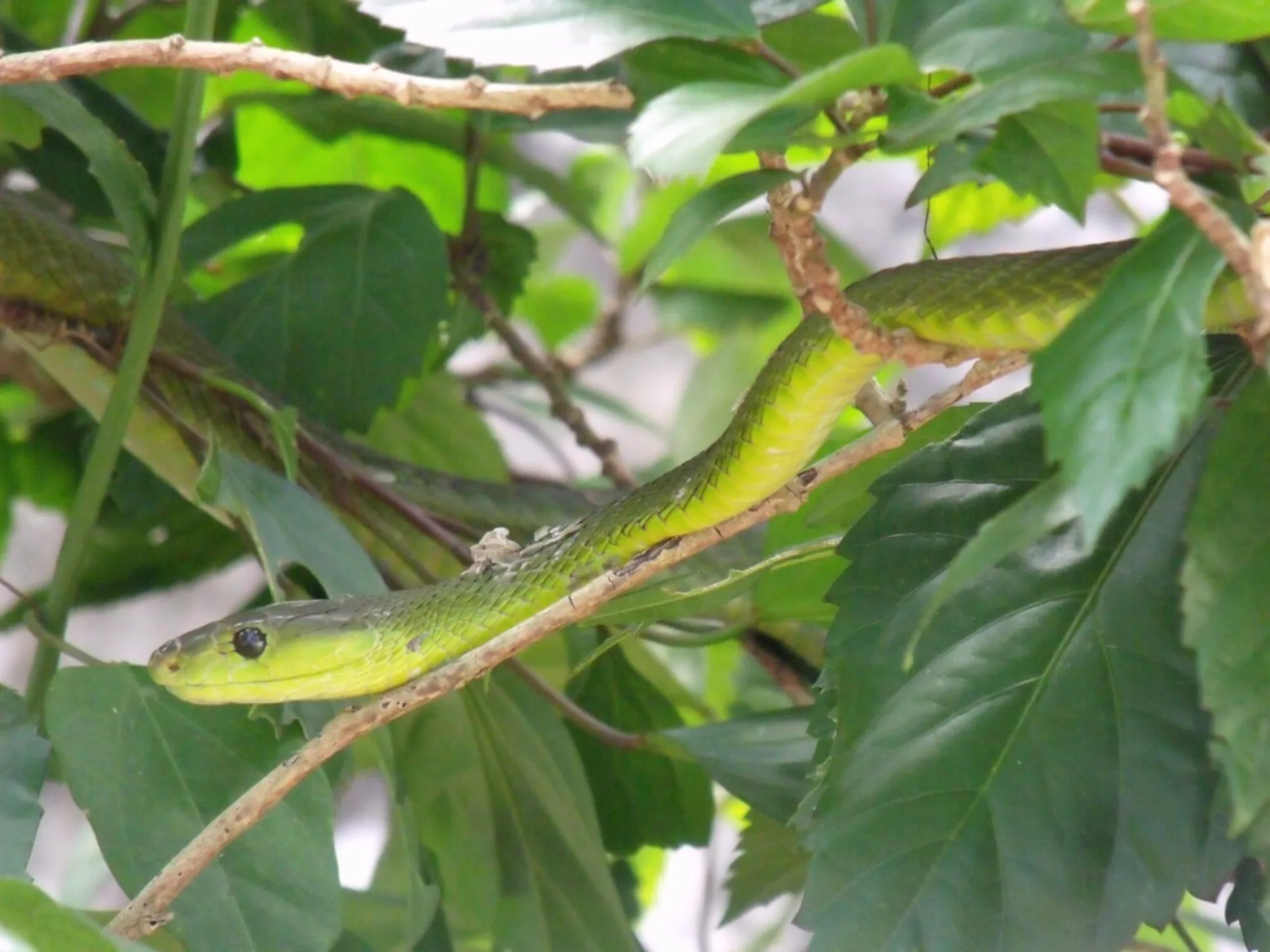
Slender and bright green, the Green Mamba is a highly venomous snake that spends much of its life among trees. Adults have green upperparts and a pale yellow-green belly, while juveniles are blue-green. Females average around 2 metres in length, with males slightly smaller. Shy and elusive, it is rarely seen, its colouring helping it blend into foliage.
Its range includes Kenya, Tanzania and Malawi, as well as eastern Zimbabwe, parts of Zambia, Zanzibar and northern Mozambique. A separate population lives along the KwaZulu-Natal coast, extending into southern Mozambique and the northeastern edge of South Africa's Eastern Cape. It favours dense, shaded vegetation and is found in forests, thickets and farm trees, including mango and coconut. In coastal East Africa it can enter houses and shelter in thatched roofs.
Active by day, the snake usually sleeps coiled in foliage and only occasionally comes to the ground, sometimes to bask in the morning sun. It can stay in one place for days and has been observed waiting to ambush prey, although it also hunts actively. Its food includes birds, eggs, bats and small mammals, and it raids nests for young birds. Generally solitary, it breeds in the rainy season; females lay 4 to 17 eggs, usually in leaf litter inside hollow trees. Humans, mongooses, snake eagles and genets prey on it, while hornbills and other snakes take juveniles. Habitat destruction and deforestation may threaten the species, and coastal housing development has fragmented its habitat in South Africa.
Written from the English Wikipedia article Eastern green mamba (CC BY-SA 4.0).
- Records
- 26
- Countries
- 2
- Atlas places
- 6
These are open occurrence records, so they show where people looked for and recorded the Green Mamba as much as where it lives. Cells are up to 25 km across, and every location is generalised to its cell.
Generalised encounter areas, not exact locations. Each shape is a grid cell coloured by how likely the species is there.
- Very likelySouth Africa25 km zone · medium confidence · 17 records · updated 80 days ago
- Very likelyTanzania25 km zone · medium confidence · 9 records · updated 80 days ago
Conservation status not assessed here yet, so every location is generalised to its grid cell.