Common Tree Snake
Dendrelaphis punctulatus
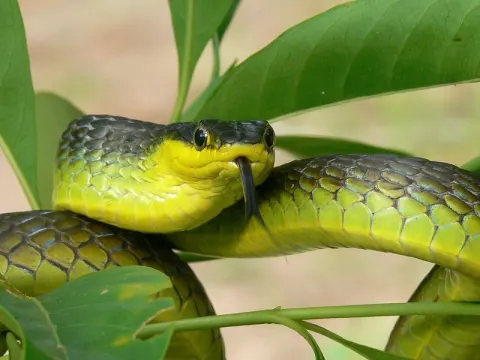
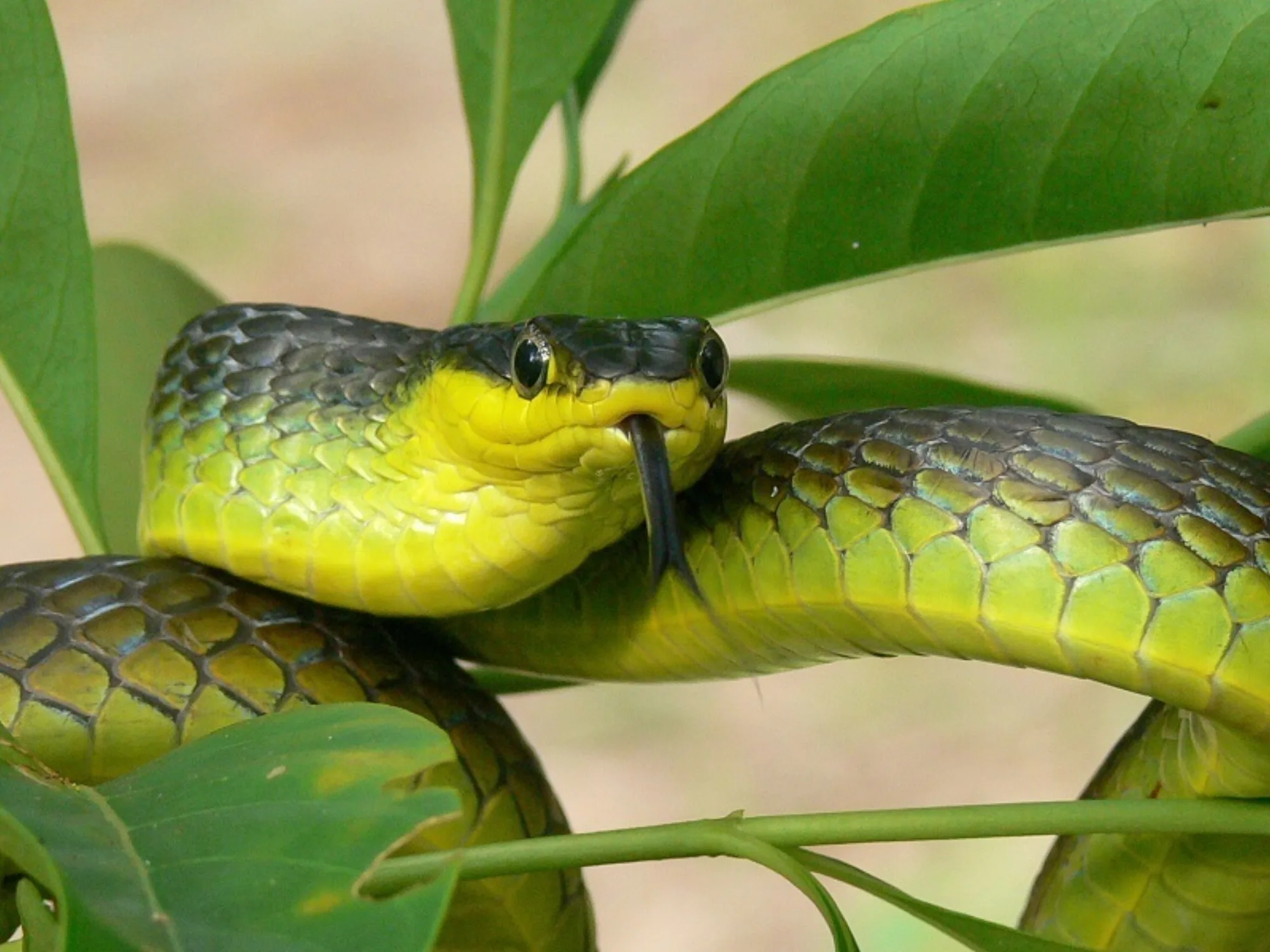
Slender, agile and large-eyed, the Common Tree Snake is a non-venomous snake that is active by day. Its back is usually dark, while its underside can be golden yellow, bright green, olive-green, black or sometimes blue. The throat and belly are often pale yellow, and blue flecks mark the flanks. Its large eyes usually have golden irises and round pupils. In a Queensland study, females averaged 1.01 metres in length from snout to vent, while males averaged 0.93 metres.
The snake lives across northern and eastern Australia and also occurs in Papua New Guinea. Its Australian range includes the Kimberley, Cape York, Torres Strait and the east coast into New South Wales. It occupies habitats from rainforest and woodland to urban areas, as well as bushland, eucalypt forest and heathland. It also favours vegetated riverbanks and other waterside places where tall grass grows among trees. In the Darwin region, public callouts indicate a peak of activity during the northern dry season, from May to July.
Near water, it may hide in long grass and watch for prey on nearby rocks or banks. A strong swimmer, it uses water both to hunt and to escape predators. Frogs, water skinks, small reptiles and their eggs make up much of its diet, alongside prey such as fish, mammals and turtle hatchlings. At night it rests in trees, logs, foliage or rock crevices, and females lay 5 to 12 elongated eggs per clutch. When threatened, it generally escapes quickly, although it may inflate its body and neck, produce an odour or bite in defence.
Written from the English Wikipedia article Dendrelaphis punctulatus (CC BY-SA 4.0).
- Records
- 8,985
- Countries
- 2
- Atlas places
- 5
These are open occurrence records, so they show where people looked for and recorded the Common Tree Snake as much as where it lives. Cells are up to 25 km across, and every location is generalised to its cell.
Generalised encounter areas, not exact locations. Each shape is a grid cell coloured by how likely the species is there.
- Very likelyAustralia25 km zone · high confidence · 8965 records · updated 80 days ago
- LikelyPapua New Guinea25 km zone · medium confidence · 20 records · updated 80 days ago
Conservation status not assessed here yet, so every location is generalised to its grid cell.