Common Dolphin
Delphinus delphis
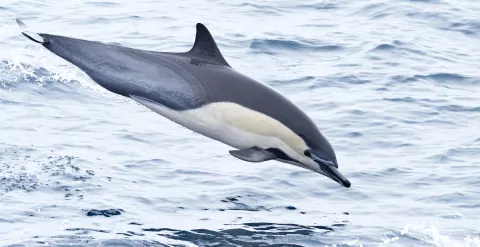
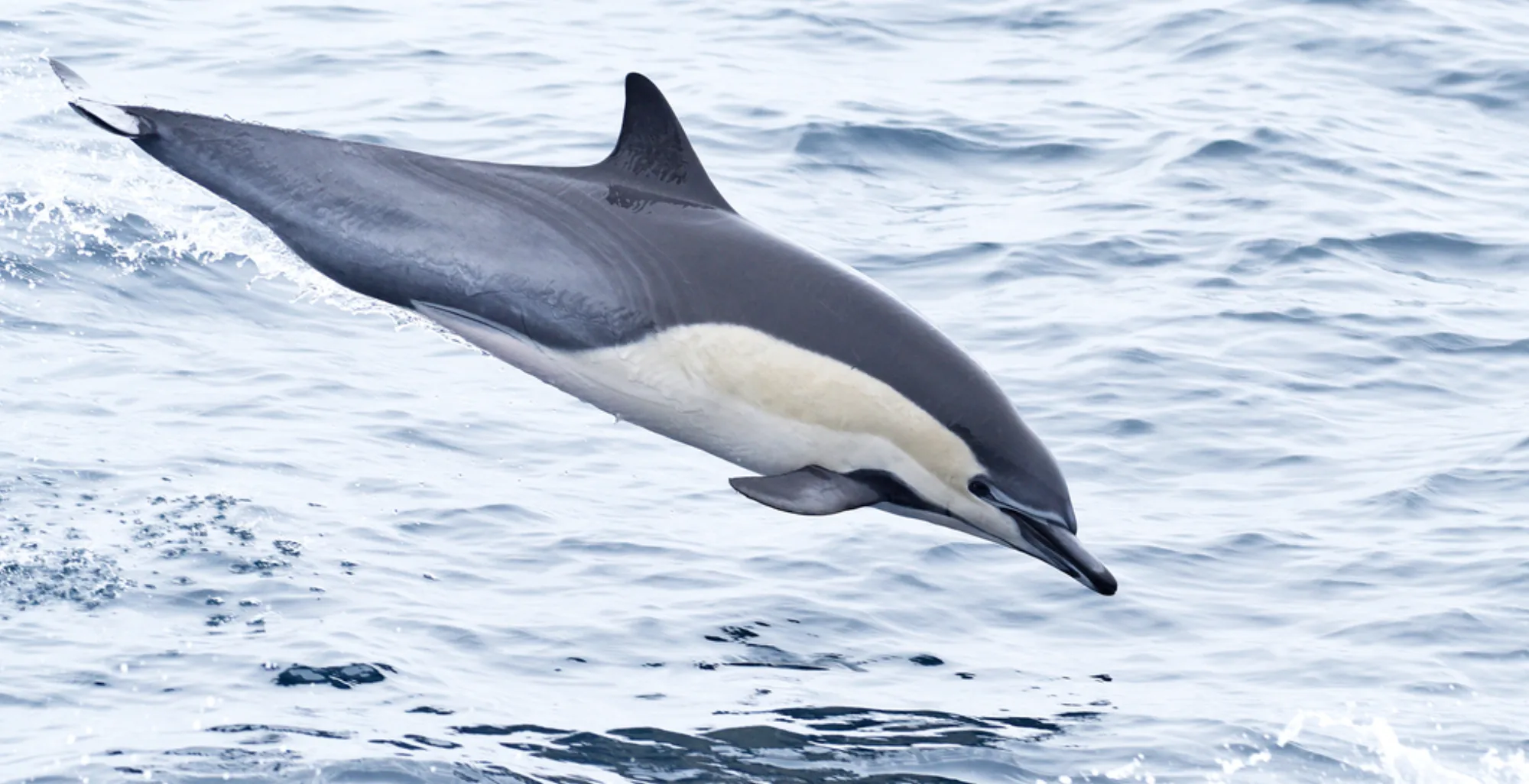
Look for a dark back, white belly and a distinctive hourglass pattern along each side: pale grey, yellow or gold towards the front, and grey behind. The Common Dolphin is medium-sized, with a long, slender beak; adults measure 1.9 to 2.5 m. It lives in warm-temperate and tropical seas around the world, both near the coast and offshore. Long-beaked dolphins mostly use shallow, warm coastal waters, while short-beaked dolphins often gather near shelf edges and underwater features such as seamounts. Places to encounter them include the California coast, the Mediterranean and the waters around New Zealand and southern Australia.
Common dolphins often travel in groups of several hundred, and groups sometimes join to form much larger gatherings. They are fast swimmers, often leaping clear of the water, and have been seen riding the bow waves of boats and baleen whales. Their diet includes many kinds of fish and squid, and they can dive to 200 metres. Groups may include females with calves, all-male parties or a mixture of adults and young. In short-beaked dolphins, pregnancy lasts 10 to 11 months; newborns measure 70 to 100 centimetres.
Accidental capture in fishing gear is the main threat described for common dolphins, with animals caught in trawler nets, drift nets and gillnets. Some populations have also been hunted off Peru for food and shark bait. Metal pollutants have been measured in some populations and are thought to harm dolphin health. In the western Mediterranean, sightings have declined rapidly since the 1960s, although the reasons are not well understood.
Written from the English Wikipedia article Common dolphin (CC BY-SA 4.0).
- Records
- 15,402
- Countries
- 14
- Atlas places
- 1
These are open occurrence records, so they show where people looked for and recorded the Common Dolphin as much as where it lives. Cells are up to 25 km across, and every location is generalised to its cell.
Generalised encounter areas, not exact locations. Each shape is a grid cell coloured by how likely the species is there.
- Very likelyUnited States25 km zone · high confidence · 6136 records · updated 80 days ago
- Very likelyFrance25 km zone · high confidence · 5290 records · updated 80 days ago
- Very likelyAustralia25 km zone · medium confidence · 1970 records · updated 80 days ago
- Very likelyPortugal25 km zone · medium confidence · 801 records · updated 80 days ago
- Very likelyUnited Kingdom25 km zone · medium confidence · 383 records · updated 80 days ago
- Very likelyCanada25 km zone · high confidence · 290 records · updated 80 days ago
- Very likelyNorway25 km zone · medium confidence · 161 records · updated 80 days ago
- Very likelyMexico25 km zone · medium confidence · 95 records · updated 80 days ago
- Very likelyIreland25 km zone · medium confidence · 87 records · updated 80 days ago
- Very likelyTaiwan25 km zone · high confidence · 62 records · updated 80 days ago
Conservation status not assessed here yet, so every location is generalised to its grid cell.