Beluga
Delphinapterus leucas
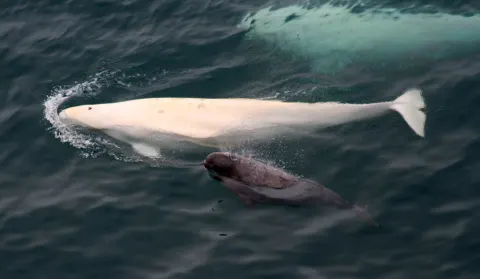
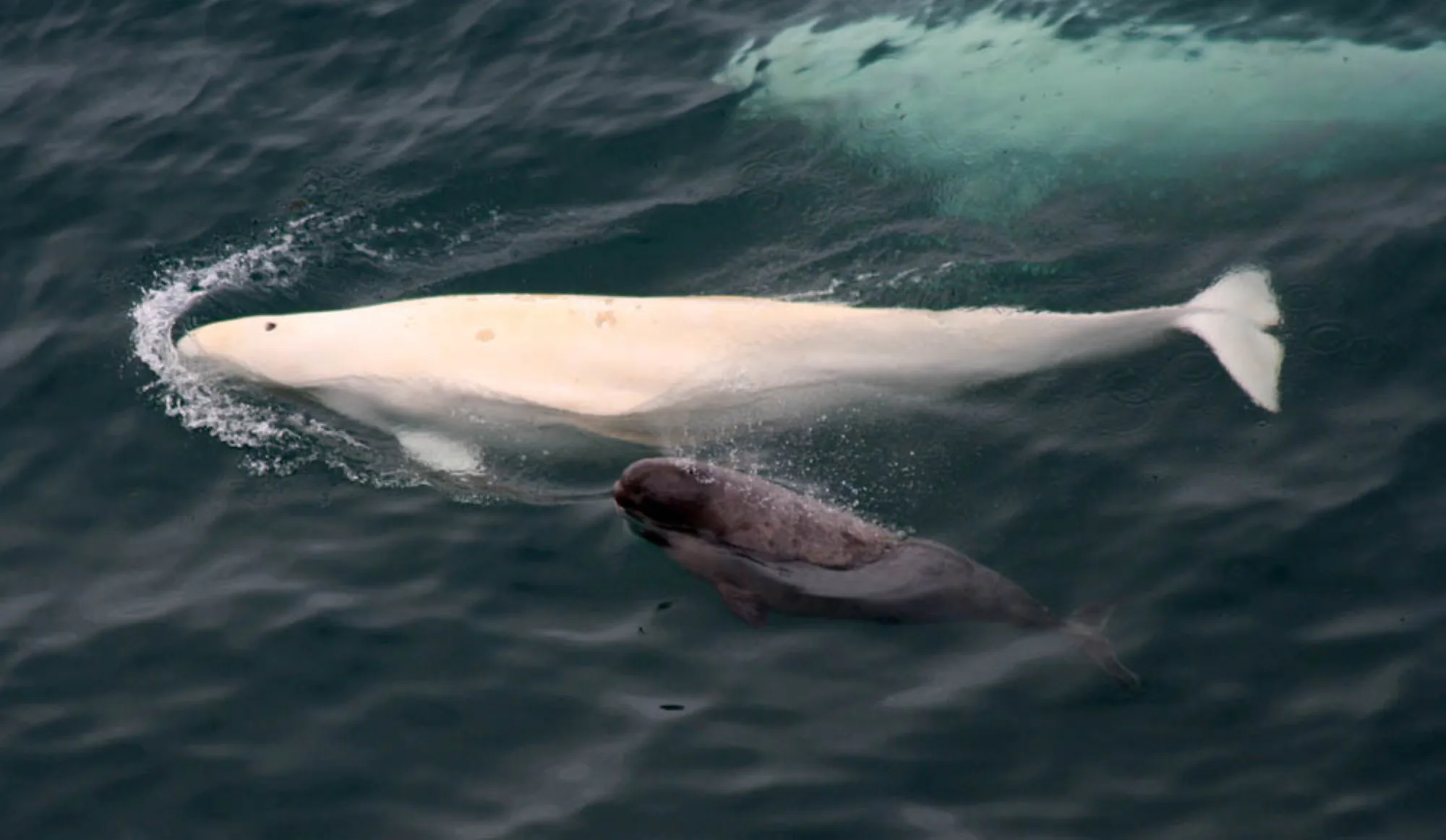
White or whitish-grey, with a rounded forehead and a stocky body, an adult Beluga is a distinctive sight in Arctic and sub-Arctic waters. It has no dorsal fin, which helps it swim beneath ice, and males can grow up to 5.5 m long. Calves are born grey and gradually acquire their white colouring as they grow.
Most Belugas inhabit the Arctic Ocean and nearby waters off Greenland, Russia and North America. Many spend winter around the Arctic ice cap, moving towards warmer estuaries and coastal waters after the summer ice melts, though some populations do not migrate far. In summer, hundreds or even thousands may gather in estuaries and shallow coastal areas. Belugas often travel in small, changeable groups, and wild animals sometimes swim alongside boats. Their high-pitched calls include whistles and squeals, earning them the name sea canary. They use sound to communicate and to find their way, prey and breathing holes in ice.
Their diet changes with location and season, but generally consists mainly of fish, with shrimp and other invertebrates also eaten. Belugas sometimes hunt together, steering shoals into shallow water before feeding. A female usually has a single calf at intervals of three years, often giving birth in a bay or estuary; the calf relies on its mother for nursing during its first year. Belugas have long been hunted by people, and numbers have fallen substantially in Russia and Greenland. Other threats include river contamination, climate change and infectious diseases, while polar bears and killer whales are natural predators.
Written from the English Wikipedia article Beluga whale (CC BY-SA 4.0).
- Records
- 811
- Countries
- 8
No atlas park has a record of the Beluga in or around it yet.
These are open occurrence records, so they show where people looked for and recorded the Beluga as much as where it lives. Cells are up to 25 km across, and every location is generalised to its cell.
Generalised encounter areas, not exact locations. Each shape is a grid cell coloured by how likely the species is there.
- Very likelyCanada25 km zone · medium confidence · 269 records · updated 81 days ago
- Very likelySvalbard & Jan Mayen25 km zone · medium confidence · 207 records · updated 81 days ago
- Very likelyUnited States25 km zone · medium confidence · 200 records · updated 81 days ago
- Very likelyNorway25 km zone · medium confidence · 92 records · updated 81 days ago
- Very likelyNetherlands25 km zone · medium confidence · 17 records · updated 81 days ago
- Very likelyAntarctica25 km zone · medium confidence · 16 records · updated 81 days ago
- LikelyRussia25 km zone · medium confidence · 9 records · updated 81 days ago
- LikelyUnited Kingdom25 km zone · medium confidence · 1 record · updated 81 days ago
Conservation status not assessed here yet, so every location is generalised to its grid cell.