Common House Martin
Delichon urbicum
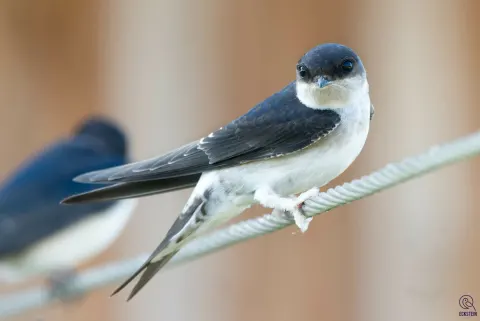
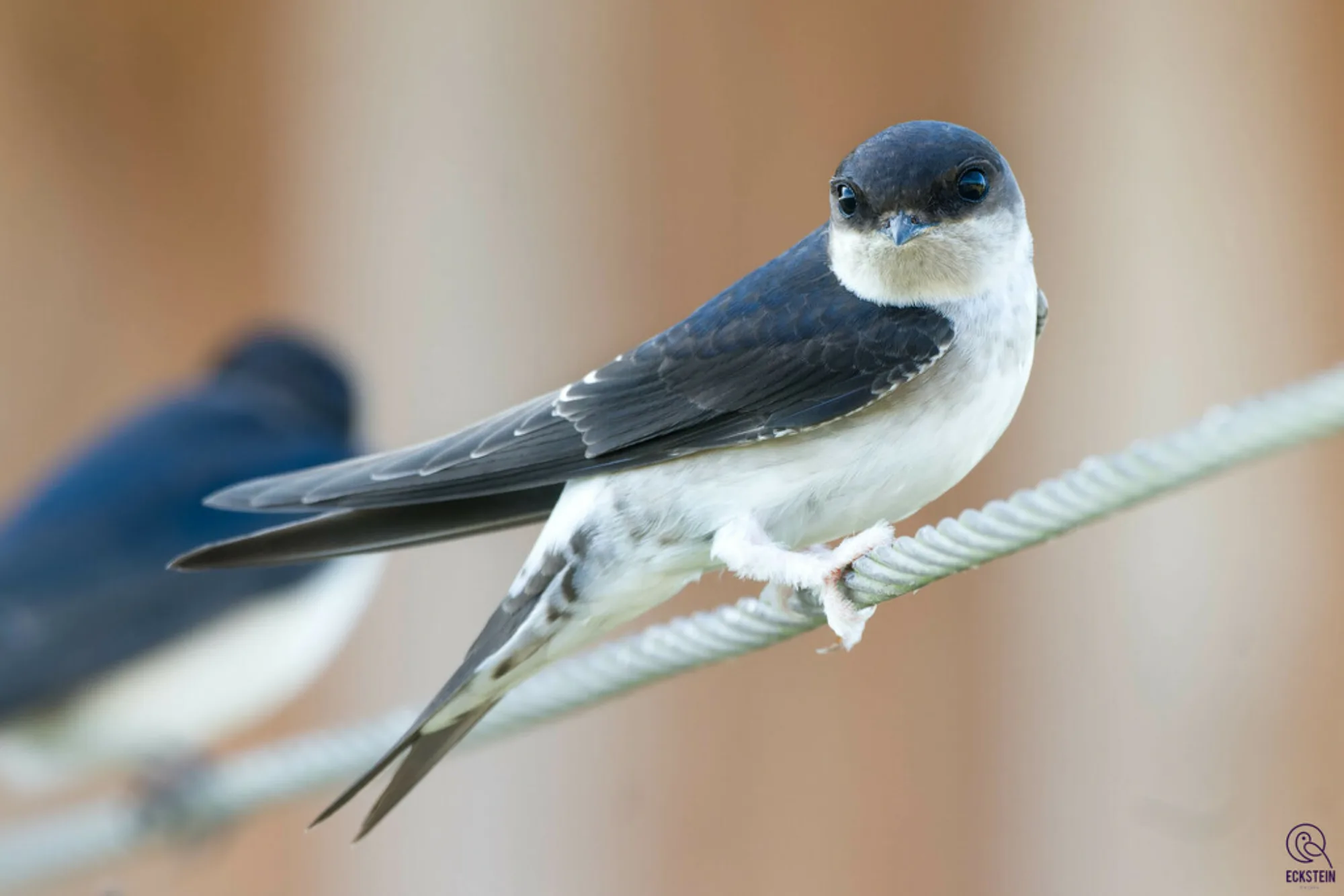
Look for a flash of white on the rump and underside as the Common House Martin flies overhead. This small member of the swallow family has a blue head and upperparts, while young birds are sooty black. Adults are 13 cm long, and the species is particularly noisy around its breeding colonies, where its song is a soft twitter of chirps.
House martins breed across Europe, north Africa and west-central Asia, then migrate to spend the winter in sub-Saharan Africa and southwestern Asia. They favour open country with low vegetation, including pastures, meadows and farmland, preferably close to water. They also nest on buildings, even in city centres where the air is sufficiently clean. On migration they usually travel by day, feeding on insects in the air. Flies and aphids form much of their breeding-season diet, and the birds may follow ploughs or large animals to catch insects they disturb.
Most house martins now nest on human structures, although some colonies still use cliffs. Both parents gather mud to build a closed cup beneath a ledge or the eaves of a house, lining it with soft material. They tend to breed in colonies, usually raising two broods a year and reusing the nest. Young birds stay with their parents for about a week after leaving it, and later gather in growing flocks on trees, rooftops or wires. Numbers can fall when weather is poor, agricultural pesticides cause poisoning, nesting mud is scarce or house sparrows compete for nests. Eurasian hobbies hunt the martins, and some nests are destroyed where droppings beneath them cause a nuisance.
Written from the English Wikipedia article Western house martin (CC BY-SA 4.0).
- Records
- 462,461
- Countries
- 23
No atlas park has a record of the Common House Martin in or around it yet.
These are open occurrence records, so they show where people looked for and recorded the Common House Martin as much as where it lives. Cells are up to 25 km across, and every location is generalised to its cell.
Generalised encounter areas, not exact locations. Each shape is a grid cell coloured by how likely the species is there.
- Very likelySpain25 km zone · high confidence · 135458 records · updated 80 days ago
- Very likelyUnited Kingdom25 km zone · high confidence · 111262 records · updated 80 days ago
- Very likelyPortugal25 km zone · high confidence · 52924 records · updated 80 days ago
- Very likelyNorway25 km zone · high confidence · 51546 records · updated 80 days ago
- Very likelyBelgium25 km zone · high confidence · 35888 records · updated 80 days ago
- Very likelyFrance25 km zone · high confidence · 32225 records · updated 80 days ago
- Very likelyFinland25 km zone · high confidence · 10507 records · updated 80 days ago
- Very likelySweden25 km zone · high confidence · 7052 records · updated 80 days ago
- Very likelyCzechia25 km zone · high confidence · 5596 records · updated 80 days ago
- Very likelyDenmark25 km zone · high confidence · 4331 records · updated 80 days ago
Conservation status not assessed here yet, so every location is generalised to its grid cell.