Aye-aye
Daubentonia madagascariensis
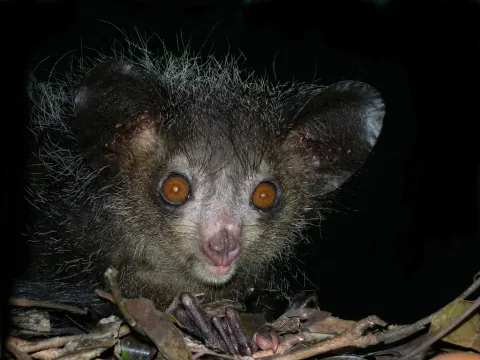
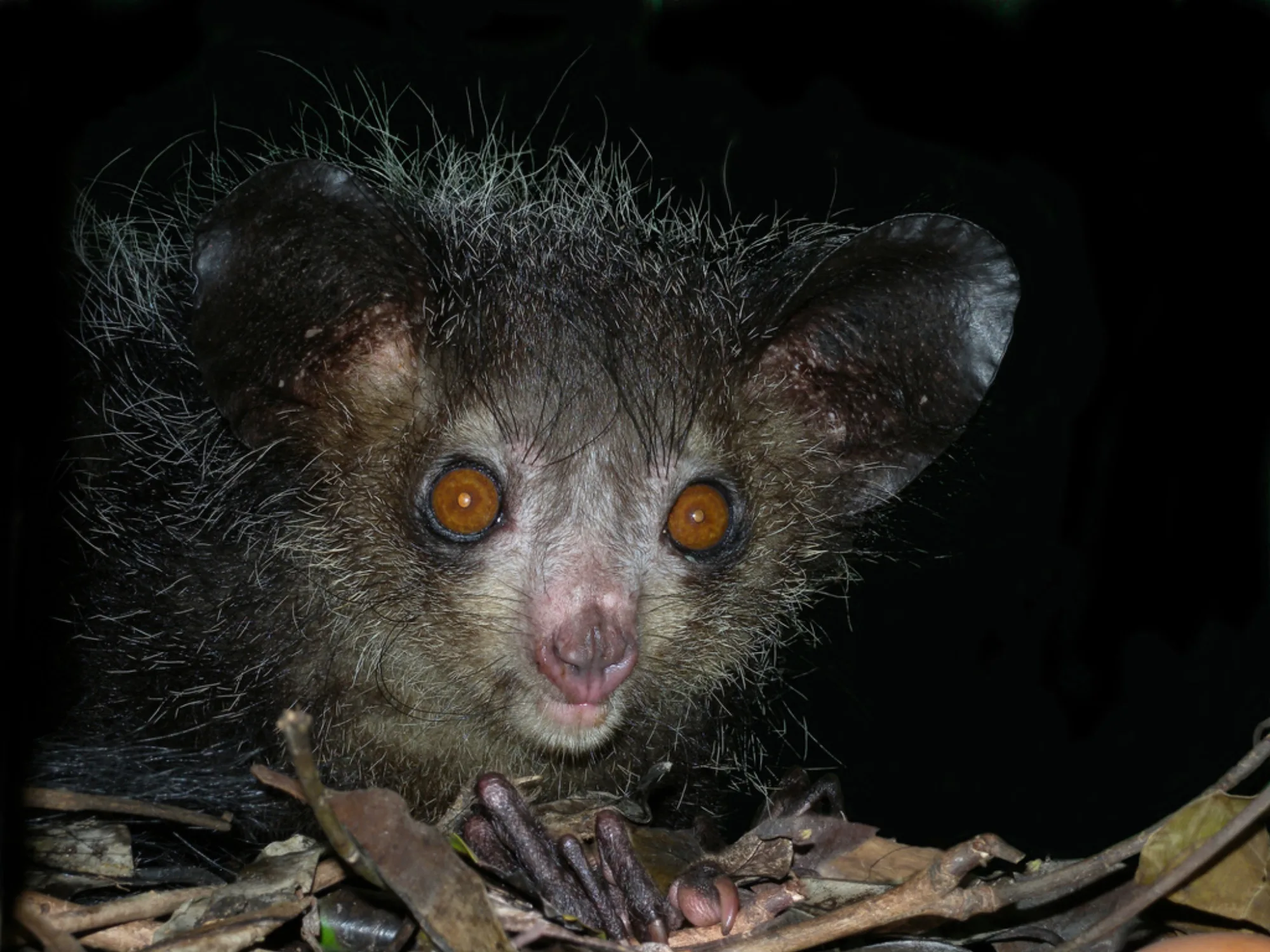
After dark in Madagascar's trees, the Aye-aye searches for food with a finger far thinner than the rest. This lemur is the world's largest nocturnal primate, with thick fur, white-tipped hairs on its head and back, and a tail longer than its body. Its other fur is generally yellow or brown, while its teeth continue to grow throughout its life. It lives mainly along Madagascar's east coast, in rainforest and dry deciduous forest, though deforestation has also left many living in cultivated areas. In rainforest, it keeps to the canopy, often among dense foliage that provides cover.
Aye-ayes spend most of their lives in trees, sleeping by day in round nests of leaves, branches and vines and emerging after dark to feed. To find larvae, an aye-aye taps on wood and listens for the echoes of hollow spaces, then chews an opening and draws out grubs with its slender middle finger. Its varied diet also includes fruit, seeds, nuts, nectar, fungi and honey. Usually solitary, it scent-marks its home range, although males may share territories and animals sometimes forage together. Females can breed throughout the year and generally have one young every two to three years. An infant may remain in its nest for two months before it first goes out, then takes another seven months to move through the canopy as skilfully as an adult.
Forest loss threatens the Aye-aye, as does poaching. Some people kill it because they associate it with evil or death, while farmers may kill it to protect crops, despite a lack of direct evidence that it threatens them.
Written from the English Wikipedia article Aye-aye (CC BY-SA 4.0).
- Records
- 48
- Countries
- 1
No atlas park has a record of the Aye-aye in or around it yet.
These are open occurrence records, so they show where people looked for and recorded the Aye-aye as much as where it lives. Cells are up to 25 km across, and every location is generalised to its cell.
Generalised encounter areas, not exact locations. Each shape is a grid cell coloured by how likely the species is there.
- Very likelyMadagascar25 km zone · medium confidence · 48 records · updated 80 days ago
Conservation status not assessed here yet, so every location is generalised to its grid cell.