Eastern Quoll
Dasyurus viverrinus
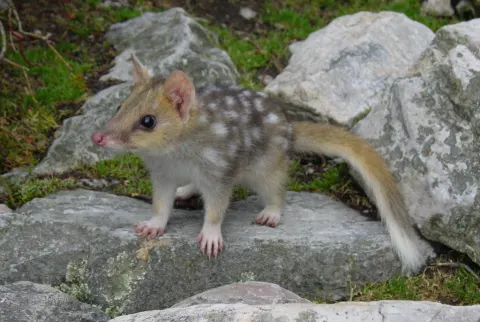
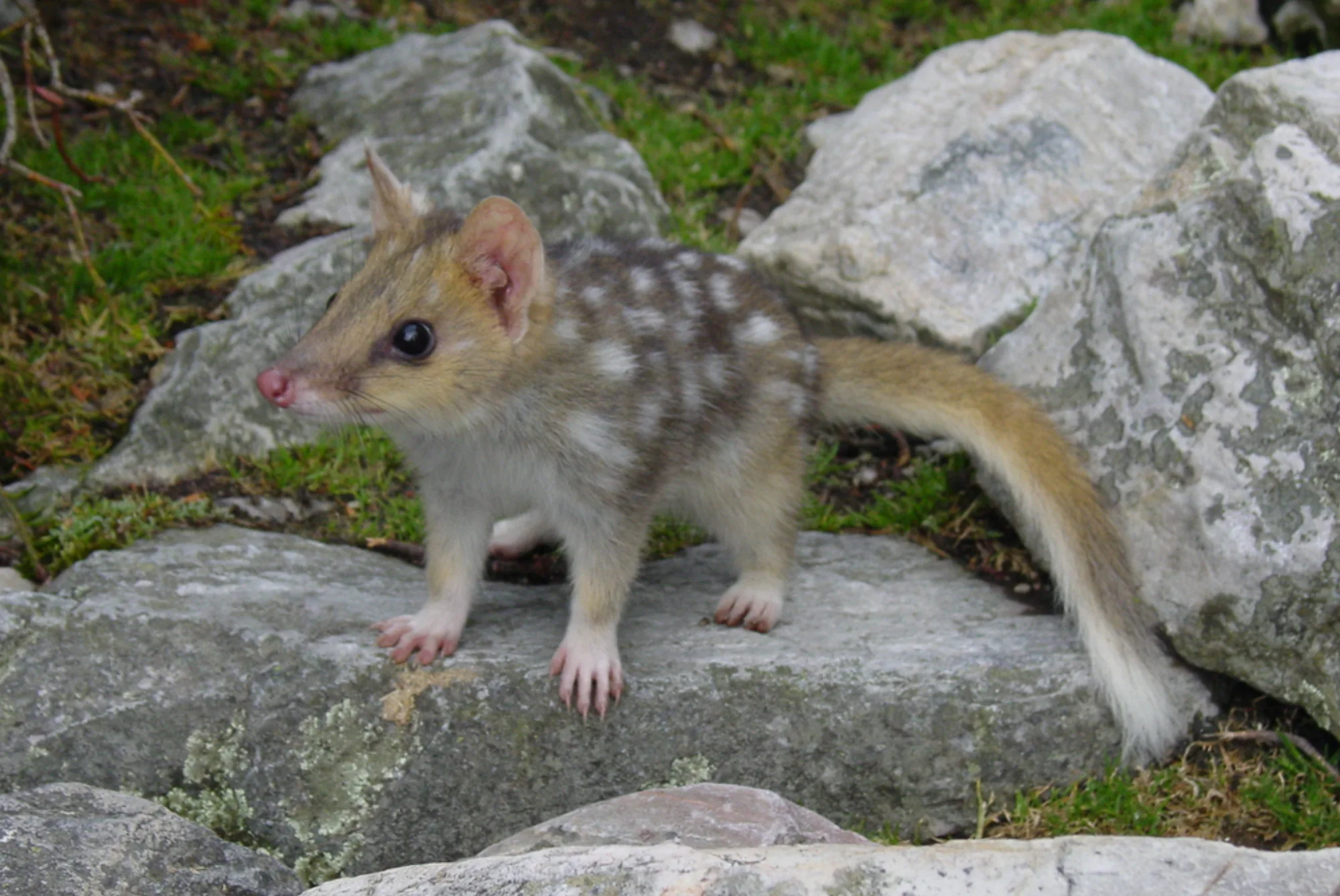
Similar in size to a small house cat, the Eastern Quoll is a carnivorous marsupial with a tapering snout, short legs and upright ears. Its thick coat can be light fawn or nearly black, with white spots across the head, back and sides, but none on the tail. The underside is off-white, from the chin to beneath the tail. Adult males measure 53 to 66 cm in total length, while smaller females measure 48 to 58 cm.
Native to Australia, the quoll remains widespread but patchily distributed in Tasmania and on Bruny Island. It lives in rainforest, heathland, alpine country and scrub below 1,500 m, favouring dry grassland and forest mosaics near farmland, especially where pasture grubs are common. Once found across much of southeastern mainland Australia, it was reintroduced to fenced sanctuaries in Victoria and the Australian Capital Territory. At Booderee National Park in New South Wales, a later release took place in a fenced area after an earlier unfenced trial failed.
Eastern quolls hunt alone at night, taking insects, small mammals, birds and reptiles, and sometimes scavenging from Tasmanian devils. They also eat grass throughout the year and fruit in summer. By day they rest in dens, rock crevices or hollow tree trunks, switching between several dens on different days. Breeding begins in early winter, and females give birth to as many as 30 young, though only those that attach to available teats survive. Introduced red foxes likely contributed to the quoll's disappearance from the mainland, with disease also a possible factor. In Tasmania, feral cats and unseasonal weather may have played a part in recent declines that could still be continuing.
Written from the English Wikipedia article Eastern quoll (CC BY-SA 4.0).
- Records
- 4,323
- Countries
- 1
- Atlas places
- 2
These are open occurrence records, so they show where people looked for and recorded the Eastern Quoll as much as where it lives. Cells are up to 25 km across, and every location is generalised to its cell.
Generalised encounter areas, not exact locations. Each shape is a grid cell coloured by how likely the species is there.
- Very likelyAustralia25 km zone · high confidence · 4323 records · updated 80 days ago
Conservation status not assessed here yet, so every location is generalised to its grid cell.