Tiger Quoll
Dasyurus maculatus
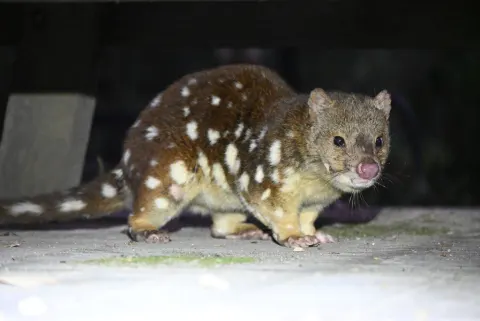
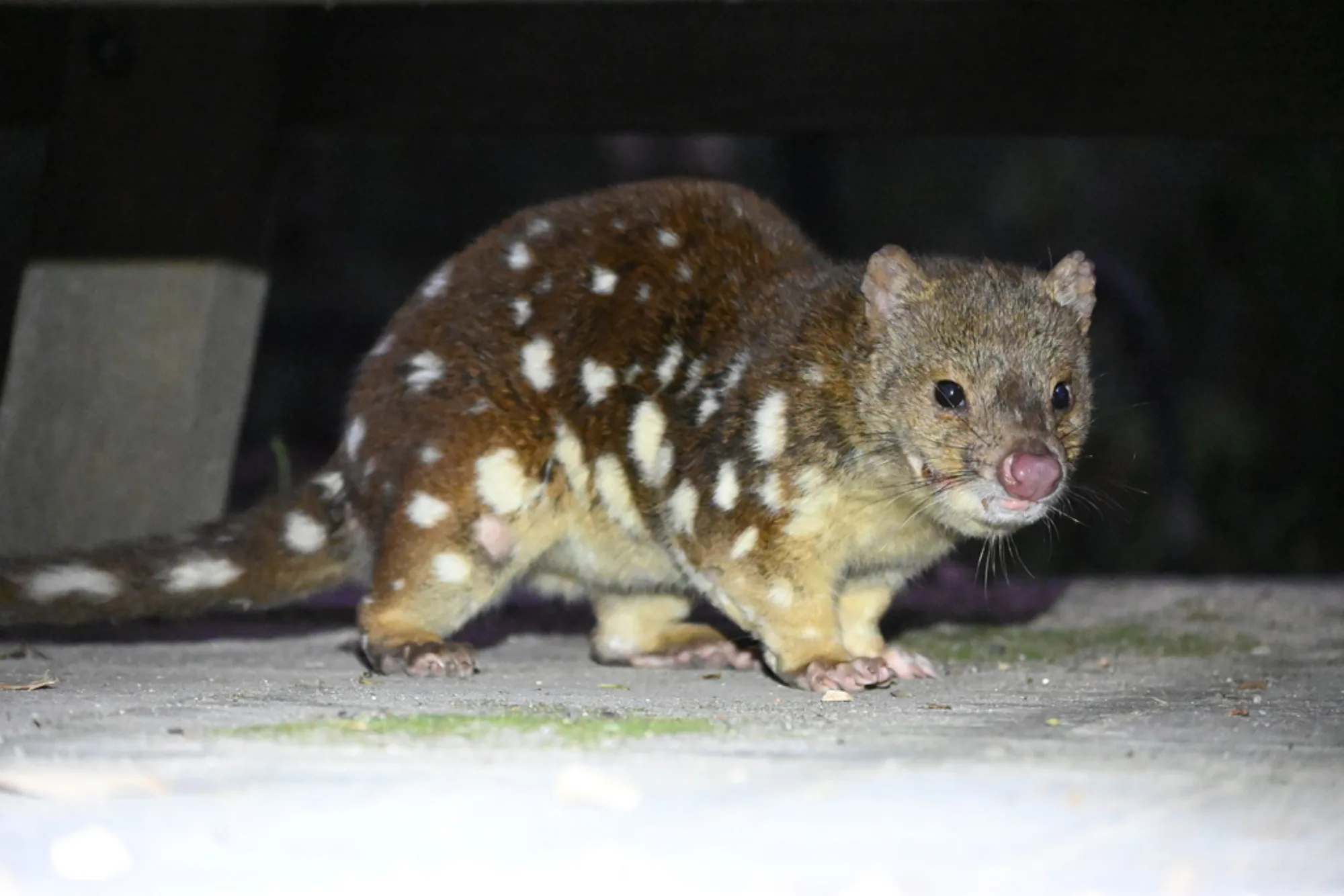
White spots run along the Tiger Quoll's body and tail, setting it apart from every other quoll species. Its coat is usually reddish-brown, though some individuals are black, and its underside is greyish or creamy white. This carnivorous marsupial has short legs and a tail as long as its head and body together. Native to Australia, it occurs in the east, with an isolated population in northeastern Queensland and a range extending from southern Queensland to Tasmania. It favours humid forests, including rainforest and closed eucalypt forest, and most sightings are at elevations of at least 600 m.
Tiger Quolls are generally nocturnal, spending the day in dens among rocks, in hollow trees or logs, and sometimes beneath buildings. Young quolls and mothers with young in the den may also venture out in daylight. They travel on the ground and in trees, where they can hunt possums and birds at night. Their varied diet includes insects, crayfish, reptiles, birds and mammals, from rabbits and bandicoots to wombats. They usually hunt live prey but sometimes feed on carcasses. Breeding is seasonal, with mating usually in midwinter, although females can breed as early as April. After a three-week pregnancy, a female gives birth to around 2 to 6 young and raises them without help from the male.
Habitat destruction is the greatest threat, and European settlement has fragmented the quoll's mainland range. Road collisions and 1080 poisoning also kill quolls, while introduced predators such as foxes and feral cats are likely competitors. Tasmanian devils and masked owls may hunt quolls in Tasmania.
Written from the English Wikipedia article Tiger quoll (CC BY-SA 4.0).
- Records
- 11,758
- Countries
- 1
- Atlas places
- 4
These are open occurrence records, so they show where people looked for and recorded the Tiger Quoll as much as where it lives. Cells are up to 25 km across, and every location is generalised to its cell.
Generalised encounter areas, not exact locations. Each shape is a grid cell coloured by how likely the species is there.
- Very likelyAustralia25 km zone · high confidence · 11758 records · updated 80 days ago
Conservation status not assessed here yet, so every location is generalised to its grid cell.