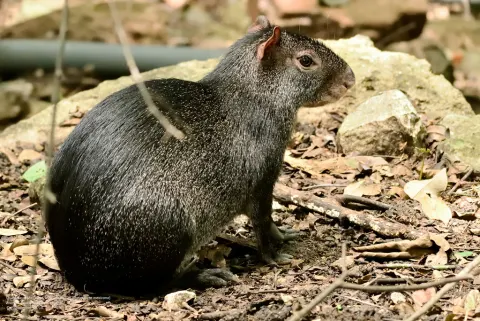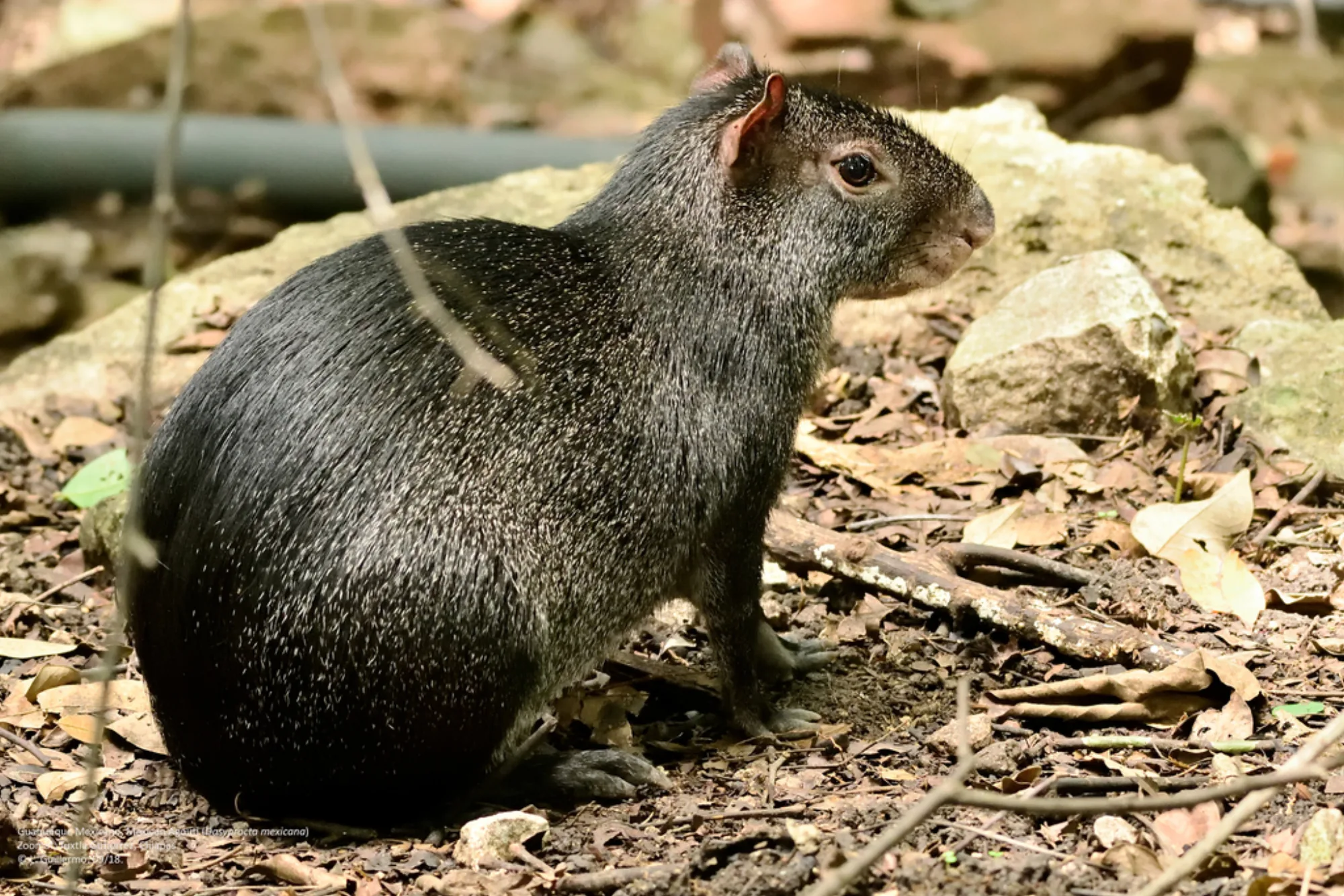
Mexican Agouti
Dasyprocta mexicana
A rounded back, long hindlegs and a dark coat give the Mexican Agouti a distinctive outline on the forest floor. This medium-sized rodent weighs 2 to 4 kilograms and measures 40 to 60 centimeters, including its short tail. Its head and back are black or dark brown, with scattered white hairs and longer black hair on the nape and rump. The chin, throat and underside are paler, while lighter areas around the eyes and ears reveal pink skin.
Native to Mexico, it lives in Gulf of Mexico lowlands in Veracruz, Oaxaca, Tabasco and Chiapas, and has also been introduced to western and eastern Cuba. It favours humid tropical rainforest, lowland evergreen forest and second growth forest, at elevations from 50 to 600 meters. Alert and agile, the agouti is naturally active during the day and at twilight, but can become nocturnal under pressure, particularly where people hunt it. When escaping danger, it may give sharp nasal barks and stamp its feet. Its diet consists mainly of fruit, soft seeds and new-growth forest plants. Agoutis also bury individual seeds and nuts, sometimes returning to them after the fruiting season.
Breeding pairs share territories of 1 to 2 hectares. They usually have 1 or 2 young during the dry season, from March to May, and females use crevices or existing burrows to give birth and raise them. The young are born furred and with their eyes open, and follow their mother while she forages. Habitat loss is driving a decline in mature individuals as forest land is converted to agriculture and urban use. Hunting also contributes to the decline, and the agouti must evade natural predators ranging from jaguars and other cats to snakes and birds of prey.
Written from the English Wikipedia article Mexican agouti (CC BY-SA 4.0).
- Records
- 30
- Countries
- 1
No atlas park has a record of the Mexican Agouti in or around it yet.
These are open occurrence records, so they show where people looked for and recorded the Mexican Agouti as much as where it lives. Cells are up to 25 km across, and every location is generalised to its cell.
Generalised encounter areas, not exact locations. Each shape is a grid cell coloured by how likely the species is there.
- Very likelyMexico25 km zone · medium confidence · 30 records · updated 80 days ago
Conservation status not assessed here yet, so every location is generalised to its grid cell.