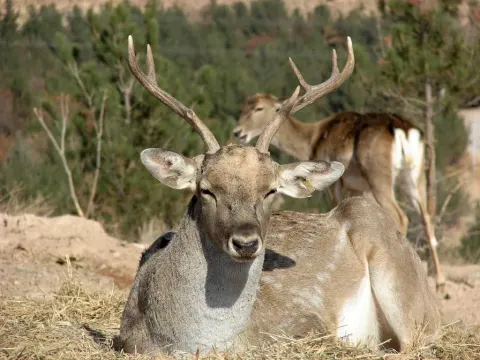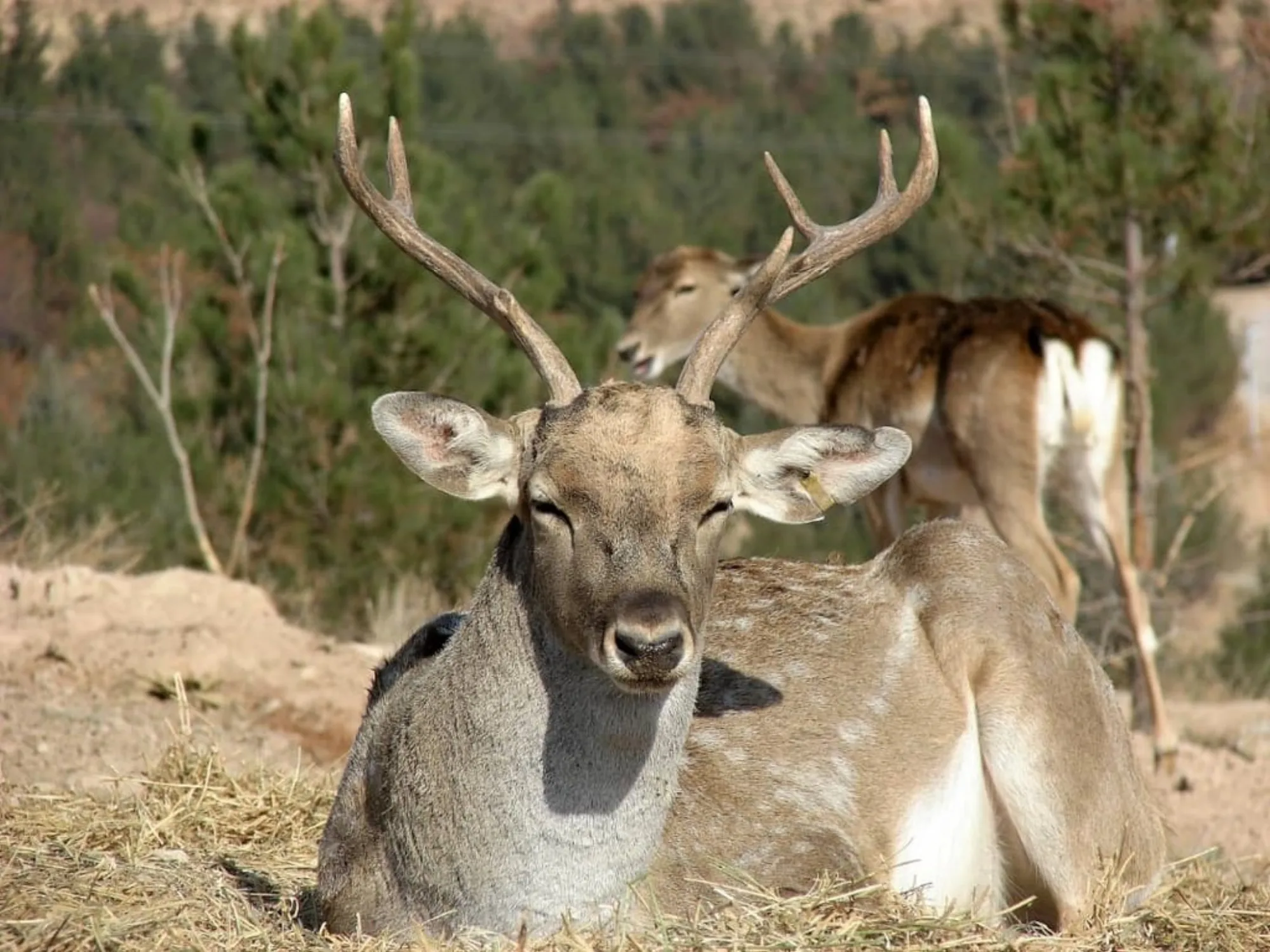
Persian Fallow Deer
Dama mesopotamica
Once widespread across West Asia, the Persian Fallow Deer now lives wild only in Iran and Israel. It is a large deer, weighing around 70 to 140 kilograms and standing roughly 80 to 110 centimetres at the shoulder. Its antlers are flattened and somewhat narrower than those of the European fallow deer.
Look for its preferred woodland habitats, where tamarisk, oak and pistachio grow. In Iran, native populations remain in the Dez and Karkeh wildlife refuges. In Israel, reintroduced deer live in western Galilee and the Judean Hills, as well as around Mount Sasa and Mount Carmel. They avoid roads even when traffic is light, a habit that restricts their movements and spread. Grass makes up 60% of their diet, supplemented by leaves and nuts. Older males are more territorial than younger ones, while older females tend to stay closer to their reintroduction sites than younger females. Pregnancy lasts around 230 days, and females continue breeding until around 15 years of age. Deer released into the wild can establish regular movements and a home range, though the time taken has varied between releases.
Hunting is thought to have been the main cause of the deer's decline. Competition with livestock, human encroachment and the loss of habitat to agriculture may also have reduced its numbers. Collisions with cars and trains are the leading cause of death, while grey wolves and feral dogs also kill deer. Captive breeding and reintroductions have helped the population recover from only a handful of animals in the 1960s to more than a thousand in the 2010s.
Written from the English Wikipedia article Persian fallow deer (CC BY-SA 4.0).
- Records
- 218
- Countries
- 1
No atlas park has a record of the Persian Fallow Deer in or around it yet.
These are open occurrence records, so they show where people looked for and recorded the Persian Fallow Deer as much as where it lives. Cells are up to 25 km across, and every location is generalised to its cell.
Generalised encounter areas, not exact locations. Each shape is a grid cell coloured by how likely the species is there.
- Very likelyIsrael25 km zone · high confidence · 218 records · updated 80 days ago
Conservation status not assessed here yet, so every location is generalised to its grid cell.