Laughing Kookaburra
Dacelo novaeguineae
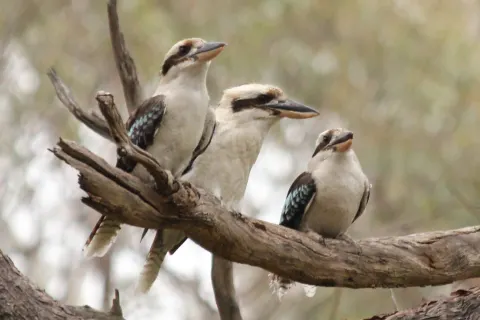
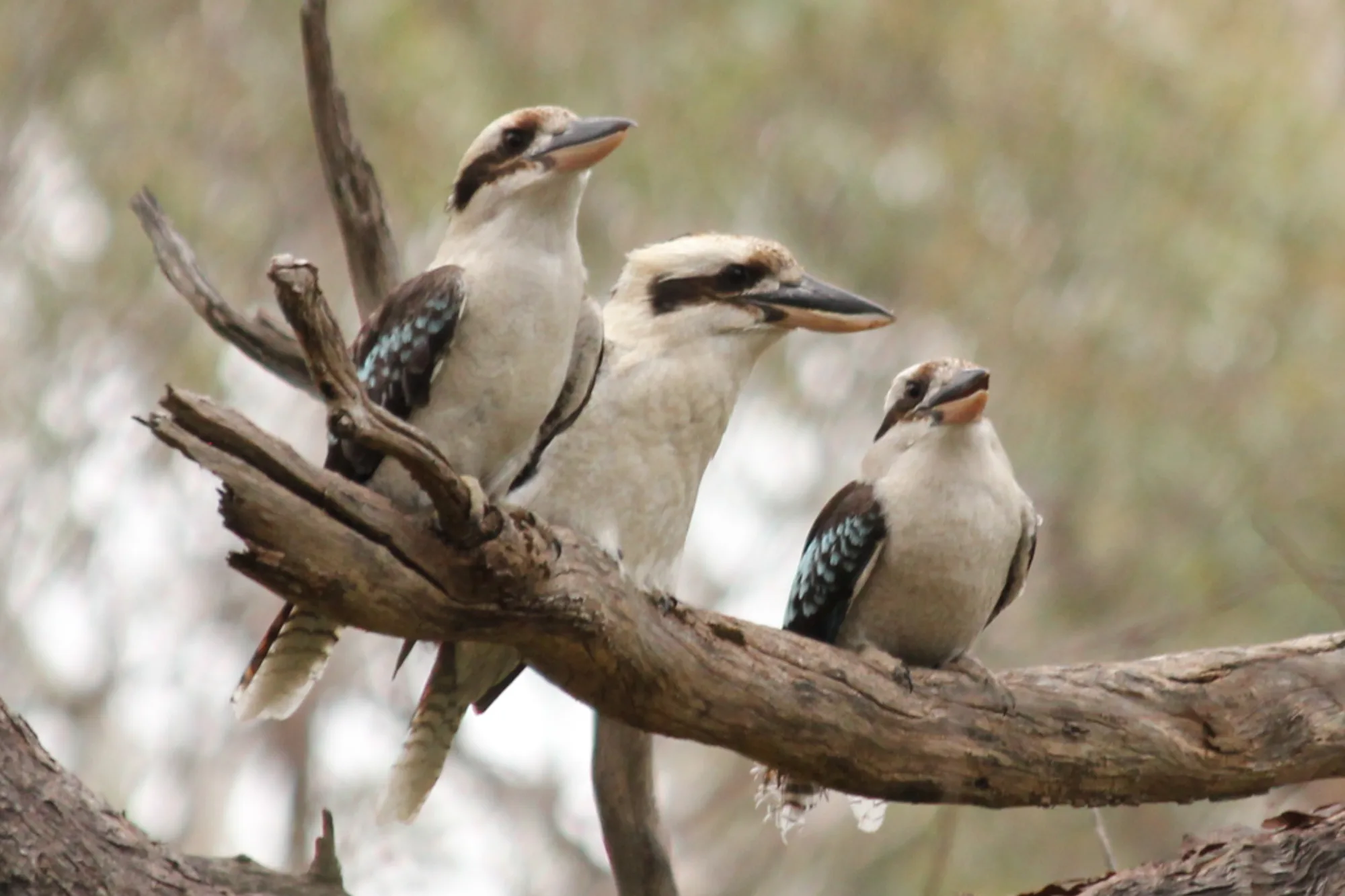
A loud burst of laughter can give away a Laughing Kookaburra, especially at dawn or dusk, when several birds may call together to mark their territory. This large, stocky kingfisher has a whitish head, a dark stripe through each eye and a long, heavy bill. Its back and wings are brown, with patches of blue on the shoulders, while the cream-white body contrasts with a rusty tail marked by dark bars. Males and females look much alike, though females are usually larger.
Native to eastern mainland Australia, the bird has also been introduced to Tasmania, Western Australia and parts of New Zealand. Look for it in dry eucalypt forest and woodland, particularly where the undergrowth is sparse or the ground grassy. It also lives around wetlands, on partly cleared land and farmland with trees, and in city parks and gardens. Birds stay in the same territory year-round, often living in loose family groups. From a branch, a kookaburra watches the ground for prey, then swoops down to seize it. Its varied diet includes insects, worms, lizards, snakes and mice, and it sometimes takes goldfish from garden ponds.
Pairs remain together for life and usually nest in tree holes or cavities dug into termite nests in trees. They typically lay three white eggs, with both parents and older offspring helping to incubate them and feed the chicks. Young birds continue to receive food from the group for six to ten weeks after leaving the nest. Food shortages can lead to fights among chicks, and the smallest may be killed by its siblings. No widespread threats are reported, although Australian sighting records suggest a marked decline in the population.
Written from the English Wikipedia article Laughing kookaburra (CC BY-SA 4.0).
- Records
- 610,560
- Countries
- 1
- Atlas places
- 7
These are open occurrence records, so they show where people looked for and recorded the Laughing Kookaburra as much as where it lives. Cells are up to 25 km across, and every location is generalised to its cell.
Generalised encounter areas, not exact locations. Each shape is a grid cell coloured by how likely the species is there.
- Very likelyAustralia25 km zone · high confidence · 610560 records · updated 80 days ago
Conservation status not assessed here yet, so every location is generalised to its grid cell.