Hooded Seal
Cystophora cristata
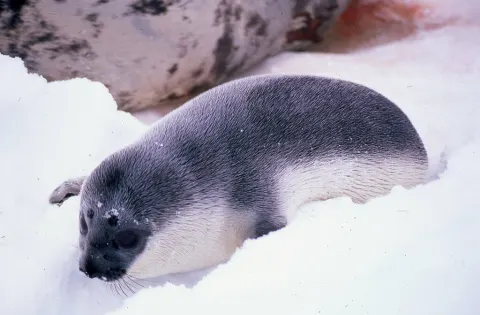
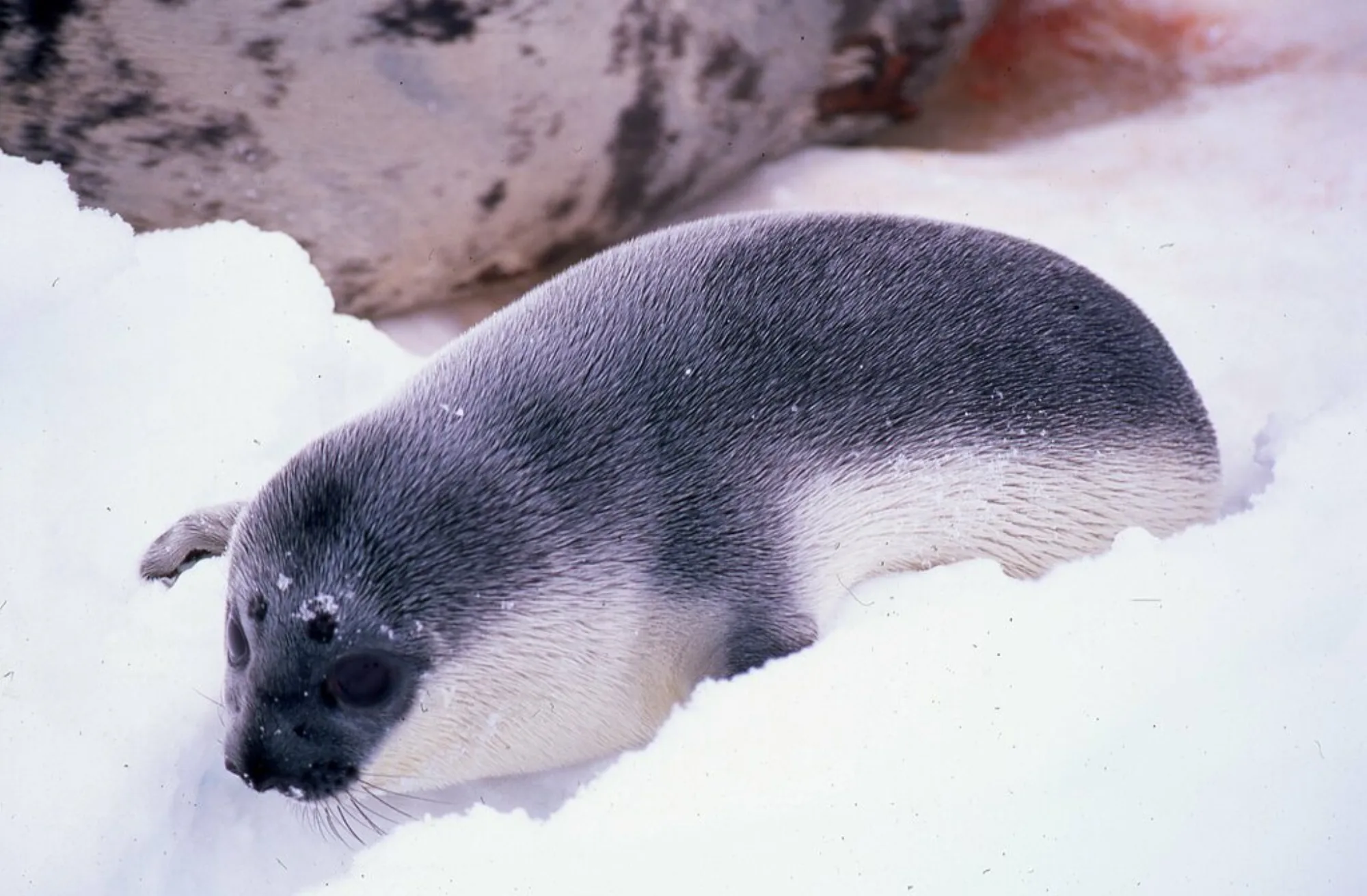
A dark, unmarked head and a silver-grey coat scattered with irregular black spots help distinguish the Hooded Seal. Adult males average 2.6 metres in length and can grow to 3.5 metres, while females are smaller. Males also have an inflatable hood on the head and can produce a pinkish, balloon-like membrane from a nostril. Pups are known as blue-backs for their blue-grey backs and pale bellies, a coat they shed after about 14 months.
These large seals spend much of their time on moving pack ice and in the deep waters of the Arctic Ocean and North Atlantic. Pack-ice areas where they occur include waters near Jan Mayen Island, off Labrador and northeastern Newfoundland, in the Gulf of St. Lawrence and in Davis Strait. They migrate widely, with some reaching Alaska to the west and the Canary Islands or Guadeloupe to the south. Usually solitary, they gather during the breeding and moulting seasons and can be aggressive and territorial. They eat fish, krill and other crustaceans, as well as animals such as squid, octopus and mussels. Feeding dives commonly reach 100 to 600 m and last 5 to 25 minutes, though some go deeper and last longer.
Births take place on the ice between mid-March and early April, and pups nurse for an average of only 4 days. After breeding, the seals travel long distances to feed, then gather again for the moult before dispersing once more. Hunting and accidental capture in fishing gear are the main threats; pups are hunted for their pelts, and mothers are sometimes killed while trying to protect them. Killer whales, polar bears and Greenland sharks also prey on hooded seals.
Written from the English Wikipedia article Hooded seal (CC BY-SA 4.0).
- Records
- 187
- Countries
- 7
No atlas park has a record of the Hooded Seal in or around it yet.
These are open occurrence records, so they show where people looked for and recorded the Hooded Seal as much as where it lives. Cells are up to 25 km across, and every location is generalised to its cell.
Generalised encounter areas, not exact locations. Each shape is a grid cell coloured by how likely the species is there.
- Very likelyGreenland25 km zone · high confidence · 160 records · updated 81 days ago
- Very likelyCanada25 km zone · medium confidence · 3 records · updated 81 days ago
- LikelyFrance25 km zone · medium confidence · 18 records · updated 81 days ago
- LikelySt. Barthélemy25 km zone · medium confidence · 3 records · updated 81 days ago
- LikelyGuadeloupe25 km zone · medium confidence · 2 records · updated 81 days ago
- PossibleSt. Pierre & Miquelon25 km zone · medium confidence · 1 record · updated 81 days ago
- PossibleSvalbard & Jan Mayen25 km zone · low confidence · 0 records · updated 81 days ago
- PossibleUnnamed area25 km zone · low confidence · 0 records · updated 81 days ago
Conservation status not assessed here yet, so every location is generalised to its grid cell.