Common Carp
Cyprinus carpio
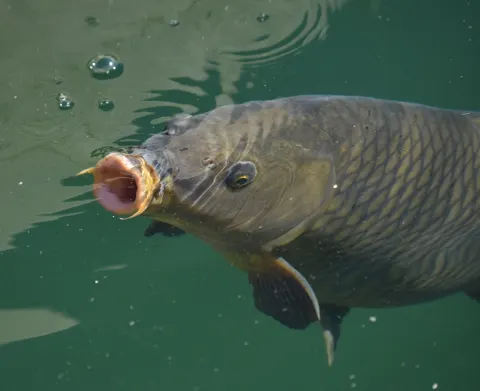
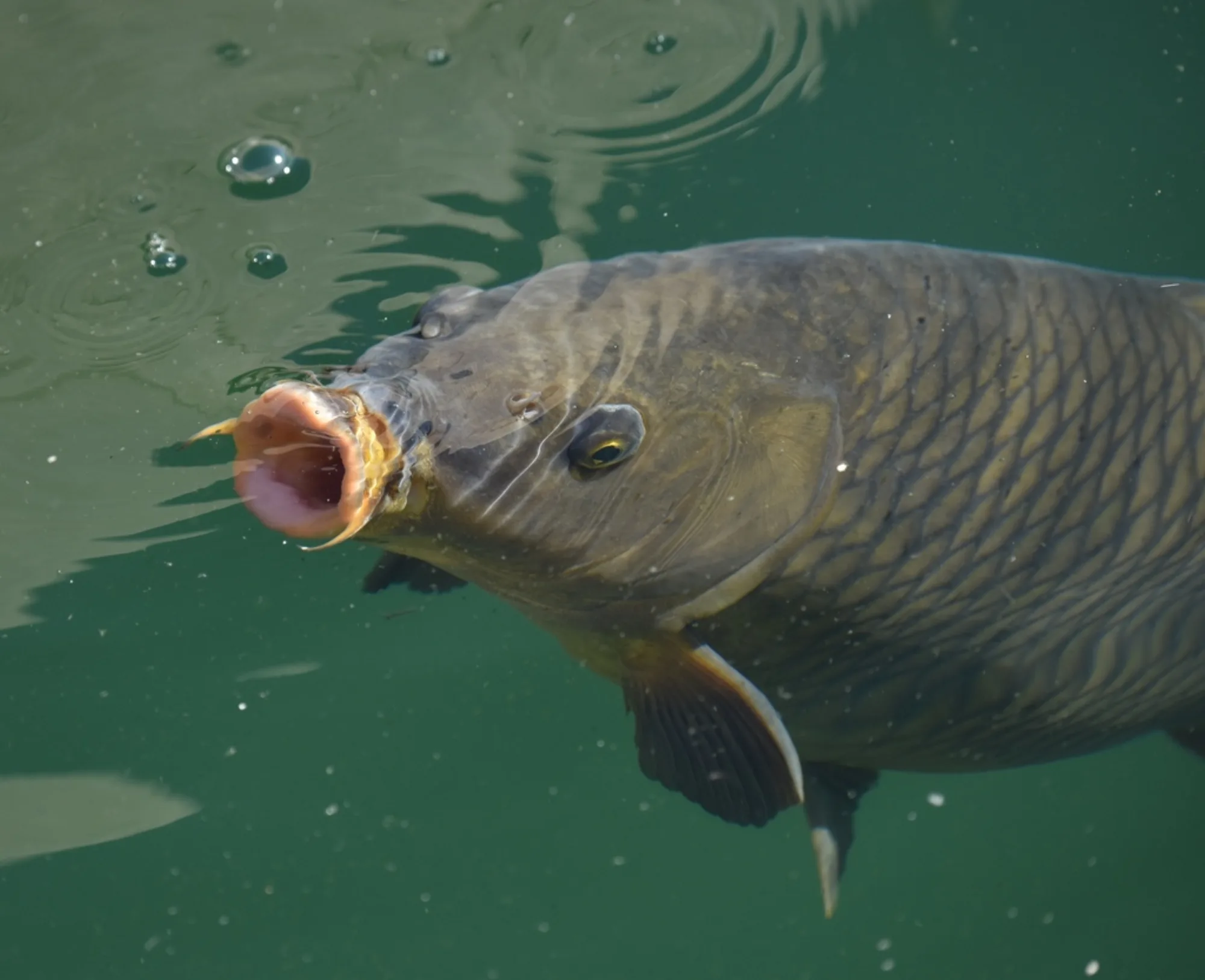
A dark gold sheen, especially on the head, gives the Common Carp a distinctive look. This robust freshwater fish has large, shiny scales, a downward-turned mouth and two pairs of barbels. Its tail and lower rear fin can be dark bronze or tinged with orange. Wild fish tend to be slimmer than domesticated carp, while some domesticated varieties have few scales or conspicuously large ones. An average Common Carp measures around 40 to 80 cm and weighs 2 to 14 kg.
Native to Europe and Asia, the fish has been introduced across the world except at the poles. Its native range includes the Danube and Volga rivers, as well as the Black, Caspian and Aral seas. Look for it in lakes and large rivers, particularly where water is slow or still and the bottom has soft, vegetated sediment. Carp usually travel in groups of five or more and can survive beneath the ice of a frozen pond if water remains free below it. They can also gulp air at the surface when oxygen in the water is very low.
Carp feed throughout the day, most intensively at night and around sunrise. They root through bottom sediment for insects, crustaceans, molluscs, worms and other animal food, though they also eat aquatic plants, tubers and seeds. Spawning usually takes place in spring as temperatures rise and rain falls, but can happen several times in a season. Eggs and young fry are vulnerable to bacteria, fungi and small predators, while juvenile carp are eaten by fish, birds and mammals. People catch carp for food and sport, and in some places control their numbers because introduced fish can damage native habitats by disturbing and eating submerged vegetation.
Written from the English Wikipedia article Common carp (CC BY-SA 4.0).
- Records
- 96,035
- Countries
- 10
- Atlas places
- 2
These are open occurrence records, so they show where people looked for and recorded the Common Carp as much as where it lives. Cells are up to 25 km across, and every location is generalised to its cell.
Generalised encounter areas, not exact locations. Each shape is a grid cell coloured by how likely the species is there.
- Very likelyAustralia25 km zone · high confidence · 49232 records · updated 80 days ago
- Very likelyUnited States25 km zone · high confidence · 38264 records · updated 80 days ago
- Very likelyFrance25 km zone · high confidence · 5192 records · updated 80 days ago
- Very likelySpain25 km zone · high confidence · 1624 records · updated 80 days ago
- Very likelyBelgium25 km zone · high confidence · 519 records · updated 80 days ago
- Very likelyMexico25 km zone · high confidence · 415 records · updated 80 days ago
- Very likelyUnited Kingdom25 km zone · high confidence · 307 records · updated 80 days ago
- Very likelyCanada25 km zone · high confidence · 171 records · updated 80 days ago
- Very likelyGermany25 km zone · high confidence · 160 records · updated 80 days ago
- Very likelySwitzerland25 km zone · high confidence · 151 records · updated 80 days ago
Conservation status not assessed here yet, so every location is generalised to its grid cell.