Devils Hole Pupfish
Cyprinodon diabolis
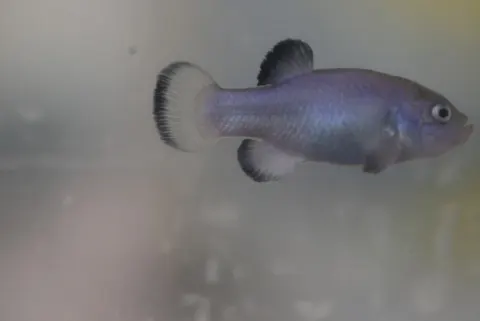
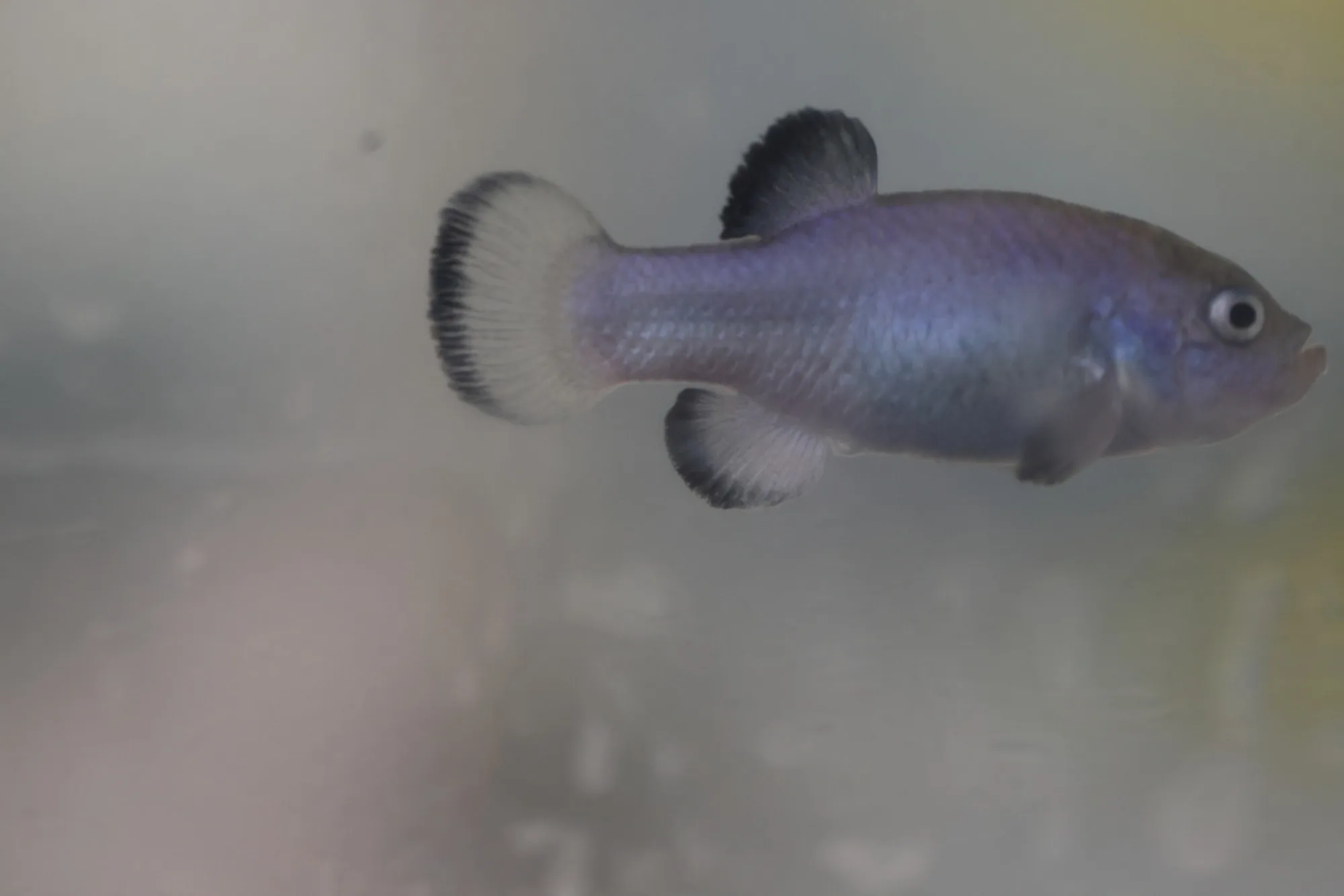
A flash of metallic blue can mark a male Devils Hole Pupfish, a small fish reaching up to 30 mm in length. Females and young are more yellow, and the species lacks pelvic fins. Its entire native range is Devils Hole, a water-filled cavern in southwestern Nevada, east of Death Valley. Although the cavern is at least 130 m deep, the fish have been found no deeper than 24 m and are most numerous above 15 m. The water stays at 33 °C and has little dissolved oxygen. A small rock shelf just below the surface is an important place for the fish to feed and spawn.
The pupfish eats a broad range of available food, including algae, beetles, snails and freshwater crustaceans, with its diet changing through the year. Its movements change with the light and seasons: fewer fish use the shallow shelf around midday when sunlight on it is strongest, particularly from April to September. Spawning takes place throughout the year, with a main peak in spring and a smaller one in summer. Females produce few eggs, and few young survive to adulthood. Disturbances such as earthquakes can send the fish into deeper water and prompt spawning outside the usual season.
Living at a single site leaves the pupfish exposed to disturbance. Groundwater drawn for agricultural irrigation lowered the water level in the 1960s and 1970s, leaving less of the feeding and spawning shelf underwater. Earthquake waves can strip algae, eggs and larvae from rocks, while flash floods can disturb the algae with debris. A diving beetle also eats pupfish eggs and juveniles, and vandalism has damaged eggs and larvae on the shelf.
Written from the English Wikipedia article Devils Hole pupfish (CC BY-SA 4.0).
- Records
- 15
- Countries
- 1
No atlas park has a record of the Devils Hole Pupfish in or around it yet.
These are open occurrence records, so they show where people looked for and recorded the Devils Hole Pupfish as much as where it lives. Cells are up to 25 km across, and every location is generalised to its cell.
Generalised encounter areas, not exact locations. Each shape is a grid cell coloured by how likely the species is there.
- Very likelyUnited States25 km zone · medium confidence · 15 records · updated 80 days ago
Conservation status not assessed here yet, so every location is generalised to its grid cell.