Black-tailed Prairie Dog
Cynomys ludovicianus
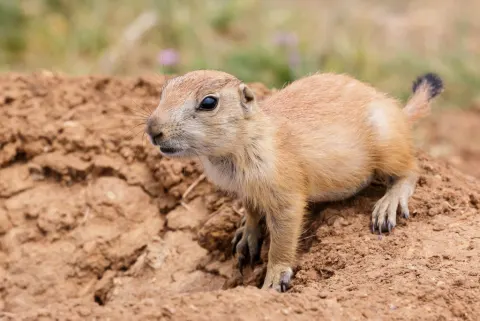
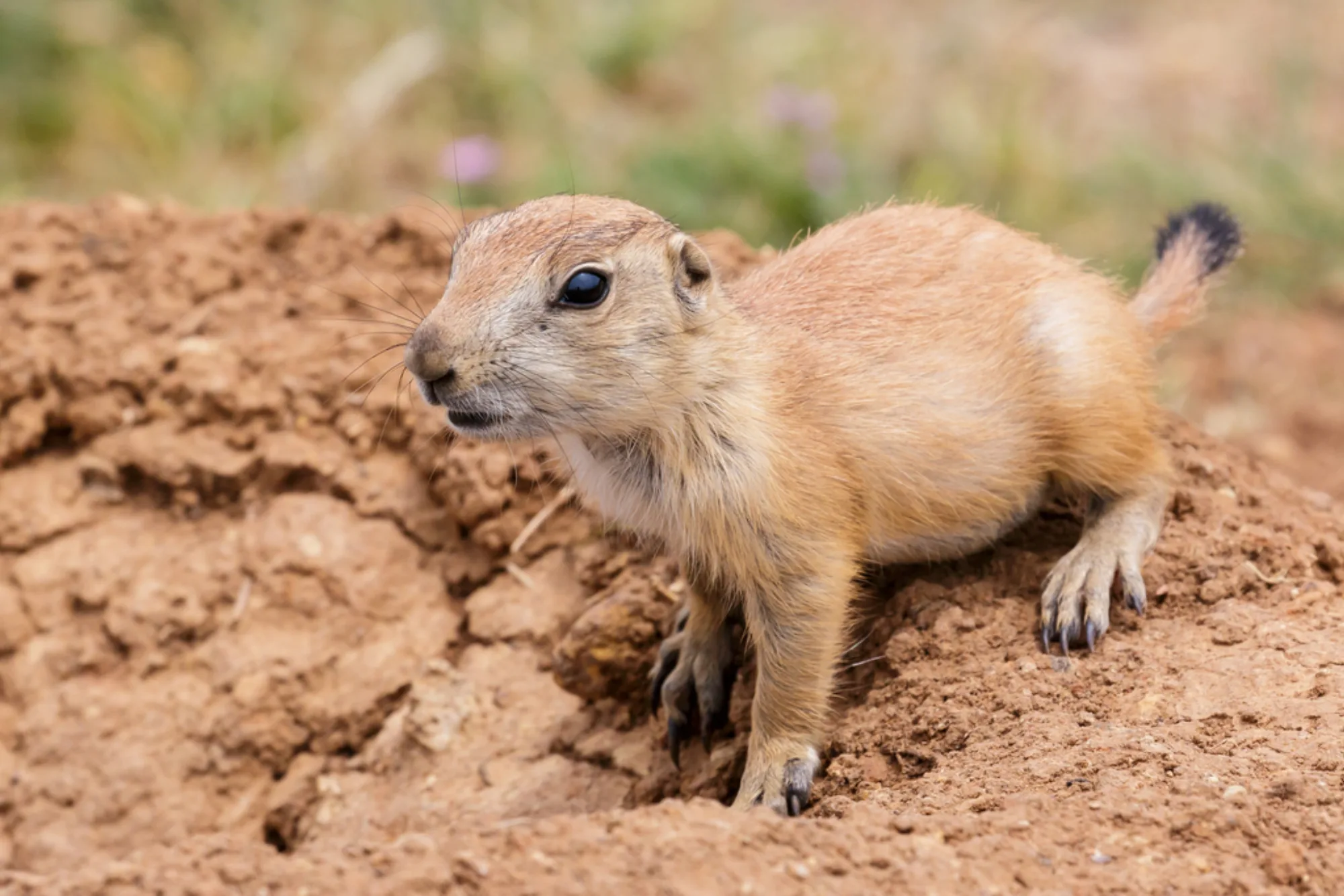
Across the Great Plains, the Black-tailed Prairie Dog lives in colonies that can hold thousands of animals. This compact member of the squirrel family is generally tan, with a pale belly, small ears and a black tip to its tail. Its body measures 36 to 43 cm, with a tail of 7.6 to 10.2 cm. Its range spans the plains from near Canada in the north to near Mexico in the south. It occupies grasslands ranging from shortgrass and mixed-grass prairies to desert grassland and sagebrush steppe; in the Great Plains, colonies commonly occur near rivers and creeks.
Active by day, prairie dogs spend less time above ground during rain, snow or intense heat. They do not fully hibernate: even in winter they leave their burrows to forage, although they enter a short, energy-saving torpor at night. Their underground burrows provide shelter from predators and places to breed and raise young. Members of a family group are friendly towards one another but hostile to outsiders. A calling animal may stand upright and throw its forefeet into the air, prompting neighbours to copy the display. Grasses are favoured foods, especially in summer, while winter meals include prickly pear and underground roots. The animals also obtain water from vegetation. Young are born underground, and each female produces one litter a year; the pups stay below ground to nurse for up to seven weeks.
Habitat loss and fragmentation, eradication efforts and sylvatic plague threaten these colonies. Farming, livestock use and development have diminished its habitat, while plague can rapidly wipe out an entire colony. Coyotes, badgers, eagles and rattlesnakes are among their predators.
Written from the English Wikipedia article Black-tailed prairie dog (CC BY-SA 4.0).
- Records
- 1,753
- Countries
- 3
- Atlas places
- 3
These are open occurrence records, so they show where people looked for and recorded the Black-tailed Prairie Dog as much as where it lives. Cells are up to 25 km across, and every location is generalised to its cell.
Generalised encounter areas, not exact locations. Each shape is a grid cell coloured by how likely the species is there.
- Very likelyUnited States25 km zone · medium confidence · 1538 records · updated 80 days ago
- Very likelyCanada25 km zone · high confidence · 211 records · updated 80 days ago
- LikelyMexico25 km zone · medium confidence · 4 records · updated 80 days ago
Conservation status not assessed here yet, so every location is generalised to its grid cell.