Philippine Flying Lemur
Cynocephalus volans
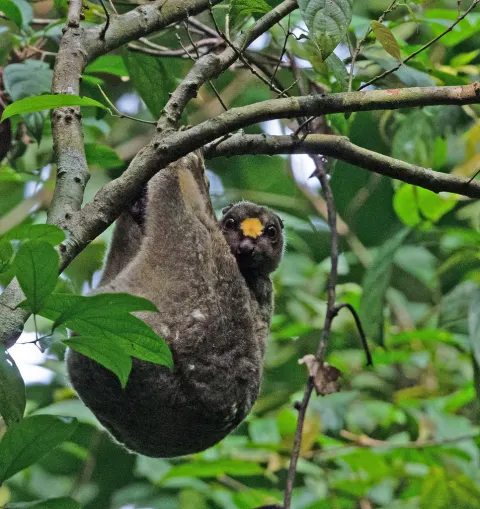
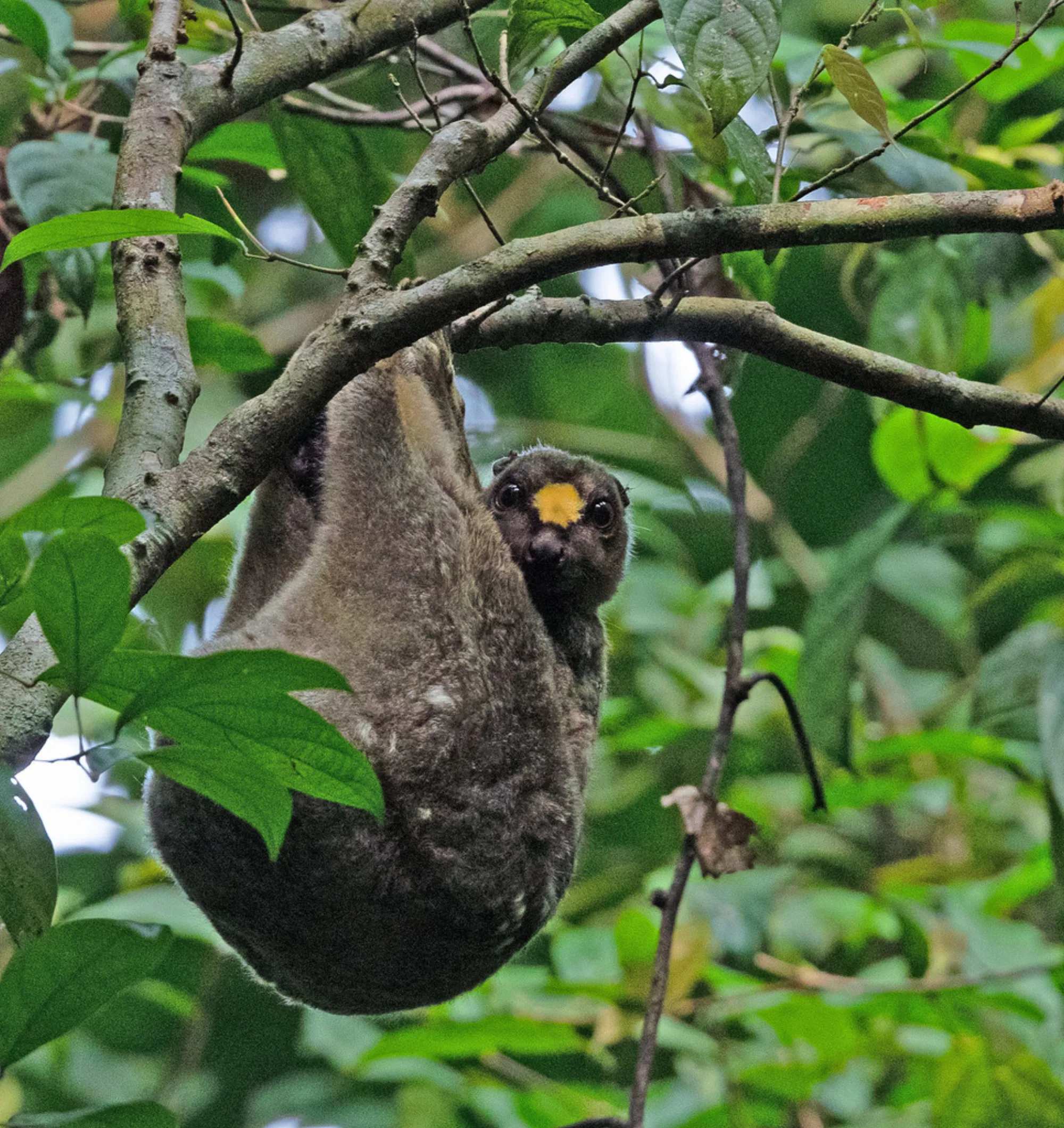
Known locally as the kagwang, the Philippine Flying Lemur is a colugo that glides between trees rather than flying under its own power. It has a broad head, small ears and large eyes, while its brownish grey-and-white coat helps it blend into trunks and branches. A web of skin stretches between its limbs and around its tail, carrying it on glides of 100 m or more. Its head and body measure 33 to 38 cm, and a typical individual weighs between 1.0 and 1.7 kg.
Found only in the southern Philippines, it is concentrated in Mindanao and Bohol, and may also occur on Samar and Leyte. It lives high in lowland and mountain forests, including primary and secondary forest, and sometimes ventures into coconut, banana and rubber plantations. By day it sleeps in hollow trees or clings to branches among dense foliage. At dusk it leaves its nest to forage, gliding through the canopy and climbing trunks slowly with its claws. It eats mainly young leaves, with occasional soft fruit, flowers, shoots and insects, and gets much of its water from plants and wet leaves. Usually solitary, individuals may share a tree while keeping their distance, and sometimes follow one another's glide paths in search of food. A female usually has one young after a two-month pregnancy, carrying it against her belly in a pouch formed by her tail membrane until it is weaned at around 6 months.
Forest destruction, partly driven by logging and agriculture, threatens the species, whose limited ability to disperse adds to the pressure. People hunt it for food, and plantation farmers also kill it where they regard it as a pest. Philippine eagles and tree-climbing snakes prey on colugos.
Written from the English Wikipedia article Philippine flying lemur (CC BY-SA 4.0).
- Records
- 12
- Countries
- 1
No atlas park has a record of the Philippine Flying Lemur in or around it yet.
These are open occurrence records, so they show where people looked for and recorded the Philippine Flying Lemur as much as where it lives. Cells are up to 25 km across, and every location is generalised to its cell.
Generalised encounter areas, not exact locations. Each shape is a grid cell coloured by how likely the species is there.
- Very likelyPhilippines25 km zone · medium confidence · 12 records · updated 80 days ago
Conservation status not assessed here yet, so every location is generalised to its grid cell.