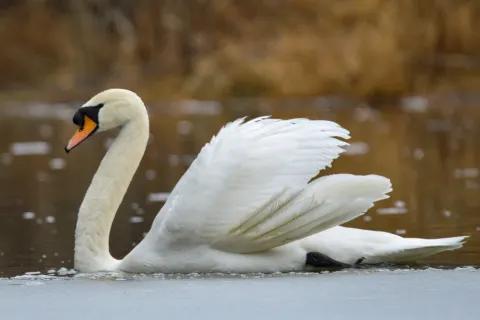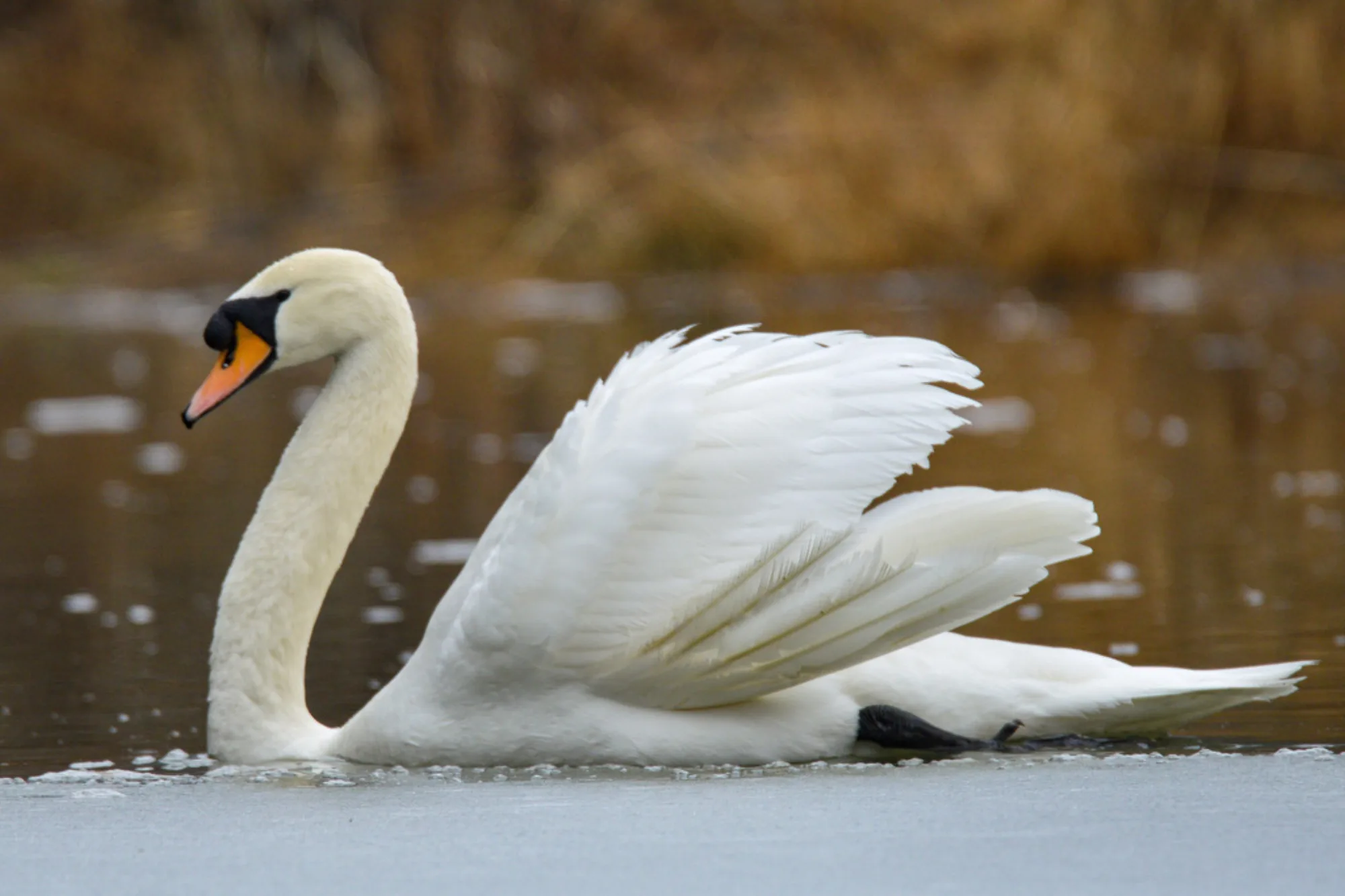
Mute Swan
Cygnus olor
White plumage, a bright orange beak edged in black and a prominent knob above the beak make the Mute Swan easy to recognise. Adults typically measure 140 to 160 cm in length, with males larger than females. Young birds usually have grey or buff down and a dull greyish-black bill during their first year. Despite its name, the swan makes grunts, hoarse whistles and snorts, while its beating wings can be heard in flight.
Across much of Europe and in parts of Asia, it occurs naturally; the far north of Africa receives it as a rare winter visitor. It has been introduced to North America, Australasia and Southern Africa. Look for it on lagoons, lakes and slow-flowing rivers, particularly medium to larger bodies of fresh water. Some populations migrate to wintering areas, while birds in Britain, Ireland and much of northwestern and central Europe typically stay put. Pairs usually defend territories, though colonies form where extensive feeding habitat is available, and unmated young birds often gather in large flocks. Swans reach underwater plants with their long necks and graze on land, also eating small amounts of aquatic insects, fish and frogs.
Pairs build mounds of waterside vegetation in shallow water, often returning to the same nest each year. Both parents care for the nest, and families may forage together once the young have fledged. Wild boars and crows take eggs, while foxes, pike and American mink sometimes prey on cygnets. Human activities also kill many swans, including collisions with power lines and lead poisoning; attacks by dogs have increased in Great Britain.
Written from the English Wikipedia article Mute swan (CC BY-SA 4.0).
- Records
- 2,037,205
- Countries
- 72
- Atlas places
- 1
These are open occurrence records, so they show where people looked for and recorded the Mute Swan as much as where it lives. Cells are up to 25 km across, and every location is generalised to its cell.
Generalised encounter areas, not exact locations. Each shape is a grid cell coloured by how likely the species is there.
- Very likelyUnited States25 km zone · high confidence · 900324 records · updated 86 days ago
- Very likelyUnited Kingdom25 km zone · high confidence · 313706 records · updated 86 days ago
- Very likelyCanada25 km zone · high confidence · 250299 records · updated 86 days ago
- Very likelyNorway25 km zone · high confidence · 234613 records · updated 86 days ago
- Very likelyBelgium25 km zone · high confidence · 62446 records · updated 86 days ago
- Very likelyFrance25 km zone · high confidence · 47560 records · updated 86 days ago
- Very likelyFinland25 km zone · high confidence · 24905 records · updated 86 days ago
- Very likelySpain25 km zone · high confidence · 18605 records · updated 86 days ago
- Very likelyGermany25 km zone · high confidence · 17680 records · updated 86 days ago
- Very likelySwitzerland25 km zone · high confidence · 15268 records · updated today
Conservation status not assessed here yet, so every location is generalised to its grid cell.